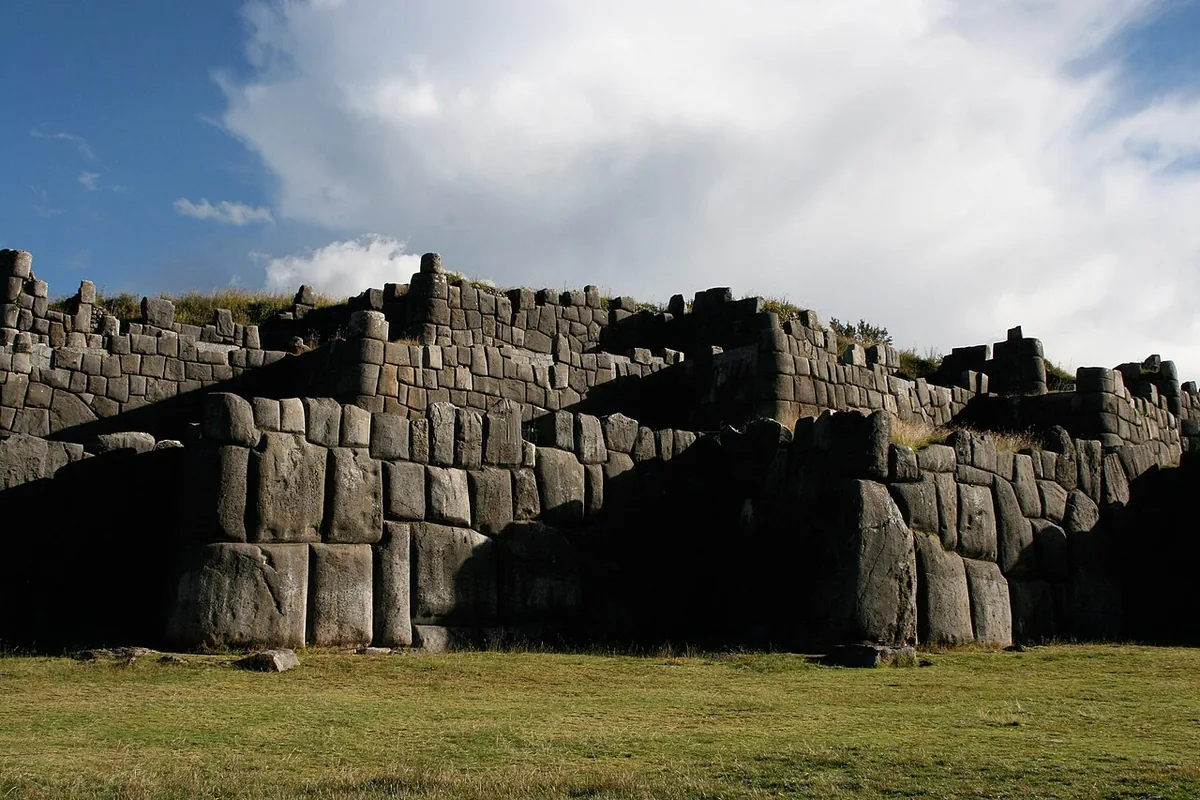
“Spanish chroniclers were so intimidated by these 100-ton stones that they claimed only demons or giants could have moved them into such perfect, mortarless alignment.”
About Sacsayhuamán
Sacsayhuaman was the northern capital's military and spiritual crown, taking nearly seventy years to complete. Following the Spanish victory in the 1530s, the site was used as a quarry; the smaller stones were rolled down the hill to build the colonial mansions and churches that still line Cusco's streets. Only the largest blocks remained, too heavy for the conquerors to budge. In 1983, it was recognized as part of the UNESCO World Heritage listing for Cusco, and today it serves as the stage for Inti Raymi, the annual festival of the sun, which draws thousands of spectators every June.
Sacsayhuaman in short
High above the terracotta roofs of Cusco, the fortress-temple of Sacsayhuaman is a titanic puzzle of stone. This site is defined by its three parallel walls, built in a zig-zag pattern that many believe represents the teeth of a puma. The scale of the masonry is staggering, with some individual boulders weighing over 120 tons. These stones were fitted together with such surgical precision that even today, a single sheet of paper cannot be slid between them. The air is thin and crisp, smelling of dry highland grass and the faint, sweet aroma of palo santo from distant vendors. It is a place of massive, silent power, where the sheer physical effort of the Inca Empire is rendered in grey diorite against the deep blue of the Andean sky. While the Spanish dismantled much of the upper structures to build Cusco's cathedrals, the foundations were simply too large to move, leaving behind a skeleton of giants.
High above the terracotta roofs of Cusco, the fortress-temple of Sacsayhuaman is a titanic puzzle of stone.
Begun during the reign of Pachacuti
Begun during the reign of Pachacuti in the mid-15th century and finished under Huayna Capac, Sacsayhuaman required the labor of an estimated 20,000 men over several decades. The Inca did not use iron tools, wheels, or draft animals; instead, they moved these massive stones using rollers, levers, and raw human power. While often called a fortress, it likely served a dual purpose as a ceremonial center dedicated to the sun. In 1536, it was the site of one of the bloodiest battles of the Spanish Conquest, where Manco Inca's forces nearly recaptured Cusco before being defeated in a desperate struggle. The Spanish were so baffled by the construction that they initially believed it must have been the work of demons or an extinct race of giants, unable to reconcile the sophisticated engineering with their own narrow views of indigenous technology.
Walking along the base of the first rampart
Walking along the base of the first rampart, The texture of the stones is surprisingly smooth, polished by centuries of wind and the occasional touch of a curious traveler. Audible: the wind whistling through the gaps in the upper ruins is the only thing that breaks the mountain silence. The moment that registers is the way the light at midday flattens the walls, but as the sun dips lower, the deep shadows reveal the complex, three-dimensional interlocking of the boulders. There is a feeling of immense cold of the rock even on a sunny day, a thermal mass that has anchored this hilltop for five hundred years. People often miss the 'Suchuna' or natural rock slides nearby, where local children still play on the smooth diorite grooves. What gets your attention is the panoramic view of Cusco below, where the city looks like a miniature model caught in the crease of the mountains.
Sacsayhuaman is an easy, albeit steep
Sacsayhuaman is an easy, albeit steep, 45-minute walk from the Plaza de Armas in Cusco. For those acclimating to the 3,700-meter altitude, a quick taxi ride is a sensible alternative. The site is part of the 'Boleto Turistico' (Tourist Ticket) and is usually the first stop on a city tour. It is best visited in the early morning before the tour groups arrive, allowing you to experience the massive scale of the walls in solitary silence.
Sacsayhuaman is an easy, albeit steep, 45-minute walk from the Plaza de Armas in Cusco.
The Experience
The way the air grows cold the moment you step into the shadow of the 'Mucha' stone, the largest in the complex. The grass of the central plaza is a vibrant, mountain green that contrasts with the somber grey of the fortifications. The thinness of the air with every step up the ancient stairs, a reminder that you are standing at the edge of the sky. Most visitors miss the 'Inca’s Throne,' a perfectly carved seat overlooking the parade ground where the Sapa Inca would have reviewed his troops. The piece that lingers is touching the seam between two massive stones and feeling the absolute absence of a gap, a tactile proof of a lost engineering genius.
Why It Matters
Sacsayhuaman is the ultimate example of Inca megalithic architecture. It represents the height of the empire's organizational and engineering capabilities. Beyond its military history, it remains a sacred site for the indigenous Quechua people, standing as a monument to their ancestors' resilience and their sophisticated relationship with the stone of the Andes.
Why Visit
Visit Sacsayhuaman to see the impossible. While the ruins in the valley are beautiful, the sheer scale here is terrifying. It is the best place in Peru to understand that the Inca weren't just building structures; they were reshaping the mountains to match their own divine geometry.
✦ Insider Tips
- 1
Enter through the back gate near the 'Slide' to avoid the uphill walk and experience the ruins from top to bottom.
- 2
Bring a warm layer even if the sun is out; the wind on this exposed ridge can be biting at 3,700 meters.
- 3
Look for the carved 'puma' and 'snake' symbols hidden in the stones of the walls; they are easily missed by those in a hurry.
- 4
Visit late in the afternoon to see the stones glow orange and avoid the mid-morning tour bus rush.
- 5
Keep your 'Boleto Turistico' handy, as you will need it to pass the checkpoint at the entrance.