“While Lima's streets buzz with modern life, this 18th-century mansion guards 45,000 artifacts that reveal the secret, often scandalous, lives of Peru's ancient gods.”
About Museo Larco
The collection was born from Rafael Larco Hoyle's obsession with the Moche culture, which he believed was the cradle of Peruvian civilization. He was the first to identify the Moche as a distinct group, separate from the Chimú. Over decades, the collection grew through both scientific excavation and the purchase of private collections to prevent them from leaving the country. Today, the museum remains in the hands of the Larco family, maintaining the original cataloging systems and the unique 'open storage' philosophy that makes it a favorite for researchers and travelers alike. Its move to Lima in 1958 solidified its place as the country's most important private cultural institution.
What Museo Larco actually is
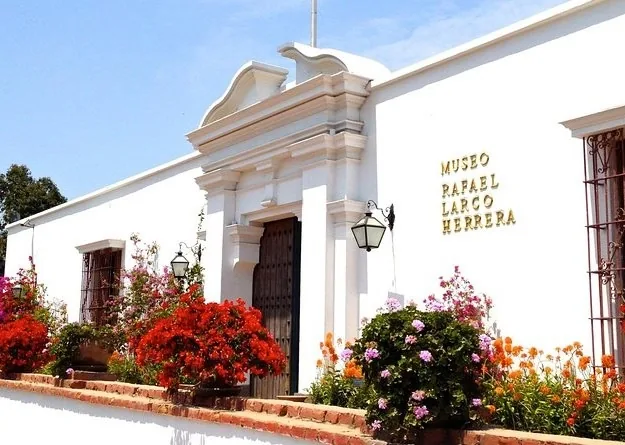
Housed in an 18th-century vice-royal mansion built over a 7th-century pre-Columbian pyramid, Museo Larco is the definitive entry point to the ancient mind of Peru. This private museum in Lima's Pueblo Libre district holds a staggering collection of over 45,000 pieces, spanning 5,000 years of history. The architecture is a lush blend of whitewashed walls and vibrant bougainvillea, creating an oasis of colonial elegance in the middle of the city. Unlike the dry, academic atmosphere of many national museums, Larco feels intimate and alive. The galleries are organized chronologically and thematically, showcasing the exquisite gold and silver jewelry, intricate textiles, and world-famous ceramics of the Moche, Nazca, and Inca cultures. It is perhaps the only museum in the world where the 'open storage' area is as much of an attraction as the main galleries, allowing visitors to walk among thousands of artifacts stacked to the ceiling.
Housed in an 18th-century vice-royal mansion built over a 7th-century pre-Columbian pyramid, Museo Larco is the definitive entry point to the ancient mind of Peru.
Founded the museum, 1926
Rafael Larco Hoyle, a pioneer of Peruvian archaeology, founded the museum in 1926 on his family's sugar estate. Larco was among the first to realize that the ancient Peruvians were not just 'pre-Inca' but belonged to distinct, highly sophisticated civilizations with their own languages and artistic styles. He spent his life excavating sites across the northern coast, personally cataloging thousands of pieces that would have otherwise been lost to looters. In the 1950s, he moved the entire collection to Lima to make it accessible to a wider audience. The mansion itself is a historical treasure, featuring a courtyard that smells of damp earth and jasmine, providing a serene backdrop for the often-startling beauty of the artifacts within. Larco's vision was to tell a story of cultural continuity, showing how the traditions of the desert coast and the high Andes merged over millennia.
Walking through the garden entrance,
Walking through the garden entrance, The sudden silence as the traffic noise of Lima is replaced by the trickling of a fountain. The light in the galleries is soft, focused on the glint of hammered gold and the matte finish of ancient pottery. The incredible detail on the Moche portrait vessels, faces so realistic they look like they might speak. Something like a sense of awe in the gold and silver room, where the sheer volume of ceremonial ornaments reflects a world where these metals were considered the sweat of the sun and the tears of the moon. Most visitors are drawn to the 'Erotic Gallery,' a separate building that displays ceramics depicting the sexual and spiritual life of the Moche with a frankness that was scandalous in the 1920s. What registers is the smell of old paper and dust in the open storage area, a visceral reminder of the museum’s role as a working archive.
Location and access
Museo Larco is located in the Pueblo Libre district, about a 20-minute taxi ride from Miraflores or San Isidro. It is well-signposted and most Limeños know it well. The museum is open daily until 10:00 PM, making it an excellent option for an evening visit when the gardens are lit up and the crowds have thinned. The on-site restaurant is considered one of the best in Lima, offering traditional Peruvian dishes in a setting that is as curated as the museum itself.
Museo Larco is located in the Pueblo Libre district, about a 20-minute taxi ride from Miraflores or San Isidro.
The Experience
What grabs you is the way the light catches the weave of a 2,000-year-old Paracas textile, the colors still incredibly vivid thanks to the coastal desert's dry air. Your footsteps on the colonial tiles echoes through the quiet halls, punctuated only by the soft explanations of a guide. There is a strange connection to the past looking into the eyes of a ceramic warrior, realizing that the emotions captured in the clay are universal. People often miss the intricate 'quipus', knotted strings used for record-keeping, that hint at a complex system of communication without writing. The bit that stays with you is dinner in the garden restaurant, where the smell of wood-fired oven and fresh herbs blends with the history surrounding you.
Why It Matters
Museo Larco is essential for understanding the depth of Peruvian history beyond the Inca. It provides the context necessary to appreciate the archaeological sites found elsewhere in the country. Its Eros gallery is a unique ethnographic resource, offering a rare glimpse into the ritualistic and reproductive beliefs of pre-Columbian societies that were largely erased by the Spanish Conquest.
Why Visit
Visit Museo Larco for the most beautiful history lesson of your life. It is the best-curated museum in Peru, offering a clarity of narrative that makes the ancient world feel accessible and deeply human. It is the only place where you can see the 'backstage' of a world-class museum and then have a five-star meal in a colonial garden.
✦ Insider Tips
- 1
Go in the evening after 6:00 PM; the museum is open late, the gardens are beautifully illuminated, and the large tour groups are usually gone.
- 2
Don't miss the 'open storage' area in the back; walking through the aisles of 30,000 ceramic vessels is a highlight most people rush through.
- 3
The museum restaurant requires a reservation on weekends, but it is the perfect place for a pisco sour after exploring the galleries.
- 4
Start with the introductory video in the foyer; it provides a necessary timeline for those not familiar with Peru's many ancient cultures.
- 5
Ask a guide to explain the 'sacrificial scenes' on the Moche pottery; the stories are as complex and dark as any Greek myth.