“A sea of orange sand larger than France contains dunes that 'sing' and a silence so deep it feels like the end of the world.”
About The Empty Quarter (Rub' al Khali)
The Rub' al Khali has been a barrier to human movement for most of history. Its name, 'The Empty Quarter,' was coined by European explorers to describe its lack of permanent settlements. However, the Bedouin have moved through its edges for centuries, navigating by the stars and the shape of the dunes. The discovery of the Shaybah oil field in the 1960s led to the construction of some of the most remote industrial facilities on earth, but these remain isolated outposts. The desert’s history is mostly geological, a record of shifting climates that saw the area transform from a tropical paradise into the world's most inhospitable sand basin over the last ten thousand years.
There is no horizon in the Rub' al
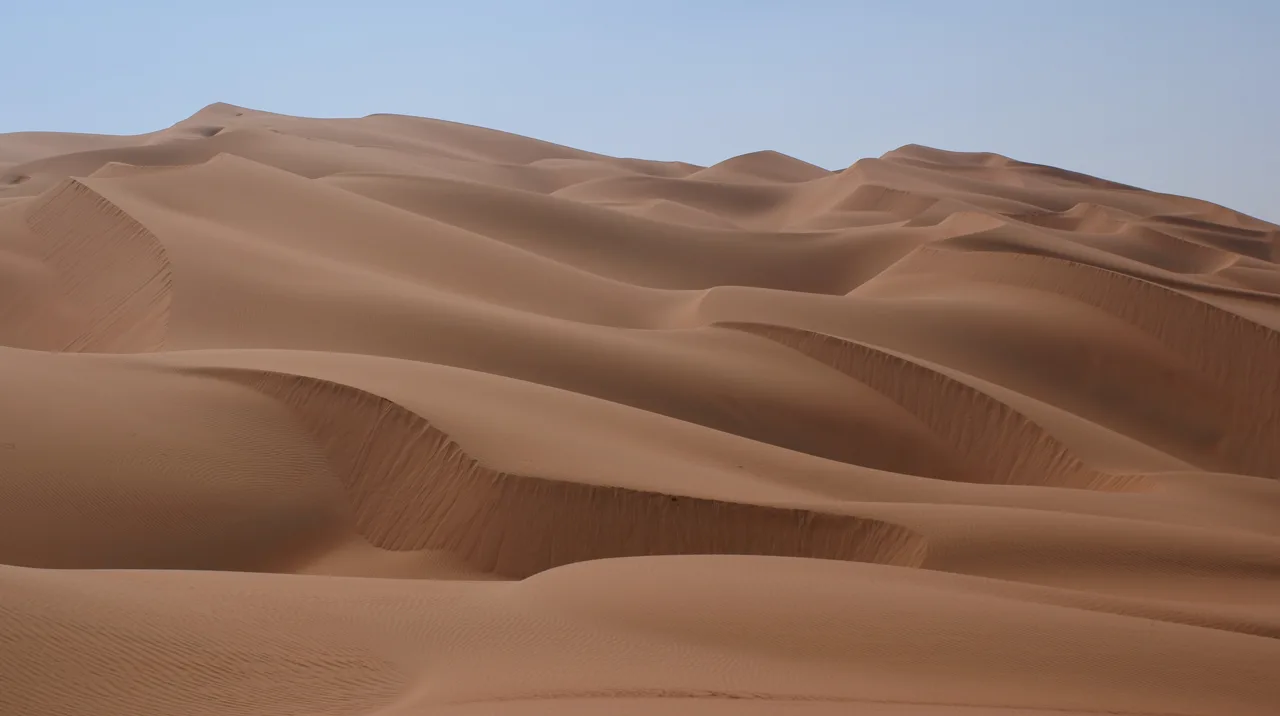
There is no horizon in the Rub' al Khali, only the endless, undulating curve of orange sand meeting the pale blue sky. Known as the Empty Quarter, this is the largest contiguous sand desert on earth, covering 650,000 square kilometers across the southern Arabian Peninsula. It is a place of absolute extremes: silence so profound You hear your own heartbeat, and dunes so gargantuan they have their own weather patterns. To step into the Empty Quarter is to leave the modern world behind entirely. This is a landscape that has broken explorers and sustained only the most resilient Bedouin tribes, a sea of sand that is as beautiful as it is unforgiving.
There is no horizon in the Rub' al Khali, only the endless, undulating curve of orange sand meeting the pale blue sky.
For millennia, the Empty Quarter
For millennia, the Empty Quarter was a blank space on the map, avoided even by the great spice caravans that hugged its fringes. It wasn't until the 1930s that Western explorers like Bertram Thomas and Wilfred Thesiger crossed its heart, guided by the legendary knowledge of the Bedouin. The desert sits atop a massive oil field, which brought the first paved roads to its edges in the mid-20th century. Despite this, the interior remains largely untouched, a shifting wilderness where the dunes can move up to 30 meters a year. In recent years, it has become a destination for extreme adventure travelers and scientists who study the ancient lake beds hidden between the dunes, which reveal a time when this desert was a green, lush savannah.
The first thing is the sound , or the lack of it. When the wind drops, the silence is so thick it is like a physical presence. The first thing you register is the color of the sand, which shifts from a pale cream at midday to a fiery, blood-orange at sunset. The dunes, some reaching 250 meters in height, feel like solid mountains until you try to climb them and the sand gives way beneath your feet. On all sides, the air is bone-dry and smells of nothing but heat and minerals. At night, the temperature plummet, and the sky becomes a carpet of stars so bright they cast shadows on the dunes. Instantly, the 'singing sands,' a low-frequency hum caused by the friction of sand grains sliding down the slopes. The Empty Quarter is not a place you 'visit' in the traditional sense; it is a region you explore with significant preparation. Most expeditions depart from the city of Najran or Sharurah in the south, or from the Eastern Province near the UAE border. You must have a convoy of at least two well-equipped 4x4 vehicles, satellite communication, and a local guide who knows the shifting geography. There are no roads, no water, and no cell service in central the desert. People typically join organized tours that handle the logistics of camping and navigation, allowing you to experience the majesty of the dunes without the extreme risk of getting lost.
The Experience
First, the tiny tracks of desert foxes and beetles in the sand, the only signs of life in a collection of minerals. The heat in the afternoon feels like a physical weight, but the moment the sun dips below the dune line, a wave of cool air washes over the landscape. The grit of the sand in everything, your clothes, your food, your hair, a constant reminder of the environment’s dominance. The most profound moment is often the 'blue hour' before dawn, when the dunes look like frozen waves of indigo and the air is perfectly still. What emerges is how your perspective on time changes; out here, the only thing that matters is the position of the sun and the remaining fuel in your tanks.
First, the tiny tracks of desert foxes and beetles in the sand, the only signs of life in a collection of minerals.
Why It Matters
The Empty Quarter is the ultimate wilderness. It represents the raw, primordial state of the Arabian Peninsula and serves as a vital laboratory for understanding climate change and planetary geology. Culturally, it is the source of the Bedouin spirit, a place of total freedom and total responsibility that has shaped the character of the Saudi people for generations.
Why Visit
The total disconnection. In a range of constant notification and noise, the Empty Quarter offers the only true silence left on the planet. It is a place to test your limits and witness a landscape of such overwhelming scale and beauty that it changes the way you see the world. It is the greatest adventure Arabia has to offer.
✦ Insider Tips
- 1
The desert is open to all visitors, but a professional guide is mandatory for safety.
- 2
Carry at least 20 liters of extra water per person per day; the dry air dehydrates you faster than you realize.
- 3
Deflate your tires to 15-18 psi before entering the soft sand to increase traction and prevent getting stuck.
- 4
Never wander away from your vehicle at night; the lack of landmarks makes it incredibly easy to get disoriented in the dark.
- 5
Bring a high-quality camera with a dust-sealed lens; the fine sand of the Rub' al Khali can destroy electronics in minutes.