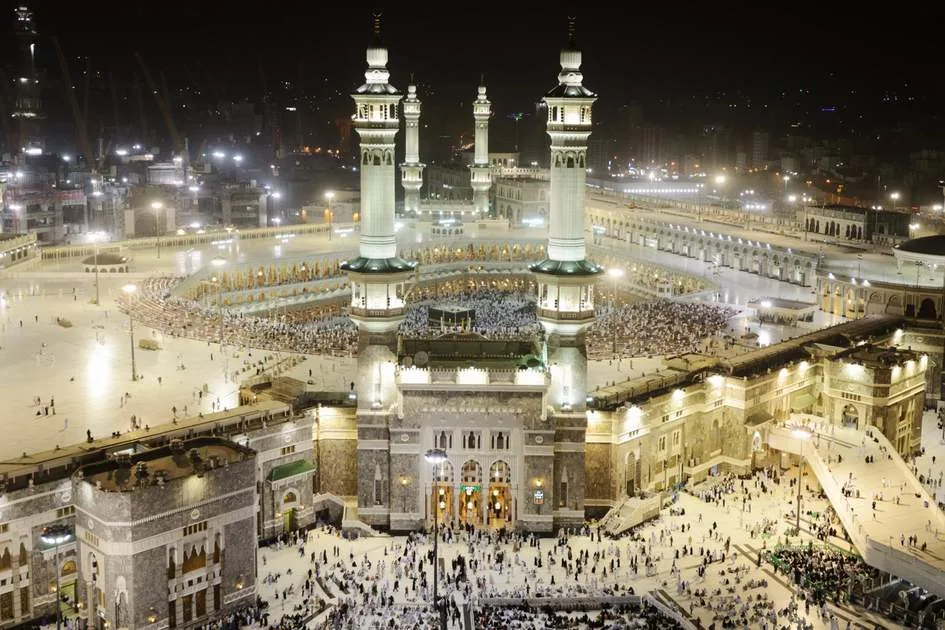
Two hundred and fifty giant mechanical umbrellas open each dawn like clockwork, turning the sun-scorched courtyards of Medina into a shaded forest of white fabric.
About Al-Masjid an-Nabawi
The mosque’s evolution began as a community center for the early Muslim community. The first major expansion was carried out by the Caliph Umar, followed by the opulent Umayyad reconstruction which introduced the mihrab (prayer niche). During the Ottoman era, the mosque received its most beautiful calligraphic decorations, many of which are preserved in the oldest parts of the structure. The modern expansion under the Saudi state used the world's finest materials, Macedonian marble, Italian glass, and gold from the Kingdom’s own mines, to create an environment that feels both ancient and futuristic.
What Al-Masjid an-Nabawi actually is
Medina breathes with a different rhythm than the rest of the world. At its heart lies Al-Masjid an-Nabawi, the Prophet’s Mosque, a sanctuary defined by the iconic Green Dome that marks the resting place of Muhammad. This is a place of profound architectural elegance, where 250 giant mechanical umbrellas bloom like white lotuses each morning to shield the marble courtyards from the sun. The mosque is not just a building but a sprawling landscape of faith, a masterpiece of light and shadow where the air is perpetually cooled by hidden vents and scented with the sweetness of Bakhoor. It is a refuge for millions, yet maintains an atmosphere of hushed, personal contemplation.
“Medina breathes with a different rhythm than the rest of the world.”
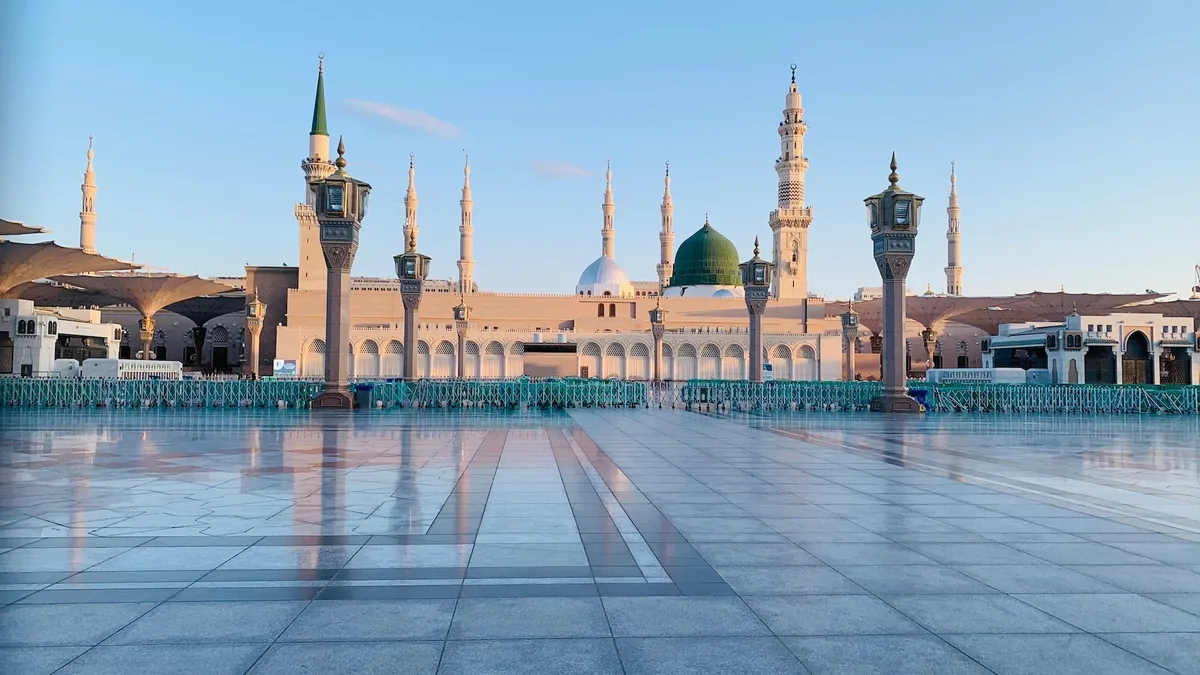
Al-Masjid an-Nabawi, Saudi Arabia
Origins
The original mosque was a simple structure built of palm trunks and mud bricks by the Prophet Muhammad and his companions in 622 CE. Over the centuries, it became the prototype for Islamic architecture worldwide. Every major dynasty from the Umayyads to the Ottomans added their own stylistic layers, resulting in the complex fusion of styles seen today. The Green Dome, perhaps the most famous silhouette in the Islamic world, was given its current color in 1837. In the late 20th century, the mosque underwent an expansion that increased its capacity tenfold, integrating modern engineering with the traditional aesthetics of the Rawdah, a small area of the mosque believed to be a garden from Paradise.
Prince Mohammad bin
Medina is accessible via the Prince Mohammad bin Abdulaziz International Airport or the Haramain High-Speed Railway. While the city itself is now open to non-Muslim visitors, the perimeter of the Prophet’s Mosque remains strictly reserved for Muslims. The majority stay in the hotels that ring the mosque’s central plaza, allowing for easy access to the five daily prayers. The area is entirely pedestrianized, with massive granite-paved squares that handle the ebb and flow of hundreds of thousands of people with remarkable efficiency.
Visiting Al-Masjid an-Nabawi
The transition into the mosque feels like stepping into a dream made of white marble and gold leaf. Beginning with the soft, velvet carpets of the Rawdah, usually crowded with worshippers seeking a moment of prayer in the sacred space. The giant umbrellas outside operate with a silent, mechanical grace, their movement providing a rhythmic markers for the passing of the day. The smell of high-grade agarwood lingers in the hallways, and the sound of the Adhan here is famously melodic, echoing through the ten minarets that pierce the Medina skyline. A sense of profound peace that locals call 'Sakina,' a calmness that seems to emanate from the very pillars of the building.
The Experience
Pay attention to the light filters through the retractable domes, casting geometric shadows across the vast prayer halls. The feel is one of disciplined devotion; millions move in unison, yet there is no shouting or chaos. The mass of the cool breeze from the air-conditioning units hidden inside the bases of the pillars, a modern comfort that allows for hours of peaceful reading and reflection. The moment the umbrellas close at sunset is particularly striking, as the evening sky suddenly opens up above the marble plazas and the green light from the dome begins to glow. It is a sensory experience of immense scale and microscopic detail.
Why It Matters
Al-Masjid an-Nabawi is the second holiest site in Islam and the final resting place of the Prophet Muhammad. It is a living record of thirteen centuries of Islamic history and art. For Muslims, it is a place of deep emotional connection, representing the bridge between the human and the divine, and a symbol of the enduring legacy of the Prophet’s teachings.
Why Visit
This is a place to witness the heights of Islamic hospitality and the perfection of religious architecture. Even for those who have seen the world's great cathedrals and temples, the sheer efficiency and aesthetic harmony of Medina’s sanctuary are staggering. It provides a rare opportunity to feel the weight of history in a space that feels brand new.
Insider Tips
- 1
Access to the mosque interior and the immediate courtyards is restricted to Muslims.
- 2
The Rawdah area requires a permit via the Nusuk app; book yours weeks in advance as slots are extremely limited.
- 3
Visit the mosque late at night after the Isha prayer to experience the sanctuary at its most quiet and luminous.
- 4
Carry a reusable water bottle to fill at the many Zamzam stations; the water is kept at different temperatures for your preference.
- 5
The outer courtyards are open to everyone, but respectful dress (covering shoulders and legs) is mandatory for all.