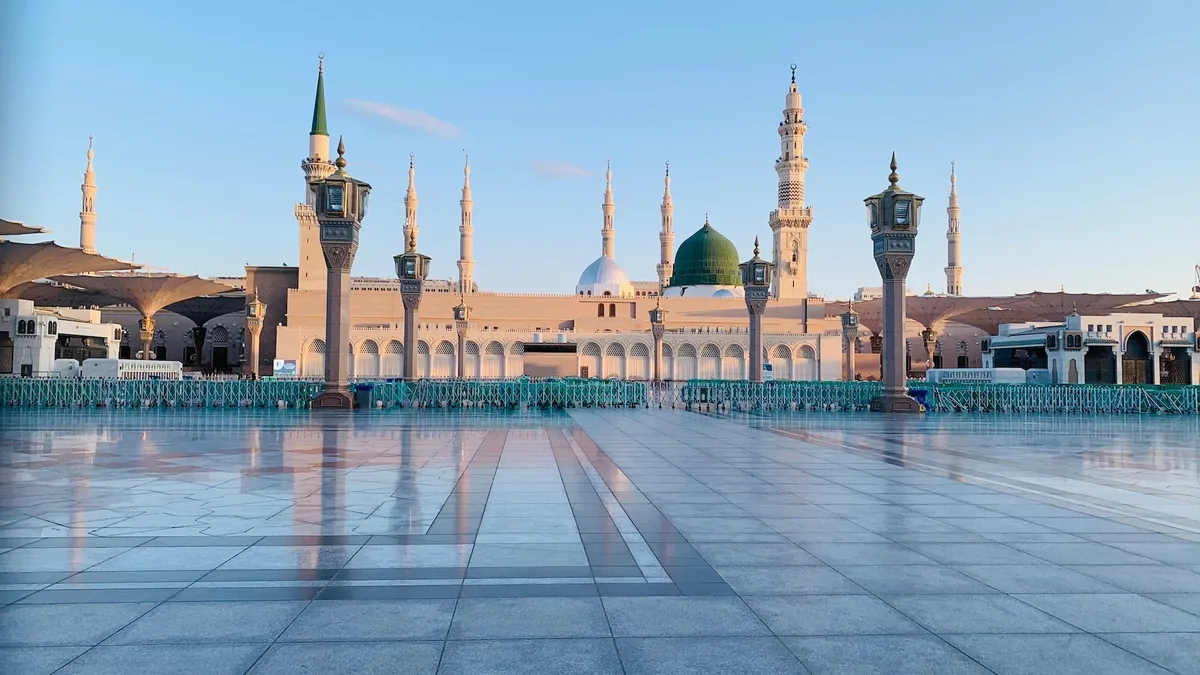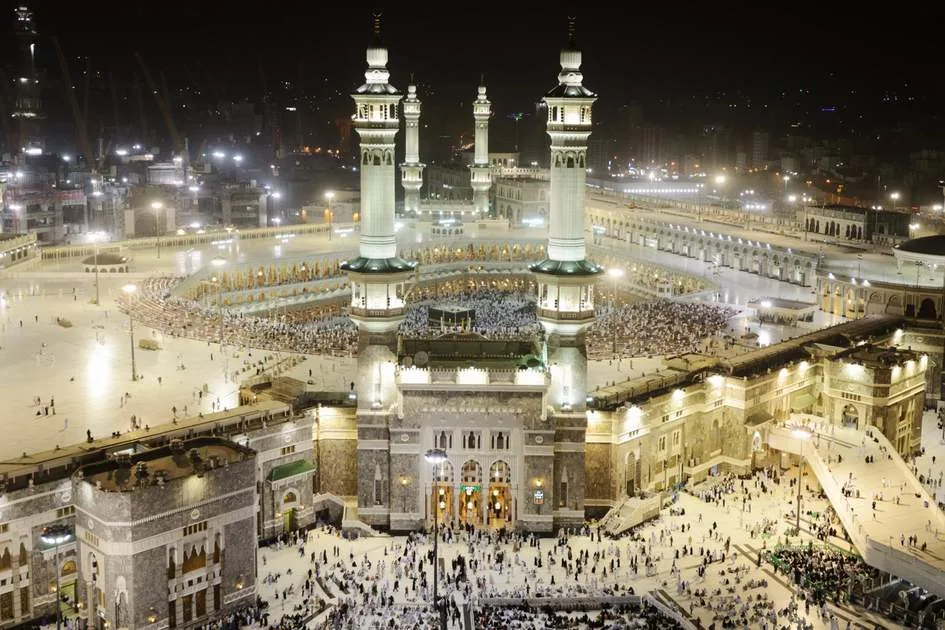
Millions of people move in a single, counter-clockwise circle around a granite cube, creating a human tide that has not stopped for over fourteen centuries.
About Masjid al-Haram
The Great Mosque has evolved from a simple open space around the Kaaba to a complex capable of holding over two million worshippers. Significant milestones include the 8th-century Abbasid expansions and the 16th-century Ottoman renovations. The most radical changes, however, have occurred in the last fifty years. These projects involved leveling entire mountains and installing some of the world's largest moving structures to provide shade and space for the ever-growing number of visitors. Despite these modern interventions, the core of the mosque remains the Black Stone, an ancient relic set into the eastern corner of the Kaaba that pilgrims strive to touch.
What Masjid al-Haram actually is
Gravity in the city of Mecca pulls toward a single, velvet-draped cube. The Masjid al-Haram, or the Great Mosque, is the largest mosque in the world and the focal point of the Islamic faith. It is a structure of immense proportions, a vast forest of white marble and gold that never sleeps. At its center stands the Kaaba, the 'House of God,' around which millions of pilgrims flow in a continuous, rhythmic circle. This movement, known as Tawaf, creates a human galaxy that is visible from space. The mosque is an architectural marvel of expansion, blending ancient Ottoman arches with ultra-modern soaring minarets and state-of-the-art cooling systems that keep the marble floors chilled even under a blistering sun.
History here is measured in millennia rather than centuries. Islamic tradition holds that the Kaaba was first built by Ibrahim and his son Ismail. Over the generations, the mosque around it has been expanded by caliphs, sultans, and kings. The Ottoman Empire added the distinctive domes and colonnades that still define the inner courtyard. In the modern era, the Saudi government has undertaken massive expansion projects to accommodate the millions who arrive for the Hajj and Umrah pilgrimages. This has transformed the surrounding landscape, once a collection of rugged hills and mudbrick houses, into a high-rise metropolis dominated by the Abraj Al Bait clock tower, which looms over the sanctuary like a modern lighthouse.
The soundscape is unlike any other place on earth. The low, guttural hum of thousands of voices in prayer blends with the rhythmic shuffle of feet on polished stone. First, the air smells of oud, rose water, and the damp coolness of the Zamzam water wells. The white marble of the floors feels surprisingly smooth and ice-cold beneath your feet, a deliberate engineering feat that provides relief in the desert heat. As the call to prayer (Adhan) echoes from the minarets, the swirling movement of the crowd suddenly halts, and millions of people align in perfect, silent rows. It is a moment of profound, shared stillness that vibrates through the very foundations of the building.
Access to the city of Mecca
Access to the city of Mecca and the Masjid al-Haram is strictly restricted to Muslims. Almost all visitors arrive via the King Abdulaziz International Airport in Jeddah, followed by a journey on the Haramain High-Speed Railway, which whisks pilgrims to the holy city in under an hour. Roads into the city are monitored by checkpoints to ensure compliance with the entry regulations. Within the city, the mosque is the terminus for all transportation, with massive pedestrian plazas designed to handle the surge of crowds during peak times.
The Experience
Opening the visit is the transition from the chaotic, neon-lit streets of modern Mecca to the serene white expanse of the mosque's interior. The scale of the architecture is so vast that the people on the upper balconies look like tiny dots. The light during the Fajr (dawn) prayer is particularly ethereal, as the sky turns a deep violet and the floodlights of the mosque illuminate the Kiswa, the black silk covering of the Kaaba, with a golden glow. Something like a sense of intense collective energy, where individual identity is surrendered to the mass of the crowd. The taste of cold Zamzam water, distributed throughout the halls, provides a physical refreshment that matches the spiritual atmosphere.
Why It Matters
Masjid al-Haram is the most sacred site in Islam, toward which every Muslim in the world turns five times a day during prayer. It represents the ultimate destination for the Hajj, a pillar of faith that unifies a global community regardless of nationality or status. Its cultural and religious significance is immeasurable, acting as the spiritual compass for nearly two billion people.
Why Visit
For the Muslim traveler, this is not a choice but a profound calling. You visit to witness the sheer power of faith expressed through mass movement and architecture. It is a place where the ancient and the futuristic collide in a way that is both overwhelming and deeply meditative.
✦ Photo Gallery
Best Season
🌤 Ramadan and the Hajj season are the most crowded; for a calmer experience, visit during the cooler months of January or February for Umrah.
Quick Facts
Best time to visit
Ramadan and the Hajj season are the most crowded; for a calmer experience, visit during the cooler months of January or February for Umrah.
Getting there
In Mecca, Saudi Arabia; reach Mecca first, then continue to the site.
What's nearby
Al-Balad and King Fahd's Fountain are also in the area.
Location
Mecca, Saudi Arabia
Type
attraction
Coordinates
21.4225°, 39.8261°
Insider Tips
- 1
Entry to the city of Mecca and the mosque is strictly for Muslims only.
- 2
Keep a small bag for your shoes to carry with you; finding them in the massive racks after prayer can be nearly impossible.
- 3
Visit the upper floors of the mosque for a panoramic view of the Kaaba that allows you to see the geometry of the crowd without being in the thick of it.
- 4
Drink frequently from the Zamzam containers located throughout the mosque to stay hydrated in the dry climate.
- 5
Try to visit during the night hours (between 2 AM and 4 AM) when the temperature is lower and the crowds are slightly thinner.