“In the 'Dawn of Happiness,' Thai kings hung a bell at the palace gates so that any citizen could ring it and ask for the ruler's personal help.”
About Sukhothai Historical Park
Sukhothai was a revolutionary city that transitioned the region from the heavy, angular architecture of the Khmers to a more delicate, uniquely Thai aesthetic. The city was surrounded by three concentric walls and featured a sophisticated system of reservoirs known as 'baray' that allowed the population to thrive in a seasonally dry climate. Following the UNESCO World Heritage designation in 1991, the park has become a benchmark for heritage management in Asia, balancing the preservation of fragile stucco with the needs of modern tourism.
About Sukhothai Historical Park
Stretching across seventy square kilometers of manicured lawns and lotus-filled ponds, the ruins of the first capital of Siam represent the 'Golden Age' of Thai civilization. The name translates to 'Dawn of Happiness,' and the atmosphere of the park reflects this, offering a sense of order and serenity that contrasts with the more chaotic ruins of Ayutthaya. Nearly 200 sites are scattered throughout the park, dominated by the graceful 'Sukhothai-style' Buddhas, slender, elegant figures with oval faces and a slight, enigmatic smile. The central zone is a masterclass in urban planning, where hydraulic systems once fed the moats and supported a city that redefined the artistic and political landscape of Southeast Asia.
Stretching across seventy square kilometers of manicured lawns and lotus-filled ponds, the ruins of the first capital of Siam represent the 'Golden Age' of Thai civilization.
the Khmer Empire, 1238
Sukhothai broke away from the Khmer Empire in 1238, establishing the first independent Thai kingdom. Under King Ramkhamhaeng the Great, the empire flourished, developing the Thai alphabet and adopting Theravada Buddhism as the state religion. This era was characterized by a paternalistic style of kingship, where the ruler was seen as a father to his people rather than a distant god-king. The kingdom’s influence lasted until 1438, when it was absorbed by the rising power of Ayutthaya. The ruins were largely forgotten until the 1970s, when a massive restoration project transformed the overgrown site into the impeccably maintained historical park we see today.
The air is still and carries the faint
The air is still and carries the faint, sweet scent of blooming lotus flowers from the surrounding moats. The soft whir of bicycle chains and the rustle of wind through the ancient frangipani trees. At Wat Mahathat, the main temple, The rhythmic spacing of the towering pillars that once supported a massive wooden roof. The light at midday is harsh on the grey stone, but as the sun begins to set, the statues take on a warm, golden glow that emphasizes their fluid lines. Exploring the outer zones, such as Wat Si Chum, brings you face-to-face with the 'Talking Buddha,' a massive seated figure glimpsed through a narrow slit in a tall, windowless stone chamber.
Sukhothai is located about five hours
Sukhothai is located about five hours north of Bangkok by bus or an hour’s flight to the charming, open-air Sukhothai Airport. The historical park is twelve kilometers from the 'New Sukhothai' town, easily reached by a colorful local wooden bus known as a 'songthaew.' Once inside the park gates, renting a bicycle is almost mandatory, as the sites are spread out and the flat, paved paths are designed for leisurely cycling among the ruins.
Sukhothai is located about five hours north of Bangkok by bus or an hour’s flight to the charming, open-air Sukhothai Airport.
The Experience
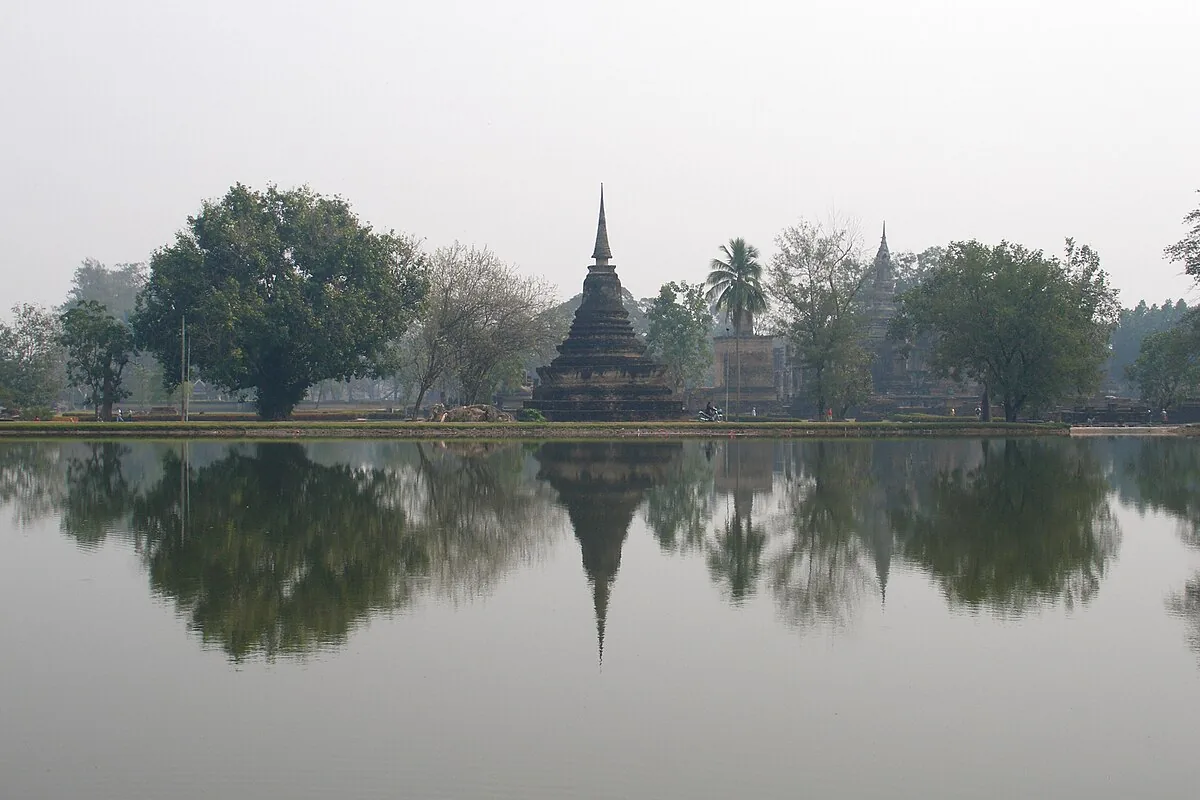
The feeling is a profound sense of peace as you cycle along the quiet moats of Wat Sa Si, where the reflection of the stupa in the water is almost as clear as the structure itself. The scale of the ruins is manageable, allowing you to notice the small details, a row of stone elephants guarding a base or the delicate fingers of a bronze Buddha. The first thing you register is that the light at 5:00 PM turns the ponds into mirrors, reflecting the indigo sky and the silhouettes of the ancient spires. It is a place that encourages slow, deliberate exploration, where the transition from one temple to the next feels like a path through a living poem.
Why It Matters
This park is the fountainhead of Thai culture. It is where the Thai language was formalized, where the classic 'Walking Buddha' posture was invented, and where the concepts of Thai law and social structure were first codified, making it the essential starting point for anyone seeking to understand the country's roots.
Why Visit
The aesthetic perfection. While Ayutthaya is about ruins and drama, Sukhothai is about grace and harmony. It is the most beautiful and well-organized archaeological site in Thailand, offering a serene environment where the ancient past feels entirely accessible and strangely modern.
✦ Insider Tips
- 1
Rent a bicycle just outside the main park entrance; they are better maintained than the ones provided by the hotels in the new town.
- 2
Visit Wat Si Chum first thing in the morning or late in the afternoon to avoid the tour bus groups that crowd the narrow entrance to the statue.
- 3
The park is divided into several zones, each with its own entry fee, so plan your route to visit at least the Central and North zones.
- 4
Try the 'Sukhothai Noodles' in the small stalls near the park entrance; they are a local version featuring green beans and crushed peanuts.
- 5
Stay for the Saturday evening light and sound show if it's running; the ruins are beautifully illuminated with traditional music and dance.