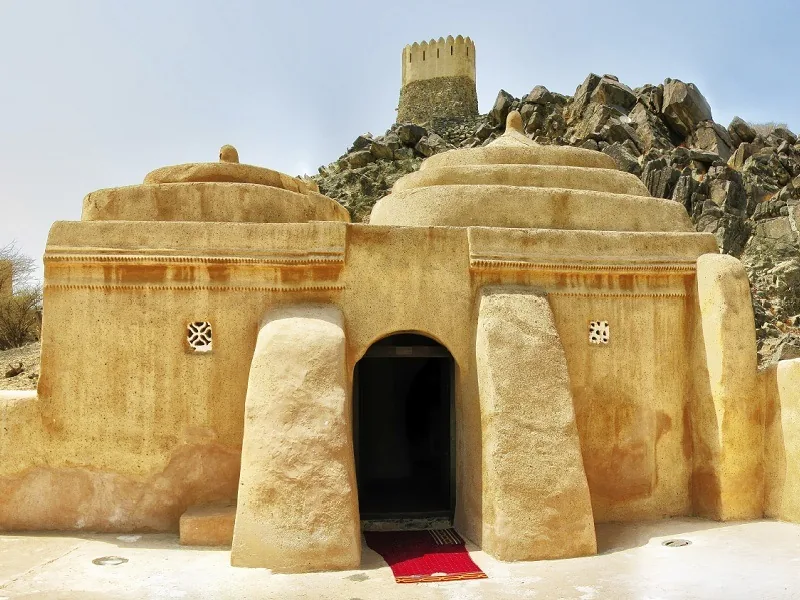
Centuries before oil derricks and glass towers appeared on the horizon, a single stone pillar was holding up the four swirled domes of this mountain sanctuary.
About Al Bidyah Mosque
Dating back to the 15th century, the mosque is frequently cited as the oldest surviving place of worship in the Emirates. It was built using materials gathered from the immediate landscape, burned clay, lime, and mountain stone, a technique that allowed it to breathe and endure the humid Gulf air. The architectural style is distinct, lacking the typical Ottoman or Persian influences seen elsewhere, suggesting a purely indigenous development of the 'multi-dome' design. Throughout the 1990s and early 2000s, the Fujairah Department of Antiquities and Heritage meticulously restored the surrounding watchtowers and the mosque's exterior, ensuring that the original mud-and-stone finish remained intact while protecting the foundation from modern erosion.
What Al Bidyah Mosque actually is
Stacked like sun-dried mud bubbles against a rocky hillside in Fujairah, this humble structure predates the modern federation by more than five centuries. Al Bidyah Mosque eschews the grand minarets and polished marble of its younger counterparts, opting instead for a squat, organic geometry that seems to have grown directly out of the Hajar Mountains. The exterior is a warm, textured ochre, fashioned from local stone and mud brick that has stood firm against the salty humidity of the East Coast since the mid-fifteenth century. Four unique, swirling domes crown the prayer hall, creating a silhouette that feels more prehistoric than modern. Visitors often find themselves whispering as they approach, as if the heavy silence of the mountain has settled permanently over the small courtyard.
Radiocarbon dating performed on the foundation
Radiocarbon dating performed on the foundation and mortar reveals a timeline stretching back to roughly 1446, though the local community has guarded this site for generations before the first researchers arrived. Across centuries, the mosque was the spiritual anchor for the surrounding agricultural valley, surviving the arrival of Portuguese explorers and the shifts of local tribal power. Its design is a marvel of primitive engineering, featuring a single central pillar that supports the weight of all four tiered domes. This internal column distributes the load with such precision that the structure has never required significant structural reinforcement. While the identities of the original stonemasons remain lost to time, their legacy persists in the lack of decorative excess, focusing instead on a functional architecture that could withstand the erratic weather of the coastal ridge.
Bending low to enter the prayer hall, The immediate embrace of cool, thick walls that smell faintly of dry earth and old stone. The interior is surprisingly compact, illuminated by tiny windows that slice the afternoon sun into sharp, dusty beams. At first, the absence of ornate calligraphy, replaced by simple niches carved into the mud for lamps and Qurans. Outside, the sound of the wind whipping around the hillside towers provides a lonesome, melodic contrast to the hushed atmosphere of the interior. The climb up the steep stone steps to the two watchtowers above the mosque reveals a panoramic view of the Gulf of Oman, where the turquoise water meets the jagged charcoal rock. The moment that captures the spirit of the place occurs at the summit, where you realize that these towers were designed to watch for pirates just as much as they were to signal the time for prayer.
Reaching Fujairah requires a ninety-minute drive
Reaching Fujairah requires a ninety-minute drive from Dubai through a dramatic landscape of red dunes that eventually gives way to the grey, imposing ridges of the Hajar range. The E88 or E102 highways lead you toward the coastal road, where the mosque sits tucked at the base of a hill in the village of Al Bidyah. Parking is available in a small gravel lot near the entrance, where a paved walkway leads up to the archaeological site. Those visiting combine the visit with a drive along the Fujairah coastline, stopping at the local fish markets and small forts that punctuate the route between the mountains and the sea.
The Experience
What hits is how the mountain air feels different here, losing the heavy, gasoline-tinged weight of the city and gaining a crisp, mineral quality. Standing inside the prayer hall, the walls feel like they are vibrating with a quiet, ancient energy, and you feel a strange sense of intimacy in such a small, sacred space. Visitors often overlook the tiny holes in the walls used for ventilation, which create a subtle cross-breeze even on the hottest days. At sunset, the shadows of the watchtowers stretch across the hillside, and the call to prayer from the neighboring modern mosque echoes off the stone, bridging the gap between the 1400s and the present day. It is a moment of profound continuity that makes the surrounding modernity feel like a temporary intrusion.
Why It Matters
Al Bidyah matters as a physical witness to the pre-modern soul of the Emirates. It is a trace of that this land has a deep, settled history of faith and community that long predates the wealth of the coastal cities. Culturally, it is the most important link to the architectural traditions of the East Coast, proving the ingenuity of early settlers who used nothing but the mud beneath their feet to build a legacy.
Why Visit
This site to see the UAE stripped of its glitter. Al Bidyah offers a rare, tactile experience of the Hajar mountain culture, providing a sense of scale and history that you won't find at the Grand Mosque in Abu Dhabi. It is a place of quiet power where the architecture doesn't shout; it endures.
✦ Photo Gallery
Best Season
🌤 The ideal window is November or February when the humidity on the East Coast is low and the light at dawn turns the stone walls into a vibrant, glowing amber.
Quick Facts
Best time to visit
The ideal window is November or February when the humidity on the East Coast is low and the light at dawn turns the stone walls into a vibrant, glowing amber.
Getting there
In Fujairah, United Arab Emirates; reach Fujairah first, then continue to the site.
Location
Fujairah, United Arab Emirates
Type
attraction
Insider Tips
- 1
Dress conservatively as this remains an active religious site, and remember to remove your shoes before stepping onto the woven mats inside the prayer hall.
- 2
Climb the stairs to the upper watchtowers for the best vantage point; the view of the village orchards and the sea is worth the steep ascent.
- 3
Look for the small graveyard just outside the mosque walls, where simple stone markers represent centuries of local lineage.
- 4
Bring a small flashlight if you want to see the details of the internal central pillar, as the light inside the hall is kept naturally dim to preserve the atmosphere.
- 5
Check the prayer times and avoid arriving during the peak of the midday Friday service to ensure you can explore the interior without interrupting the worshippers.