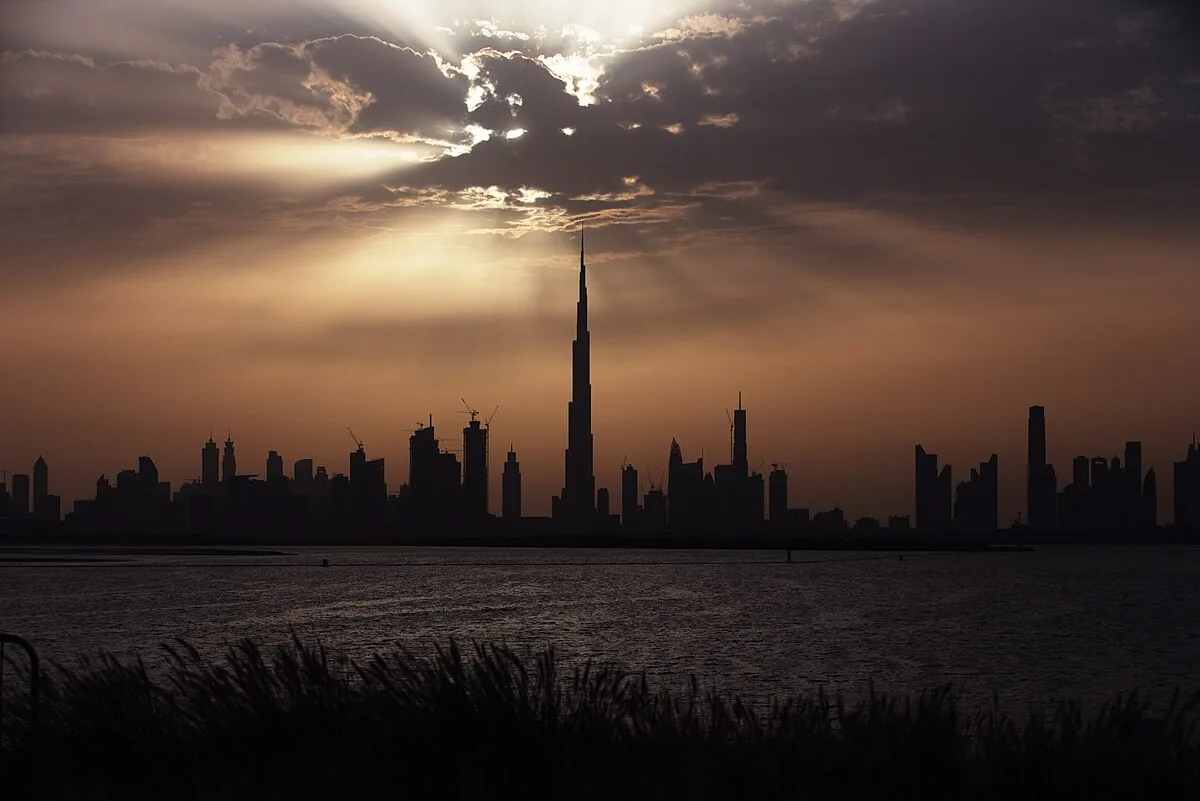
Twenty-six thousand hand-cut glass panels sheath this spire, creating a reflective skin so vast that the tower remains visible to pilots from ninety-five kilometers away across the shifting desert sands.
About Burj Khalifa
Ground was broken in January 2004, marking the start of an ambitious six-year marathon that redefined structural engineering. The lead architect, Adrian Smith, utilized a 'buttressed core' design, a hexagonal central hub supported by three wings that spiral upward to manage the immense wind loads at high altitudes. At the peak of construction, over 12,000 professionals and specialists were on-site daily, representing over 100 different nationalities. The project consumed 330,000 cubic meters of concrete and 39,000 tonnes of steel rebar. Upon its completion in 2010, the spire had reclaimed the title of the world’s tallest man-made structure for the Middle East, a record held centuries prior by the Great Pyramid of Giza before being lost to European cathedrals.
What Burj Khalifa actually is
Standing at the base of this silver needle, your neck tilts until the horizon disappears and the sky takes over. The Burj Khalifa does not merely occupy space in Dubai; it anchors the city's entire identity, a 828-meter achievement in glass and reinforced steel that mimics the geometry of a desert flower. While the sheer scale often dominates the conversation, the tower is best understood through the play of light upon its tiered facade. As the sun moves, the reflective panels transition from a cool, morning blue to a searing gold, eventually glowing with a soft lavender hue as twilight settles over the Persian Gulf. It is a vertical city, housing homes, offices, and the world's highest lounge, yet from the street, it is like a silent sentinel watching over the frantic pace of the desert metropolis below.
On site
Construction began in 2004, driven by a vision to diversify Dubai's economy from oil toward a global tourism hub. Adrian Smith and the engineering team at SOM looked toward the Hymenocallis, a regional lily, for inspiration. This biological blueprint allowed for a Y-shaped floor plan that reduces wind forces and maximizes views. Workers from across the globe labored through brutal summer heat, pouring concrete that had to be mixed with ice to prevent it from setting too quickly in the 50-degree temperatures. When the tower finally opened in 2010, its name was changed at the last moment from Burj Dubai to Burj Khalifa, honoring Sheikh Khalifa bin Zayed Al Nahyan, then President of the UAE, following a crucial financial intervention during the global economic crisis.
Visiting Burj Khalifa
The journey begins in the subterranean levels of the Dubai Mall, where a high-speed elevator launch feels more like a cinematic transition than a mechanical lift. Within sixty seconds, the pressure in your ears shifts, and the doors open to a perspective that recalibrates your sense of scale. From the observation decks on the 124th or 148th floors, the surrounding skyscrapers, many of which are fifty stories tall, look like architectural models scattered on a sandy table. The faint, rhythmic pulse of the Dubai Fountain music drifting up through the vents, a ghostly echo of the choreographed water show below. On clear days, the curve of the Earth becomes visible where the pale blue sea meets the hazy line of the horizon, and the vast, undulating dunes of the Arabian Desert reveal their true, terrifying emptiness.
Reaching the tower is a lesson
Reaching the tower is a lesson in modern urban planning, best navigated via the Dubai Metro's Red Line. The Burj Khalifa/Dubai Mall station connects to the landmark through a glass-enclosed, air-conditioned walkway that stretches for nearly a kilometer, offering glimpses of the skyline through the heat haze. Taxis and ride-shares drop passengers at the Armani Hotel entrance or the dedicated tourist gates within the mall. For those staying in Downtown Dubai, the walk through Emaar Boulevard provides the most dramatic approach, allowing the tower to grow steadily larger until it consumes the entire field of vision.
The Experience
Stepping onto the outdoor terrace, the first thing that strikes you is the wind, which carries a surprisingly cool bite compared to the humid air at ground level. First, the silence up here; the roar of six-lane highways and the construction hum of the city are replaced by a muted, ethereal whistle. Below, the city appears as a circuit board of neon lights and sprawling interchanges, while the shadows of the clouds crawl across the desert floor like slow-moving giants. A large share of visitors focus on the height, but the real magic is in the detail of the shadow the building casts, a long, dark sundial that stretches miles into the sea as the afternoon wanes.
Why It Matters
Beyond the records, the Burj Khalifa represents the physical manifestation of a region’s transition into the post-oil era. It is a monument to human audacity and the refusal to be limited by geography or climate. Culturally, it has become the focal point for the UAE's national celebrations, acting as a vertical canvas for laser shows and pyrotechnics that signal Dubai's position as a crossroads between the East and the West.
Why Visit
Ignore the skeptics who call it a vanity project. Up on the upper decks offers a rare, visceral understanding of the fragile boundary between human civilization and the wilderness of the desert. No other vantage point on the planet provides this specific contrast: the hyper-modern grid of a 21st-century city meeting the timeless, prehistoric stillness of the Arabian sands in a single, unbroken glance.
✦ Photo Gallery
2 photos of Burj Khalifa · click to enlarge
Best Season
🌤 Visit during the winter months of January or February when the desert air is crisp and the 'shamal' winds have cleared the dust, offering the sharpest visibility and the most vibrant sunsets.
Quick Facts
Entry
Around 169 AED for the At The Top deck (levels 124/125); the higher level 148 costs considerably more. Prices rise for prime sunset slots.
Opening hours
Open daily, roughly 8:30am to 11pm, with last entry before closing.
Time needed
About 1.5 to 2 hours.
Best time to visit
Visit during the winter months of January or February when the desert air is crisp and the 'shamal' winds have cleared the dust, offering the sharpest visibility and the most vibrant sunsets.
Getting there
In Downtown Dubai; the Dubai Mall/Burj Khalifa metro station connects via a long walkway, and the entrance is inside Dubai Mall.
What's nearby
Museum of the Future, Dubai Creek and Mleiha Archaeological Centre are also in the area.
Location
Dubai, United Arab Emirates
Type
attraction
Coordinates
25.1972°, 55.2742°
Insider Tips
- 1
Arrival thirty minutes before sunrise allows you to watch the city lights flicker out as the desert sun hits the top of the spire first.
- 2
Look for the small, circular vents on the outdoor terrace; they pump out a custom-blended fragrance of oud and jasmine to mask the metallic scent of the height.
- 3
The 148th-floor 'Sky' ticket includes a private elevator and lounge access, skipping the often hour-long queues found at the lower levels.
- 4
Check the local humidity forecast; a level above 70% often creates a floor of clouds below the observation deck, making you feel as if you are floating on a white sea.