Twelve tons of hand-knotted wool lie beneath your feet here, yet the silence in a room built for forty thousand people is so profound you can hear the hum of the air conditioning.
About Sheikh Zayed Grand Mosque
The first stones were laid in 1996, fueled by a mandate to build a structure that would last for centuries rather than decades. Sheikh Zayed envisioned a site that reflected the diversity of his people, leading to a decade-long construction period involving artisans from Italy, Germany, Morocco, and India. The carpet alone arrived in pieces on three separate aircraft, having been woven by 1,200 women in the villages of Khorasan. Every detail was scrutinized, from the specific shade of gold leaf on the minarets to the way the reflective pools would mirror the evening sky. When the doors finally opened to the public in 2007, it immediately shifted the cultural center of gravity for the entire peninsula, providing a physical heart for the young nation.
What Sheikh Zayed Grand Mosque is
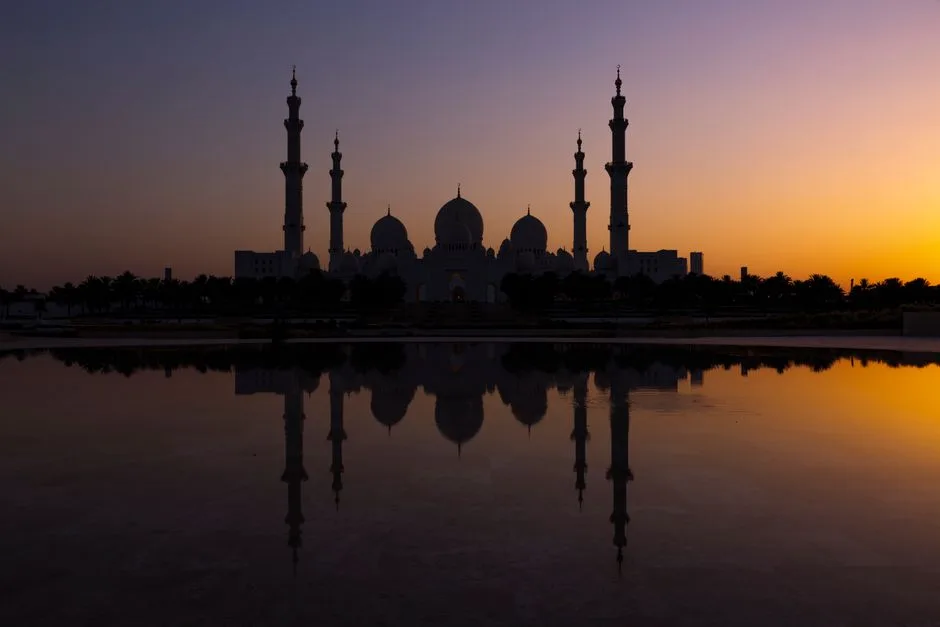
White marble dominates the horizon approaching the outskirts of Abu Dhabi, appearing less like a building and more like a salt-sculpted mirage rising from the desert floor. The Sheikh Zayed Grand Mosque is a massive, luminescent anchor for the city, reflecting the intense Arabian sun with such purity that visitors often find themselves reaching for sunglasses before they even exit their vehicles. Eighty-two domes of varying sizes crown the structure, each topped with a gilded finial that catches the light like a needle. Unlike many global monuments that lean on the weight of ancient history, this space feels vibrantly contemporary, a fusion of Fatimid, Mamluk, and Ottoman styles that manages to feel cohesive rather than cluttered. The sheer scale is difficult to process until standing in the central courtyard, where the floral mosaics underfoot cover seventeen thousand square meters of polished stone.
Commissioned by Sultan Al
Sheikh Zayed bin Sultan Al Nahyan, the founding father of the United Arab Emirates, initiated this project in the late 1990s with a desire to create a sanctuary that unified the Islamic world’s diverse architectural lineages. He did not live to see its completion in 2007, but his vision dictated the use of natural materials from every corner of the globe. Sivec marble came from Macedonia, Lapis Lazuli was brought in from Afghanistan, and iridescent mother-of-pearl was sourced to inlay the floral patterns that climb the columns. British architect Yusef Abdelki led a team of thousands, ensuring that the 1,096 external columns were topped with gold-leafed palm tree capitals, honoring the regional landscape while utilizing global craftsmanship. The mosque eventually became the final resting place of the Sheikh, whose tomb lies in a modest garden on the northern side of the complex.
Walking across the courtyard
Walking across the courtyard in the late afternoon, the radiating heat from the white stone begin to soften as the call to prayer echoes from the four minarets. Inside the main prayer hall, the air temperature drops sharply, carrying a faint scent of sandalwood and the soft muffled sound of bare feet on wool. The world’s largest hand-knotted carpet spreads out beneath you, a sea of green and cream that took 1,200 Persian artisans two years to complete. Above, seven massive chandeliers dripping in millions of Swarovski crystals cast a fractured, rainbow-colored light against the Qibla wall, where the ninety-nine names of Allah are inscribed in subtle Kufic calligraphy. The most striking element remains the lighting system designed to follow the phases of the moon; on nights of a new moon, the exterior glows a deep, moody blue, gradually brightening to a pale white as the moon waxes.
Travelers typically arrive via the highway
Travelers typically arrive via the highway connecting Dubai to Abu Dhabi, a journey of roughly ninety minutes that ends with the mosque’s domes appearing like white clouds on the horizon. Taxis are the most efficient method of arrival, dropping passengers at the 'Wahat Al Karama' area or the dedicated underground visitor entrance. If you are staying in central Abu Dhabi, the local bus network serves the site frequently, though most visitors prefer the convenience of a private car. Upon arrival, entering through a glass dome that leads to an underground mall and security checkpoint, where the transition from the modern commercial world to the sacred space begins through a series of moving walkways.
The Experience
From the entrance, the temperature of the marble first; despite the 40-degree heat outside, the white Sivec stone remains cool to the touch under your palms. As evening approaches, the white surfaces absorb the violet and orange of the desert sunset, creating a fleeting moment where the building seems to glow from within. Overhead, is unique, a mix of the fluttering wings of birds nesting in the arches and the rhythmic, low-frequency chanting of the Quran that plays softly through the pillars. The majority look up at the chandeliers, but if you look down at the peripheral columns, you will see the intricate vine work where the marble has been carved out and replaced with semi-precious stones so precisely that the surface feels like a single, unbroken piece of silk.
Why It Matters
The mosque functions as a bridge between the traditional and the global, proving that religious architecture can innovate without losing its soul. It demonstrates to the UAE’s rapid transformation, moving beyond the glass towers of finance to create a space of deep cultural and aesthetic resonance. It remains one of the few active mosques in the region that opens its doors to people of all faiths, fostering a specific kind of quiet, cross-cultural dialogue.
Why Visit
Plenty of places offer luxury, but few offer this level of sensory discipline. While the Burj Khalifa offers height, this site offers depth, inviting you to slow your pace and consider the sheer human effort required to inlay a single petal of mother-of-pearl into a ton of stone. It provides a rare moment of absolute stillness in a region otherwise defined by its frantic, skyward-reaching ambition.
✦ Photo Gallery
2 photos of Sheikh Zayed Grand Mosque · click to enlarge
Best Season
🌤 Time your visit for November through March, specifically during the hour before sunset, when the transition from natural golden light to the lunar-synced blue floodlights creates a surreal, dual-toned atmosphere.
Quick Facts
Entry
Free to enter; pre-booked timed tickets are required and guided tours are also free.
Opening hours
Open daily to visitors except Friday mornings, roughly 9am to 10pm, with the mosque closed to tourists during prayer times.
Time needed
About 1.5 to 2 hours.
Best time to visit
Time your visit for November through March, specifically during the hour before sunset, when the transition from natural golden light to the lunar-synced blue floodlights creates a surreal, dual-toned atmosphere.
Getting there
In Abu Dhabi; reachable by taxi or car, with a visitor centre and car park at the mosque.
What's nearby
Louvre Abu Dhabi, Qasr Al Watan and Burj Khalifa are also in the area.
Location
Abu Dhabi, United Arab Emirates
Type
attraction
Coordinates
24.4120°, 54.4740°
Insider Tips
- 1
Skip the heavy clothing and utilize the free, high-quality abayas and kanduras provided at the underground entrance to ensure you meet the strict dress code without overheating.
- 2
Look closely at the Qibla wall in the main hall; the subtle fiber-optic lighting is designed to be invisible when turned off, revealing the calligraphy only when the sun fades.
- 3
Avoid Friday mornings when the mosque is closed to tourists for congregational prayer, and aim for a Monday or Tuesday to find the courtyard at its quietest.
- 4
Carry a pair of thick socks in your pocket if you visit in summer, as the marble in the sun-drenched outer areas can occasionally get quite warm for bare feet.