“Seven thousand tons of steel floating above the sea would usually feel like an industrial intrusion, but here it looks as delicate as a lace veil draped over the tide.”
About Louvre Abu Dhabi
The narrative of this site started as a bold diplomatic handshake in 2007, involving a billion-dollar investment to secure the Louvre name and expertise for three decades. Construction proved to be a titanic feat of marine engineering, requiring the excavation of 503,000 cubic meters of sand to create a dry site on the edge of the Gulf. Jean Nouvel’s design was inspired by the interlaced palm leaves used in traditional desert roofing, reimagined through a complex mathematical pattern of overlapping stars. Despite the global financial shifts of the late 2000s, the project persevered as the flagship of Saadiyat Island’s cultural master plan. Its completion in 2017 marked a pivotal moment for the UAE, signaling a shift from a transit and trade hub to a global destination for the arts and humanities.
Louvre Abu Dhabi in United Arab Emirates
Floating on the turquoise fringe of Saadiyat Island, this museum challenges the very notion of what a gallery should be. Jean Nouvel designed a silver dome that appears to hover weightlessly over a cluster of fifty-five white cuboid buildings, all reflecting the surrounding Persian Gulf. The structure draws from the traditional Arab medina, creating a micro-climate where the salt-heavy sea breeze circulates through open-air plazas. While the name suggests a French transplant, the soul of the space is entirely regional, utilizing the harsh desert sun to create a kinetic interior environment. Water channels weave between the galleries, mimicking the ancient falaj irrigation systems, while the rhythmic lapping of the tide provides a constant, meditative soundtrack to your exploration.
Floating on the turquoise fringe of Saadiyat Island, this museum challenges the very notion of what a gallery should be.
The project began with a landmark thirty-year agreement
The project began with a landmark thirty-year agreement between Abu Dhabi and the French government in 2007, a cultural exchange unprecedented in scale. Beyond the brand name, the ambition was to create the first universal museum in the Arab world, telling a chronological story of humanity rather than a geography-based one. Nouvel spent years perfecting the roof, an eight-layer geometric marvel of 7,850 unique aluminum and stainless steel stars. Engineers had to build a temporary sea wall and drain the seabed just to lay the foundations, eventually letting the water back in once the structure was secure. Since its inauguration in 2017, the museum has functioned as a living laboratory for cross-cultural history, blending loaned masterpieces from Paris with a growing permanent collection of Eastern antiquities.
Walking beneath the dome during the middle
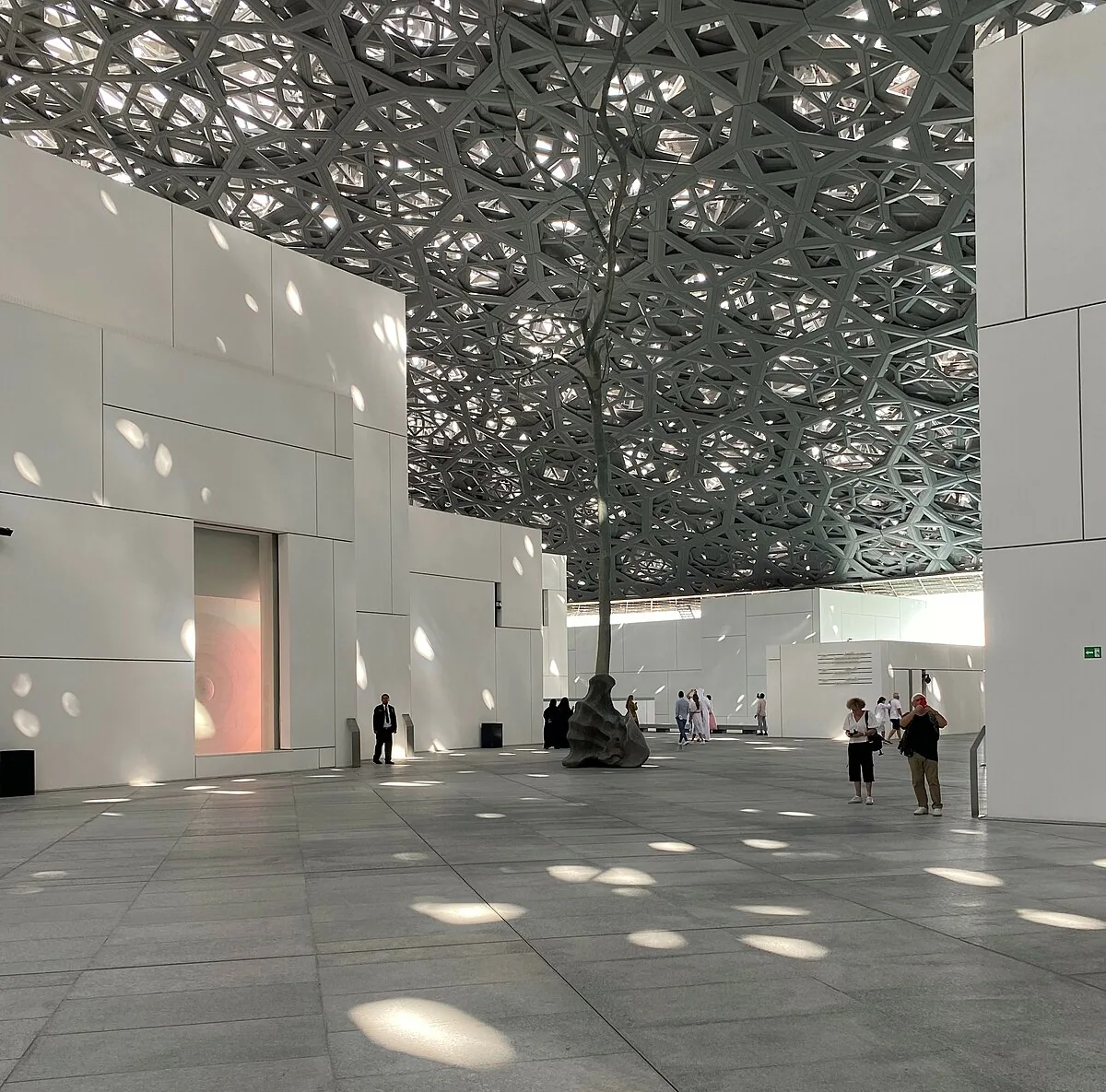
Walking beneath the dome during the middle of the day reveals the 'Rain of Light,' a phenomenon where the sun filters through the star-shaped lattice to scatter thousands of shifting spotlights across the white walls. You come across a temperature drop moving from the exposed boardwalks into the shadowed sanctuary of the plaza, where the air smells faintly of sea salt and damp stone. The galleries follow a linear path through time, placing a medieval French ivory alongside a contemporaneous Islamic bronze, forcing a realization that different cultures have always been grappling with the same human questions. Visitors generally linger by the windows where the floor meets the sea, watching the light ripple upward from the water onto the ceiling in a silent, hypnotic dance. The transition from the hushed, climate-controlled galleries to the bright, breezy outdoor space creates a sensory rhythm that prevents the usual museum fatigue.
Accessing the museum requires a short
Accessing the museum requires a short drive from the Abu Dhabi city center across the Sheikh Khalifa Bridge, a route that offers a panoramic view of the skyline before diving into the developing cultural district of Saadiyat. Taxis remain the primary mode of transport for international visitors, though a public bus service connects the site to the main transport hub at Abu Dhabi Central Bus Station. For those coming from Dubai, the journey takes about ninety minutes along the E11 highway, passing the sprawling mangroves that line the coast. Once parked or dropped off, a shaded walkway leads you into the subterranean ticketing hall, marking the departure point from the modern city into the quietude of the museum island.
Taxis remain the primary mode of transport for international visitors, though a public bus service connects the site to the main transport hub at Abu Dhabi Central Bus Station.
The Experience
The soundscape here is what surprises you; the usual museum hush is replaced by the hollow echoing of footsteps on stone and the constant, rhythmic slapping of waves against the lower tiers of the building. Right away you see how the light changes every few seconds as clouds move or the sun shifts, sending the 'Rain of Light' into a slow-motion swirl across your path. Near the water’s edge inside the dome, the boundary between the architecture and the ocean disappears, making the massive structure feel like a ship docked for the afternoon. It is a place where you find yourself looking at the shadows on the floor just as often as the paintings on the walls, mesmerized by the way the building itself breathes with the outdoor environment.
Why It Matters
This site serves as a physical rebuttal to the idea that civilizations are separate or conflicting entities. By arranging artifacts chronologically rather than by nation of origin, the museum highlights the shared technological and artistic leaps that connected the Silk Road to the Mediterranean. It matters because it repositioned the Middle East as a central narrator of the global story, bridging the gap between Western museum traditions and Eastern heritage.
Why Visit
Don't mistake this for a satellite office of a Parisian institution. While the art inside is world-class, the building itself is a masterpiece of light and water that cannot be replicated in a traditional European city. You come here for the moment the desert sun is transformed into a shimmering canopy, a sensory experience that makes the act of looking at art feel entirely new and deeply grounded in the Arabian landscape.
✦ Insider Tips
- 1
Book a kayaking tour around the museum’s perimeter at sunset to see the architecture from the water and understand how the foundations integrate with the seabed.
- 2
The 'Rain of Light' effect is most vivid between 11:00 AM and 2:00 PM when the sun is directly overhead and the shadows are sharpest.
- 3
Look for the 'Salt and the Sea' installation by Giuseppe Penone, a bronze tree with mirrored branches that perfectly captures the museum's fusion of nature and industry.
- 4
Download the museum’s app and bring your own high-quality headphones, as the curated audio guides are designed to sync with your specific location within the galleries.
- 5
Check the schedule for the 'Dome’s Night' events when the museum stays open late, allowing you to see the star-lattice illuminated by artificial light against the pitch-black sky.