“A single dirham buys you a wooden boat ride across the creek to a place where skyscrapers disappear and air conditioning is still powered by the movement of the wind.”
About Al Fahidi Historical Neighbourhood
The district flourished between 1890 and 1930, acting as the upscale residential heart for the elite families who managed the pearl trade. These traders didn't just build homes; they built fortresses of comfort, using thick coral stone and the iconic barjeel towers to survive the brutal Arabian summers. When the pearl market collapsed due to the rise of cultured pearls and the global depression, many families moved away, and the area became a destination for migrant workers. The neighborhood narrowly escaped the wrecking ball in 1989 after a local campaign highlighted that once these coral stones were crushed, the city's connection to its nomadic and maritime roots would be severed forever. Today, it works as a preserved relic of the Trucial States era, a bridge between the humble fishing village of the past and the global metropolis of the present.
The short version
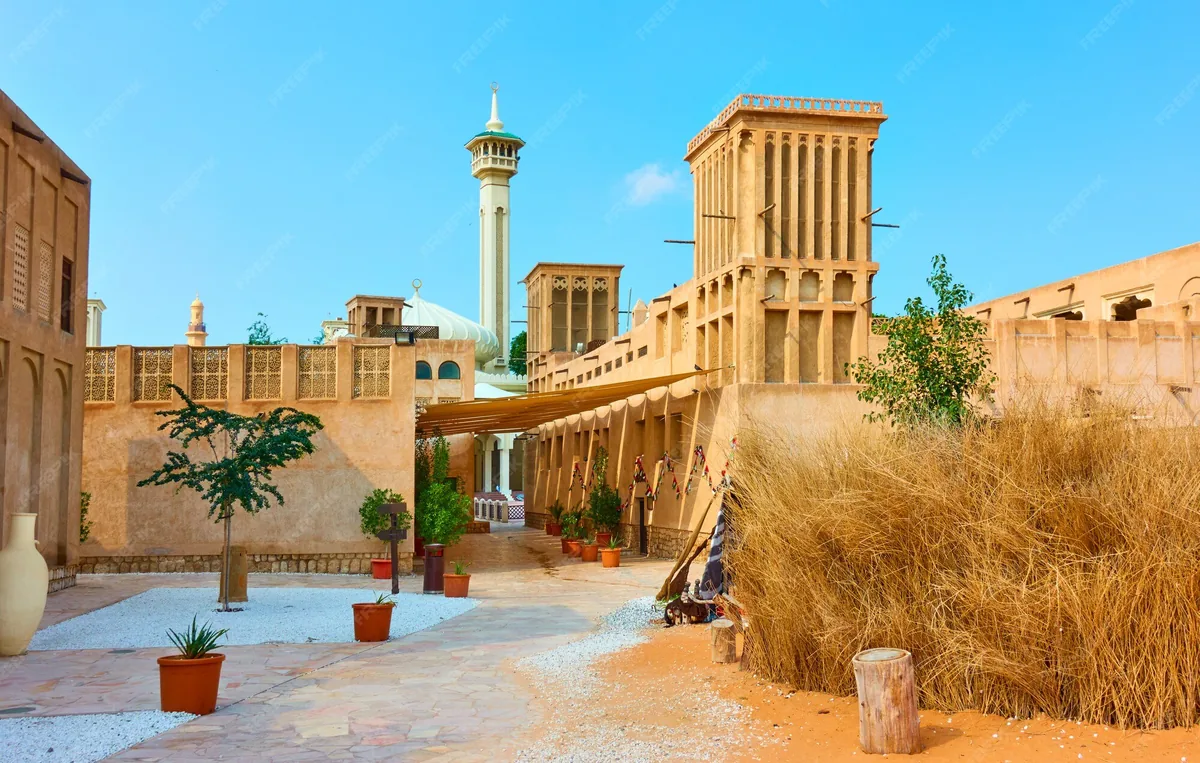
Sand-colored walls built from coral and gypsum rise in jagged silhouettes against the Dubai skyline, offering a startling textural contrast to the glass towers of the nearby financial district. Walking into Al Fahidi, often still called Bastakiya by the locals, feels like stepping behind a heavy velvet curtain where the roar of six-lane highways suddenly drops to a whisper. The room here moves differently, funneled through high, rectangular wind towers that have cooled these homes for over a century. Narrow sikkas, or alleyways, twist in unpredictable directions, designed to keep the sun at bay and the sea breeze close. It remains one of the few places in the city where you can touch the original fabric of a pre-oil maritime society, a labyrinth of fifty buildings that refused to be paved over in the name of progress.
Sand-colored walls built from coral and gypsum rise in jagged silhouettes against the Dubai skyline, offering a startling textural contrast to the glass towers of the nearby financial district.
Established in the late 1890s, this
Established in the late 1890s, this enclave was primarily built by textile and pearl traders from Bastak, Iran, who were lured to the banks of the Dubai Creek by tax-free incentives and a burgeoning port. These merchants brought with them the barjeel, or wind tower, a primitive but brilliant form of air conditioning that caught the highest breezes and directed them down into the living quarters. By the 1970s, as the city exploded outward and modern villas became the norm, the neighborhood fell into a state of neglect and was slated for demolition. A fortuitous intervention by an architect and a visiting British royal helped convince the local government of its irreplaceable value. The subsequent restoration in the 1990s was meticulous, utilizing traditional materials to ensure the coral-stone walls maintained their porous, breathable quality while housing new lives as galleries and cafes.
The scent of dried lime and saffron wafts
The scent of dried lime and saffron wafts from the spice suq nearby, mingling with the earthy aroma of coffee being brewed over hot sand at the Coffee Museum. The mass of the rough, uneven texture of the walls under your fingertips, a mixture of sea-harvested coral and shell that still feels cool despite the afternoon sun. Sounds are intimate here; the clatter of a wooden gate, the rhythmic scraping of a broom on stone, and the distant, melodic call to prayer reflecting off the tight alleyway walls. What hits is how the light becomes a decorative element itself, casting long, geometric shadows from the wooden lattice balconies onto the dusty ground. What sticks with you is usually found in a quiet courtyard, sitting on a woven floor mat with a cup of gahwa, watching the sky turn a deep violet above the top of a wind tower.
Arriving by water provides the most
Arriving by water provides the most authentic introduction to the district, as the wooden abras cross the Dubai Creek from Deira for a mere one-dirham coin. From the water, the wind towers appear like a forest of stone chimneys guarding the southern bank. If you prefer the metro, the Sharaf DG station on the Green Line sits a ten-minute walk away, though the heat makes the creek-side approach much more appealing. Taxis can navigate to the edge of the neighborhood, but the interior remains entirely pedestrian, a sanctuary where the only traffic you will encounter is a stray cat or a fellow wanderer lost in the sikkas.
Arriving by water provides the most authentic introduction to the district, as the wooden abras cross the Dubai Creek from Deira for a mere one-dirham coin.
The Experience
The initial impression is a strange phenomenon inside these walls: the city’s humidity seems to vanish, replaced by a dry, still coolness that clings to the shadows. As you wander deeper into the sikkas, the scale of the world shrinks until it is just you and the rhythmic sound of your own footsteps on the sand-dusted pavement. Visitors often miss the tiny details, like the heavy brass door knockers shaped like hands or the intricate floral carvings on the teak wood doors that signify the wealth of the original inhabitants. In the late afternoon, the light hits the upper sections of the wind towers first, turning the yellowed gypsum into a glowing gold while the alleys below remain in a deep, sapphire twilight. It is a sensory experience defined by quietude, a rare commodity in a city that usually screams for attention.
Why It Matters
Al Fahidi is more than a cluster of old buildings; it is the architectural DNA of the Emirates. It represents a period of history where survival depended on an intimate understanding of the environment and a clever use of natural resources. Culturally, it serves as the city’s memory bank, hosting the Sikka Art Fair and the Sheikh Mohammed Centre for Cultural Understanding, ensuring that the heritage of the Creek remains a living, breathing part of modern Dubai.
Why Visit
Skip the observation decks for an afternoon and come here if you want to understand how a city was built before electricity. Al Fahidi offers a human scale that the rest of Dubai lacks, providing a tactile, dusty, and deeply fragrant encounter with a side of the Middle East that hasn't been polished into a mirror finish. It is the only place where the desert’s history feels louder than its future.
✦ Insider Tips
- 1
Look for the XVA Gallery's courtyard; it is tucked away so deeply that many tourists walk right past the entrance to the city's best vegetarian cafe and contemporary art space.
- 2
Pay attention to the height of the doorways; the high thresholds were originally designed to keep out the blowing desert sands and stray animals.
- 3
Visit the Coffee Museum located in Villa 44 to see a 300-year-old coffee pot and taste traditional Emirati brew that hasn't changed its recipe in generations.
- 4
The wind towers actually work; stand directly beneath the central shaft in any open courtyard house to feel the downdraft of cool air even on a still day.
- 5
Walk the sikkas at night after the museums close, as the neighborhood is beautifully illuminated and almost entirely empty of crowds.