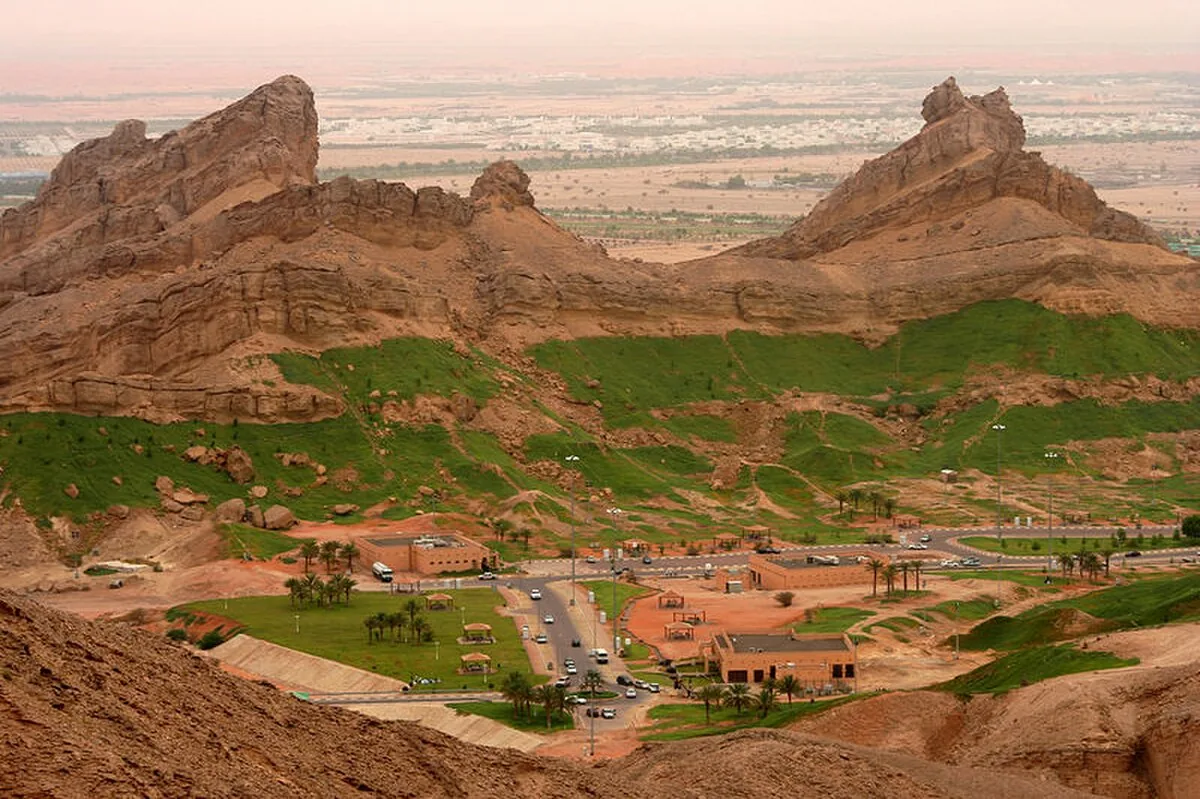
Five thousand years ago, humans dragged stones up this jagged limestone ridge to build beehive tombs, creating a graveyard for the Bronze Age that still overlooks the modern city of Al Ain.
About Jebel Hafeet
The mountain was born from the tectonic collision between the Arabian and Eurasian plates, but its cultural life began during the 'Hafeet Period' between 3200 and 2700 BCE. These early inhabitants utilized the mountain as a landmark and a sacred burial ground, constructing single-chamber tombs that remain some of the most important archaeological sites in the Gulf. Fast forward to the late 20th century, and the mountain became a personal passion project for the nation's founder. Sheikh Zayed envisioned the summit as a place of respite from the summer heat, leading to the construction of a palace and a luxury hotel at the top. The road itself was built by a German firm and is frequently cited by automotive enthusiasts as one of the finest driving experiences on the planet, characterized by its smooth surfacing and perfectly banked turns.
Jebel Hafeet in short
Craggy limestone ribs thrust upward from the desert floor on the outskirts of Al Ain, creating a sun-scorched monolith that defies the surrounding flatness. Jebel Hafeet stands 1,249 meters above sea level, a weather-beaten sentinel guarding the border between the United Arab Emirates and Oman. While the coastal cities of Dubai and Abu Dhabi rely on glass and steel to touch the sky, this mountain does so with ancient, crumbling sedimentary rock. The terrain feels primitive, nearly lunar, stripped of almost all vegetation by the unrelenting heat. Below the peak, the Green Mubazzarah hot springs provide a startling contrast of emerald grass and steaming water, but the mountain itself remains a kingdom of stone and silence. At dusk, the entire range turns a deep burnt umber, reflecting the dying light across the Empty Quarter.
Geologists trace the mountain's origins back tens of millions of years to the late Cretaceous period, yet its human history is even more compelling. In the 1950s, Danish archaeologists discovered over 500 dome-shaped stone tombs at the mountain's base, dating back 5,000 years to the dawn of the Bronze Age. These beehive structures reveal that a settled community once thrived here, trading copper and pottery with distant Mesopotamian civilizations. Sheikh Zayed bin Sultan Al Nahyan later transformed the accessibility of the peak, commissioning the winding mountain road that opened in 1980. This engineering marvel took years to carve through the stubborn rock, requiring sixty tight curves and three lanes of asphalt to conquer the steep gradient. Today, the mountain is a trace of that the history of this land began long before the first oil derrick was ever erected.
Driving the ascent is a physical conversation with gravity, as the car leans into hairpins while the temperature outside the window steadily drops. What you catch first is the air thinning and clearing, losing the heavy humidity of the coast and replacing it with a dry, mineral scent. From the summit parking lot, the sprawl of Al Ain looks like a toy village tucked into a forest of date palms, surrounded by the infinite orange ripples of the desert dunes. The wind up here has a sharp, whistling edge that carries the faint sound of loose scree shifting underfoot. As night falls, the streetlights along the mountain road switch on, creating a glowing yellow ribbon that snakes through the darkness like a necklace of fallen stars. Visitors often overlook the small fossils embedded in the limestone walls near the lookout points, tiny reminders that this parched peak once rested at the bottom of a prehistoric sea.
Reaching the mountain requires a two-hour journey
Reaching the mountain requires a two-hour journey from Abu Dhabi or Dubai, traveling through the rolling red sand dunes of the interior. The E22 highway leads directly into Al Ain, the garden city, from where signs for Jebel Hafeet become impossible to miss. Private vehicles are essential for the climb, as the road is designed for a slow, scenic crawl rather than a quick commute. Many travelers stop first at the base to see the ancient tombs before beginning the twenty-minute drive to the top. Local taxis in Al Ain are familiar with the route, though most locals prefer to make the trip in the late afternoon to catch the sunset from one of the many designated roadside pull-offs.
The Experience
You feel the car's engine strain as you climb the 7% grade, passing through layers of rock that change color from pale cream to deep ochre. At the viewing platforms, the silence is occasionally broken by the cry of an Egyptian Vulture circling the thermals or the distant hum of a motorbike leaning into a curve below. The light at mid-afternoon is harsh and unforgiving, highlighting every fracture in the stone, but as the sun dips, the shadows grow long and purple, filling the canyons with a sense of immense age. At the edge of the summit, you can see the border fence with Oman cutting through the landscape, a thin wire line that seems insignificant compared to the geological scale of the mountain. It is a place that makes you feel very small, very quiet, and remarkably disconnected from the neon-lit world of the coast.
Why It Matters
Jebel Hafeet is the literal and figurative bedrock of Emirati identity, grounding the country in a deep, ancient past that predates modern statehood. It represents the resilience of life in a landscape that offers nothing but heat and stone, serving as a sanctuary for rare flora and fauna like the Arabian Tahr. Culturally, it acts as a compass for the people of Al Ain, a permanent North Star in an ever-changing desert.
Why Visit
Forget the sleek sky-lounges of the coast; this is where you come to see the desert as it was for millennia. It offers a raw, tactile connection to the Earth that no elevator ride can provide. The drive alone is a ritual of transition, moving you from the man-made gardens of the oasis to a stark, windswept height where the horizon spans two different nations.
✦ Photo Gallery
Best Season
🌤 Visit during the cool window between November and February, ideally on a weekday when the summit is free of weekend crowds and the air is clear enough to see the mountains of Oman.
Quick Facts
Best time to visit
Visit during the cool window between November and February, ideally on a weekday when the summit is free of weekend crowds and the air is clear enough to see the mountains of Oman.
Getting there
In Al Ain, United Arab Emirates; reach Al Ain first, then continue to the site.
What's nearby
Al Ain Oasis, Hili Archaeological Park and Mleiha Archaeological Centre are also in the area.
Location
Al Ain, United Arab Emirates
Type
attraction
Coordinates
24.0586°, 55.7775°
Insider Tips
- 1
Test your car's brakes and coolant levels before the climb, as the constant ascent and descending hairpins put significant stress on the vehicle's hardware.
- 2
Stop at the 'Green Mubazzarah' park at the mountain's base to soak your feet in the natural hot springs before starting the drive up.
- 3
Bring a light jacket even in the warmer months, as the temperature at the summit can be ten degrees cooler than the city below once the sun sets.
- 4
Look for the prehistoric marine fossils in the rock face at the second major lookout point; they are easily found if you search the flat surfaces of the limestone.
- 5
Visit on a Tuesday or Wednesday afternoon to avoid the heavy traffic of local families who gather for mountaintop picnics during the weekend.