“Two hundred and thirty-nine steps separate the emerald shade of the world's northernmost date groves from the blood-stained limestone where the last tribal resistance against the British Empire finally crumbled.”
About Dhayah Fort
The fort we see today rose from the ashes of the 1819 Persian Gulf Campaign, built on a site that has been fortified since the Bronze Age. General William Keir Grant led the British forces that surrounded this hill, dragging heavy cannons through the sand to break the resolve of the local Al Qasimi defenders. It was a brutal, three-day standoff that ended when the fort’s high-altitude advantage was finally neutralized by superior artillery fire. Following the surrender, the structure was partially razed but later reconstructed by local rulers to maintain a watchful eye over the vital trade routes between the mountains and the sea. The 1990s saw a meticulous restoration by the Ras Al Khaimah Department of Antiquities, using traditional lime mortar and mountain stone to keep the aesthetic faithful to its 19th-century origins.
What Dhayah Fort actually is
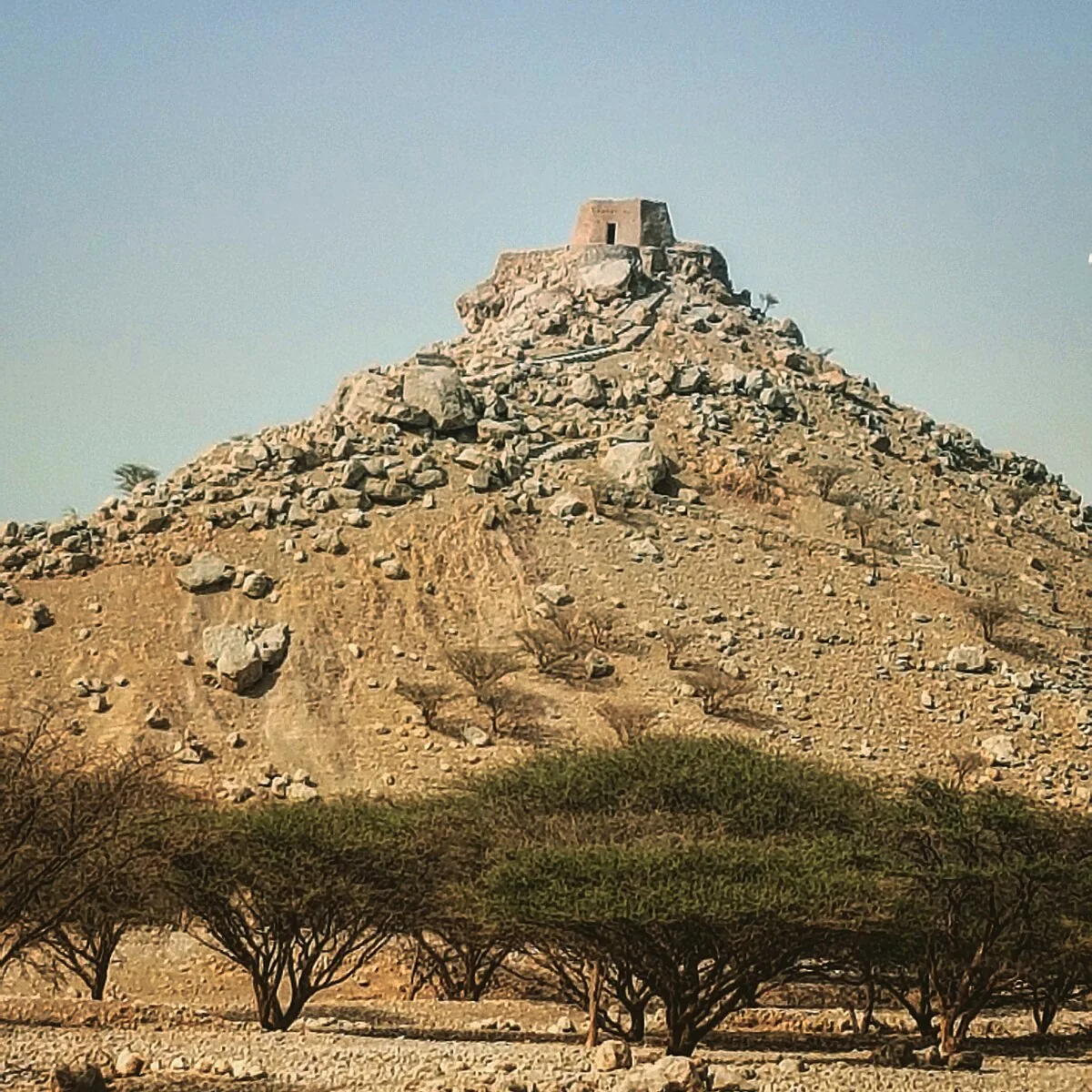
High above the lush date palms of Rams, a golden-hued citadel grips a jagged limestone peak like a crown of weathered stone. Dhayah Fort is the final hilltop bastion of Ras Al Khaimah, offering a stark, military elegance that contrasts sharply with the emerald gardens at its feet. This twin-towered fortress does not rely on massive scale to impress; its power comes from its position, surveying a narrow corridor between the sapphire Gulf and the muscular Hajar Mountains. The climb to the top involves a winding staircase of 239 zigzagging steps that force a slow, contemplative pace. Every turn reveals a different texture of the landscape, from the parched grey rock of the mountain to the swaying fronds of the oasis. Once at the summit, the air feels thinner and significantly cooler, smelling of salt spray and sun-baked mud brick.
High above the lush date palms of Rams, a golden-hued citadel grips a jagged limestone peak like a crown of weathered stone.
a pivotal siege, 1819
History here is etched into the very stones of the ramparts, dating back to a pivotal siege in 1819 when the local Qawasim tribes faced the overwhelming might of the British Royal Navy. This site was the last line of defense in a conflict that reshaped the maritime politics of the entire peninsula. The current structures were rebuilt in the early 19th century on foundations that had likely seen centuries of tribal skirmishes. During the Battle of Dhayah, the defenders retreated to this high ground, enduring a heavy bombardment that eventually forced a surrender, marking the end of the resistance against the General Maritime Treaty. Modern restoration efforts have carefully preserved the irregular, organic feel of the masonry, ensuring the fort looks less like a polished museum and more like a battle-scarred veteran of the dunes.
Reaching the final terrace, the wind pick up suddenly, whipping through the crenellations with a low, whistling hum. The internal chambers are small and dark, providing a cool, shadowed retreat where the walls feel rough and porous under your palms. What you catch first is the silence of the surrounding valley, a deep and ancient stillness that is only occasionally broken by the distant bleat of a mountain goat. Looking westward, the view stretches across the salt flats to the sea, where the light at midday turns the water into a sheet of hammered silver. Something like a strange sense of isolation at this height, realizing that for the soldiers who stood here, this view was their only warning system against an approaching world. What sticks with you is watching the sunset through a narrow archway, seeing the mountains catch fire in shades of crimson and violet.
Finding this mountain perch requires
Finding this mountain perch requires a drive north from Ras Al Khaimah city toward the coastal village of Rams. The road skirts the base of the mountains, passing through dusty industrial pockets and vibrant palm groves before the fort appears, perched precariously on its conical hill. A small parking area at the base is the trailhead for the stone staircase. Taxis are available from the city center, but having your own vehicle allows for a more flexible arrival, particularly for those wanting to witness the pre-dawn light hitting the ramparts. The journey from Dubai takes approximately ninety minutes, provided you avoid the morning rush, making it a feasible but rewarding detour into the northernmost reaches of the federation.
Finding this mountain perch requires a drive north from Ras Al Khaimah city toward the coastal village of Rams.
The Experience
It becomes clear how the stairs seem to narrow as you ascend, a deliberate defensive design that makes you feel the precariousness of the climb. Here, the changes as you rise, shedding the humid weight of the coastal plains for a dry, mountain breeze that smells faintly of wild thyme and hot rock. Inside the towers, the light is sliced into sharp triangles by the arrow slits, casting long shadows across the uneven floor. First-time visitors often overlook the prehistoric tomb foundations at the base of the hill, but standing among those ancient stones before your ascent adds a layer of deep time to the experience. When you finally reach the top, the panoramic view of the Rams mangroves meeting the Gulf creates a moment of visual clarity that makes the physical effort of the climb disappear instantly.
Why It Matters
Dhayah matters because it is the only hilltop fort of its kind remaining in the Emirates, a physical anchor for the identity of the northern tribes. It represents a rare architectural marriage between the rugged Hajar geology and the strategic needs of maritime defense. Beyond its military past, it is a human monument to resilience, standing as a silent witness to the transition from tribal sovereignty to the unified modern state.
Why Visit
Visit Dhayah if you are tired of the polished, air-conditioned history of the coastal museums. This is history you have to sweat for, a raw and windy outpost that offers the most dramatic mountain-to-sea perspective in the country. It is the only place where you can stand on the very stones where the map of the modern Middle East began to be drawn.
✦ Insider Tips
- 1
Arrive exactly twenty minutes before sunrise to watch the Hajar Mountains transition from a ghostly grey to a burning orange while the valley below remains in shadow.
- 2
Look for the prehistoric 'beehive' tombs at the foot of the hill before you start your climb; they are over four thousand years old and easily missed.
- 3
Bring a small bottle of water for the 239-step climb even in winter, as the humidity from the nearby mangroves can be surprisingly draining.
- 4
Walk to the very edge of the northern rampart for a clear view of the traditional salt pans that still dot the coastline near Rams.
- 5
Wear footwear with a significant grip, as the limestone steps have been worn smooth by centuries of wind and can be unexpectedly slick.