Snow falls here more often than you might imagine, dusting the jagged limestone peaks in a fleeting white coat while the desert floor below remains trapped in a permanent summer.
About Jebel Jais
Formed from the massive tectonic uplift of the Arabian Plate, Jebel Jais is a limestone archive of a prehistoric seabed. For millennia, the mountain remained a fortress for the nomadic mountain tribes who mastered the art of vertical survival, carving terraced gardens into the rock. The modern era arrived not through industry, but through leisure and infrastructure. The road to the summit was meticulously blasted out of the rock over eight years, opening the doors to a wave of hikers, cyclists, and campers. This transition from a tribal stronghold to an international adventure hub was finalized in 2018 with the opening of the Jais Flight, a record-breaking zipline that solidified Ras Al Khaimah's reputation as the adventure capital of the Middle East.
What Jebel Jais actually is
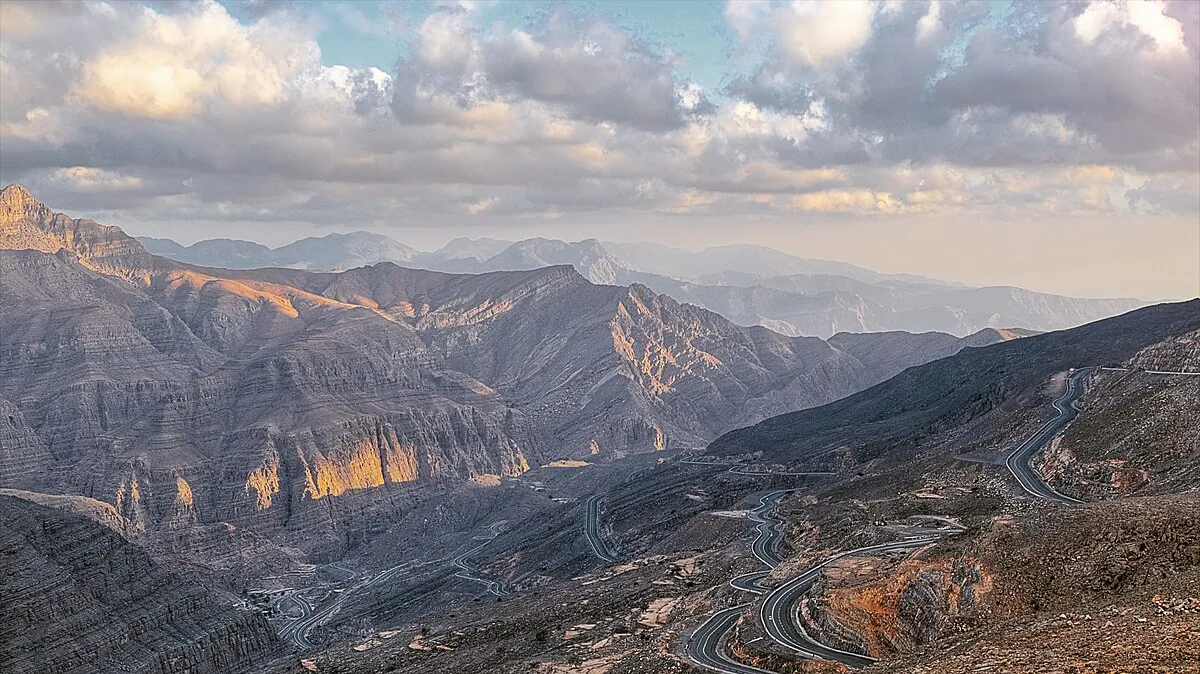
Sharp limestone peaks tear through the haze of Ras Al Khaimah, offering a rugged, vertical sanctuary that feels worlds away from the manicured lawns of the coast. Jebel Jais reaches 1,934 meters into the sky, marking the highest point in the United Arab Emirates and serving as the crown jewel of the Hajar Mountain range. The landscape here is unapologetically raw, characterized by deep tectonic fissures and pale grey rock that turns a soft charcoal as the sun dips below the horizon. While much of the country is defined by horizontal desert expanses, this mountain provides a dramatic verticality where the air is noticeably thinner and the temperature can drop by fifteen degrees in a single afternoon. It is a playground for those who prefer the scrape of stone under a boot to the hum of a shopping mall.
Geology dominates the deep history here
Geology dominates the deep history here, with the mountains formed over 70 million years ago from the same thrusting crustal movements that created the Alps. Over the centuries, these highlands were the secretive domain of the Shihuh tribe, who built dry-stone houses and clever cisterns to capture rare rainfall in a landscape that offers little mercy. Modern accessibility changed forever in 2013 with the completion of a multi-million dollar road project that carved thirty-six kilometers of asphalt into the mountainside. This engineering feat transformed an inaccessible wilderness into a destination for high-altitude adventure. In recent years, the mountain has gained global fame for hosting the world's longest zipline, a steel cable that spans nearly three kilometers, effectively turning the ancient geological silence into a theater for high-speed adrenaline.
The ascent is a rhythmic sequence
The ascent is a rhythmic sequence of hairpin turns where the view expands with every gear shift, revealing the silver thread of the road winding behind you. A trace of the pressure change in your inner ear as the arid lowlands give way to a climate that supports ghaf trees and mountain goats that skip across sheer cliffs with terrifying ease. At the Viewing Deck Park, the wind carries a fresh, pine-scented chill that forces you to button up your jacket even in mid-July. The standout is the silence is heavier here, occasionally broken by the distant, metallic zip of a thrill-seeker flying across the canyon or the low rumble of a thunderhead gathering over the Omani border. The piece that sticks with you is standing at the edge of a lookout as the clouds roll in below your feet, effectively severing your connection to the world beneath. Reaching the peak requires a two-hour drive from Dubai or roughly an hour from the center of Ras Al Khaimah city. The E11 highway is the main artery until turning toward the mountains, where the road begins its steep, winding climb. Private vehicles are the standard mode of transport, as the drive itself is considered one of the most rewarding in the region. Taxis can be hired from Ras Al Khaimah hotels, but many visitors opt for the shuttle buses that run from the city to the Jais Adventure Park. Upon reaching the upper tiers, the road splits into several large parking areas, each positioned to offer a different angle of the sunset over the Arabian Gulf.
The Experience
Right away, the scent first; the heavy, dusty smell of the plains is replaced by a crisp, mineral freshness that hits the back of your throat. As you stand on the viewing platforms, the surrounding peaks look like the crumpled velvet of a giant’s bedspread, layered in shades of violet and slate. The light at 4:00 PM is particularly transformative, casting long, sharp shadows into the wadis that make the mountains look twice as deep as they actually are. You might hear the faint tinkling of a goat's bell or the rhythmic breathing of a cyclist conquering the final incline. The thing most people overlook is the incredible variety of tiny desert flowers that bloom in the rock crevices after a winter rain, a delicate defiance against the brutal grey stone.
Why It Matters
Jebel Jais provides the necessary topographical relief to a nation often perceived as purely flat and sandy. It represents the UAE's environmental diversity and serves as a vital sanctuary for the Arabian Leopard and the mountain gazelle. Humanly, it offers a space for reflection and physical challenge, reminding visitors that the spirit of the Emirates is rooted as much in the mountain peaks as it is in the desert dunes.
Why Visit
Go because you need to feel the wind in your hair and the cold on your skin in a land of perpetual heat. Jebel Jais offers a perspective that no skyscraper can mimic, a view of the world where nature still holds the upper hand. It is the only place in the country where you can stand above the clouds and watch the sun set behind the curve of the ocean.
✦ Photo Gallery
Best Season
🌤 Plan your visit between October and April when the air is clear for miles; for a truly rare experience, go in late January for a chance to see the peaks dusted in a rare layer of mountain frost.
Quick Facts
Best time to visit
Plan your visit between October and April when the air is clear for miles; for a truly rare experience, go in late January for a chance to see the peaks dusted in a rare layer of mountain frost.
Getting there
In Ras Al Khaimah, United Arab Emirates; reach Ras Al Khaimah first, then continue to the site.
What's nearby
Dhayah Fort, Mleiha Archaeological Centre and Dubai Creek are also in the area.
Location
Ras Al Khaimah, United Arab Emirates
Type
attraction
Coordinates
25.9531°, 56.1842°
Insider Tips
- 1
Check the mountain’s dedicated weather forecast before leaving, as conditions at the summit can be wildly different and much stormier than in Ras Al Khaimah city.
- 2
The 1484 by Puro restaurant is the highest dining point in the country; book a terrace table at least two weeks in advance to secure a sunset view.
- 3
Pull over at the lower wadi entrances before the main climb to see the ancient stone houses built by the Shihuh tribe that are almost invisible against the rock.
- 4
Fill your fuel tank at the base of the mountain, as there are no petrol stations once you begin the thirty-kilometer ascent to the summit park.
- 5
Bring a high-quality pair of binoculars to spot the elusive mountain goats that blend perfectly with the grey limestone of the opposite ridges.