Gravity seems like a mere suggestion here, where a three-hundred-meter wall of sand stands at a terrifying fifty-degree angle, waiting to swallow the engines of those brave enough to climb it.
About Moreeb Dune
For centuries, Moreeb Dune was a navigational anchor for the Bani Yas and Manasir tribes, marking the southern reaches of the Liwa Oasis before the desert becomes truly uninhabitable. Its name, which translates roughly to 'Scary Hill,' reflects the ancestral respect for its treacherous incline. The site gained international fame in the late 20th century when the Abu Dhabi government paved the desert road, inviting the first organized hill-climb competitions. What was once a silent sentinel of the Empty Quarter became the heart of the Moreeb Festival, a multi-week celebration of falconry, camel racing, and modern horsepower. Today, the area at the base features a permanent drag strip and camping facilities, yet the dune itself remains an untamable force of nature that shifts and reshapes itself with every seasonal gale.
What Moreeb Dune in United Arab Emirates
Deep in the Liwa Oasis, the asphalt finally surrenders to a wall of sand so steep it resembles the edge of the world. Moreeb Dune, or Tal Moreeb, rises three hundred meters from the desert floor, a colossal wave of apricot-colored silica frozen in a permanent state of collapse. This is the undisputed king of the Rub' al Khali, the Empty Quarter, boasting a fifty-degree incline that defies both gravity and the courage of most drivers. While the coastal cities of the Emirates trade in vertical glass, Liwa trades in vertical sand. The scale is difficult to process until seeing a massive four-wheel drive at the base, looking like a discarded toy against the mountain of grain. The surroundings here is bone-dry, carrying the faint, toasted scent of sun-baked minerals and the absolute silence of a landscape that has remained largely unchanged for millennia.
“Deep in the Liwa Oasis, the asphalt finally surrenders to a wall of sand so steep it resembles the edge of the world.”
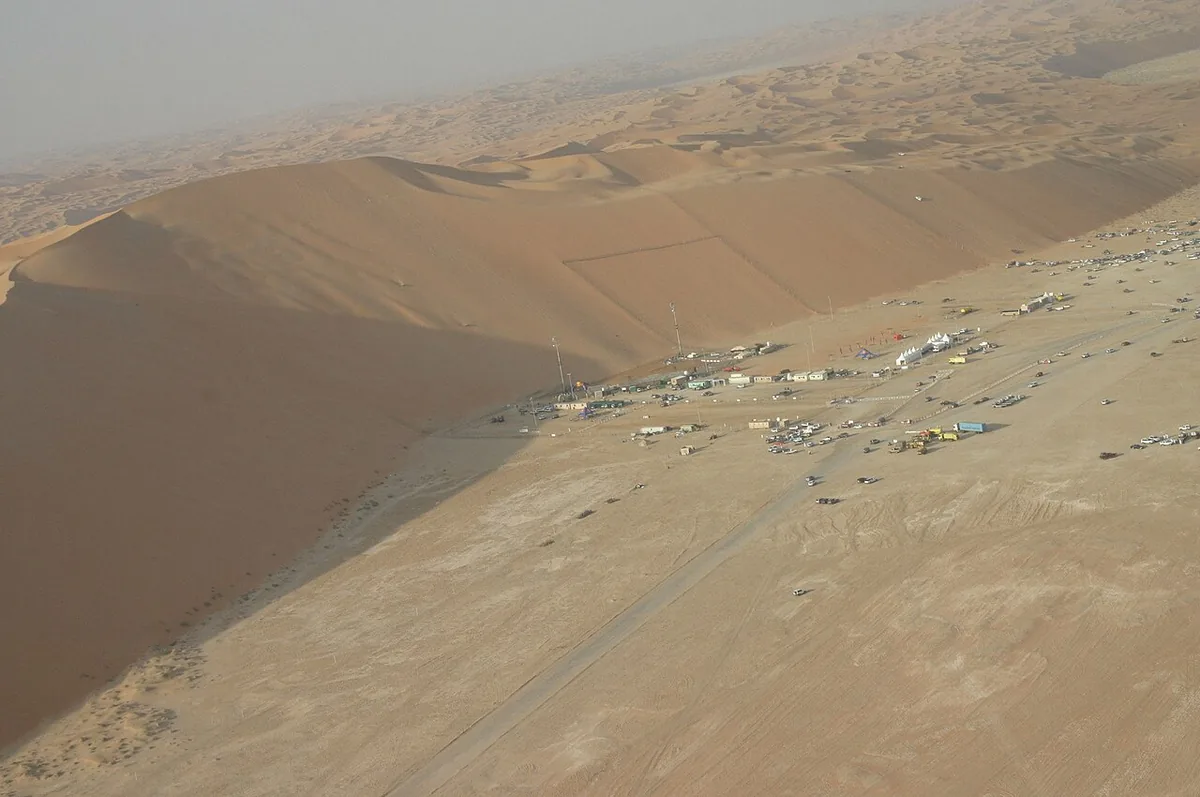
Moreeb Dune, United Arab Emirates
Geology fashioned this monster over thousands of years
Geology fashioned this monster over thousands of years as prevailing winds funneled sand into the hollows of the Liwa crescent, but its modern legend was born from the Bedouin's obsession with speed. Traditionally, these dunes were the formidable borders of the Bani Yas tribe's ancestral home, a place where survival depended on knowing every slip-face and shadow. In recent decades, the dune has transformed into a high-octane stadium for the Liwa International Festival. Every winter, the quiet of the desert is shattered by the roar of thousand-horsepower engines as drag racers attempt to conquer the 'Scary Hill.' This transition from a tribal landmark to a global center for desert motorsports mirrors the broader story of the nation, a bridge between deep nomadic roots and a relentless drive toward the future.
Standing at the summit requires a grueling,
Standing at the summit requires a grueling, calf-burning climb that rewards you with a view of an endless, undulating sea of orange. The sand move beneath your feet, a fluid and unpredictable texture that hums with a low, vibrating drone when the wind catches the crest. The horizon is a jagged line of peaks and troughs, where the light at mid-morning is so sharp it carves every ripple into a work of art. Instantly, the way the color shifts from a pale lemon at noon to a deep, bruised purple just after sunset. While the base can be crowded with campers and roaring engines during festival season, the early morning offers a profound, heavy stillness where the only sound is the rhythmic thrum of your own pulse in your ears.
pilgrimage
Reaching Moreeb requires a dedicated three-hour pilgrimage from Abu Dhabi, heading south toward the Saudi border on a road that gradually loses its greenery. The drive takes you through the heart of the Liwa Oasis, passing through small towns where date palms are the only canopy. A well-maintained road leads directly to the foot of the dune, though the final stretches feel increasingly isolated as the dunes grow taller and the sky wider. The majority opt for a sturdy SUV, though the road to the base is paved, allowing even standard vehicles to witness the spectacle. There are no gas stations in the immediate vicinity of the dune, so fueling up in Mezaira'a is a mandatory ritual before venturing into the deep sands.
“Reaching Moreeb requires a dedicated three-hour pilgrimage from Abu Dhabi, heading south toward the Saudi border on a road that gradually loses its greenery.”
The Experience
It starts with the silence first, not a lack of noise, but a heavy, pressurized quiet that makes the desert feel like an outdoor cathedral. The sand is incredibly fine, feeling like silk between your fingers but acting like liquid when you try to gain purchase on the slope. From the top, the modern world feels entirely irrelevant; the only thing that matters is the heat of the sun on your neck and the infinite repetition of the dunes. Something like a strange sense of vertigo looking down the fifty-degree drop, watching the tiny silhouettes of people far below. The most memorable moment occurs when the wind picks up just enough to create 'singing sand,' a low-frequency moan produced by the friction of shifting grains that sounds like a distant, ghostly choir.
Why It Matters
Moreeb Dune is the ultimate monument to the Rub' al Khali, a landscape that has defined the Emirati character for centuries. It represents the raw, unyielding power of the environment that the Bedouin mastered long before the age of air conditioning. Humanly, it matters as a site where ancient desert skills meet modern engineering, serving as a proving ground for both man and machine in one of the harshest climates on Earth.
Why Visit
Go because the desert shouldn't just be something you see from a plane window; it should be something you feel in your lungs and under your feet. Moreeb offers a scale of nature that makes the Burj Khalifa look modest. It is the only place where you can experience the true, terrifying majesty of the Empty Quarter with the safety of a paved road leading you back home.
Insider Tips
- 1
Lower your tire pressure to about 15 psi before you even think about driving off the paved road; the sand here is notoriously soft and forgiving to no one.
- 2
Time your arrival for 4:30 PM to catch the 'blue hour' when the shadows in the dune troughs turn a vivid, electric indigo against the orange sand.
- 3
Bring a heavy-duty power bank and extra water, as the extreme heat can drain both your phone battery and your hydration levels faster than you expect.
- 4
Walk along the very crest of the dune where the sand is most compacted; the slopes are often too loose to provide any reliable footing.
- 5
Fuel up your vehicle in the town of Mezaira'a before the final 25-kilometer drive, as there are no facilities once you enter the Moreeb valley area.