“A single gazelle supposedly led a thirsty tribe to a freshwater spring here, inadvertently founding a global capital on a spot where a lone coral watchtower once stood guard.”
About Qasr Al Hosn
Construction of the original watchtower in 1761 represented the first permanent structure on Abu Dhabi island, a pivotal moment that turned a nomadic hunting party into a sovereign settlement. Sheikh Shakhbut bin Diyab Al Nahyan expanded the site into a formidable fort in the 1790s, using materials gathered from the seabed to create a stronghold that was as much a biological part of the island as the mangroves. For nearly two centuries, it served as the seat of government, the military headquarters, and the private home of the Al Nahyan dynasty. The 1930s brought another layer of complexity when an outer palace was commissioned by Sheikh Shakhbut bin Sultan Al Nahyan, funded by the very first oil exploration concessions. This architectural layering created a 'fort within a palace,' a physical timeline of the country's move from the pearling era to the petroleum age.
What Qasr Al Hosn actually is
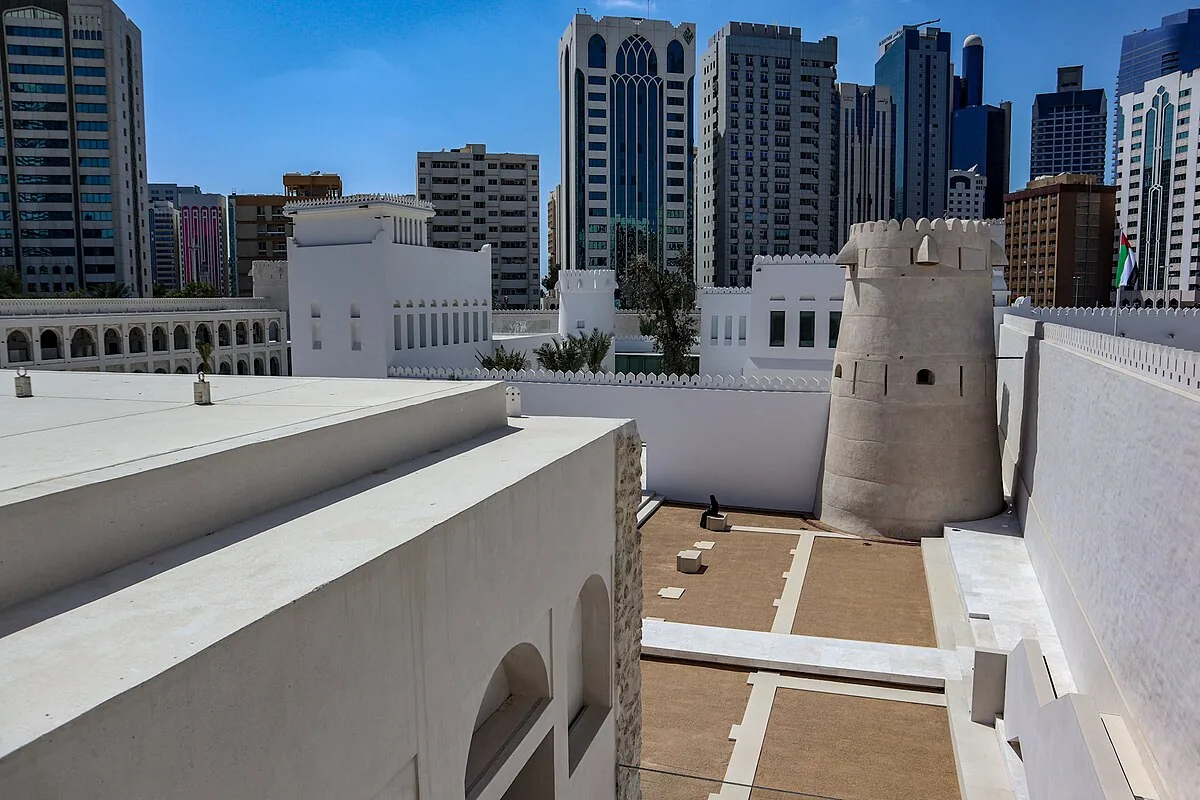
Pure white coral stone glows with a ghostly intensity against the steel-and-glass grid of modern Abu Dhabi, marking the exact spot where the city’s heart first began to beat. Qasr Al Hosn is still a defiant architectural fossil, a stark horizontal fortress surrounded by a vertical forest of banking towers and luxury hotels. It began life as a solitary watchtower guarding the only freshwater well on the island, eventually swelling into a grand palace that housed the ruling Al Nahyan family for generations. Today, the complex is a masterclass in restorative architecture, where the porous textures of traditional sea-stone meet the sharp lines of contemporary concrete. The walk through its gates provides an immediate sensory shift, as the roar of the capital’s six-lane highways is muffled by thick walls and the cooling influence of narrow, shaded courtyards.
Pure white coral stone glows with a ghostly intensity against the steel-and-glass grid of modern Abu Dhabi, marking the exact spot where the city’s heart first began to beat.
Legend says a wandering tribe
Legend says a wandering tribe from the Liwa Oasis followed a gazelle to this island, discovering a pocket of fresh water that allowed life to take root in the salt-heavy air. Around 1761, a conical watchtower was built to protect this liquid gold, marking the transition from a nomadic existence to a permanent settlement. By the mid-19th century, the tower had been engulfed by a much larger fort, featuring a series of defensive rooms and high-walled enclosures designed to withstand tribal skirmishes and the harsh maritime climate. When oil was discovered in the 1950s, the fort evolved again, becoming the administrative center of a nation rapidly transforming before the world’s eyes. A massive outer palace was added to surround the original inner fort, creating a symbolic shell that protected the old traditions while the new world was constructed just outside the perimeter.
Stepping onto the open plaza,
The heat radiating off the white stone, but the air grows noticeably stiller entering the inner chambers. The rough, pitted surface of the coral-stone walls, a mixture of sea-harvested rock and shell that was once held together by a traditional mortar of lime and sand. The volume is intimate, defined by the dry scuff of sandals on stone and the occasional creak of a heavy teak door. Inside the museum galleries, the scent of aged paper and leather bindings accompanies the displays of early navigational tools and handwritten decrees. The most evocative moment occurs in the quiet spaces between the inner and outer forts, where the play of light and shadow on the geometric floors creates a rhythmic, meditative atmosphere. Above, from the traditional wind towers to see the summit of a nearby skyscraper provides a jarring, essential realization of how much change has occurred in a single human lifetime.
Finding the fort requires a trip
Finding the fort requires a trip to the center of the city’s oldest district, located between Zayed the First Street and Hamdan Bin Mohammed Street. Taxis are the most frequent sight in this part of town and will drop you at the entrance of the sprawling cultural park that surrounds the landmark. If you prefer public transport, several bus lines serve the nearby Central Bus Station, followed by a short walk through the heart of the downtown commercial grid. The approach on foot is particularly rewarding, as the white fortress emerges slowly from the shadows of the surrounding high-rises, appearing like a pale, solid anchor in a sea of shifting glass reflections.
Finding the fort requires a trip to the center of the city’s oldest district, located between Zayed the First Street and Hamdan Bin Mohammed Street.
The Experience
What you see first is a peculiar coolness within the thick-walled inner fort, a natural insulation that has defied the desert sun for over two hundred years. The transition from the bright, bleached plaza into the shadowed rooms feels like a dip into a subterranean world where the sounds of the modern city are replaced by a soft, hollow echo. Visitors generally focus on the large courtyard, but the real soul of the place is found in the narrow stairwells where the walls are still stained with the minerals of the sea. Up on the battlements at dusk, you feel the coastal breeze coming off the Gulf, and for a second, the glowing skyscrapers of the Corniche seem to disappear, leaving only the sound of the wind against the coral stone. It is a moment of profound stillness that remains with you long after you rejoin the frantic pace of the city.
Why It Matters
Qasr Al Hosn matters because it is the only physical witness to the entire history of Abu Dhabi, from its origins as a collection of palm huts to its status as a global metropolis. It is the nation's psychological anchor, proving that the identity of the Emirates is not built on glass and steel alone, but on a 250-year-old foundation of resourcefulness and maritime resilience. Culturally, it acts as a sacred space where the oral histories of the desert are formally archived and honored.
Why Visit
Ignore the skeptics who say Abu Dhabi has no history. While the nearby malls offer luxury, Qasr Al Hosn offers the raw, unpolished truth of how a city survives in the wilderness. You come here to touch the actual coral that built this country and to understand the scale of a transformation that happened in the blink of an eye.
✦ Insider Tips
- 1
Look closely at the walls of the inner fort to see the imprints of ancient seashells and coral fans that were never smoothed away by the original builders.
- 2
The 'House of Artisans' on-site offers live demonstrations of Sadu weaving; ask the weavers about the specific tribal meanings behind the geometric patterns.
- 3
Visit during the hour before sunset to see the white stone transition from a sharp, clinical blue to a warm, honey-colored glow as the sun hits the surrounding skyscrapers.
- 4
Head to the 'Cultural Foundation' building next door after your tour to find one of the city’s quietest libraries and a hidden terrace overlooking the fort.
- 5
Check the floor of the watchtower chamber; the traditional cooling system involved venting air over water jars, a method you can still feel the effects of today.