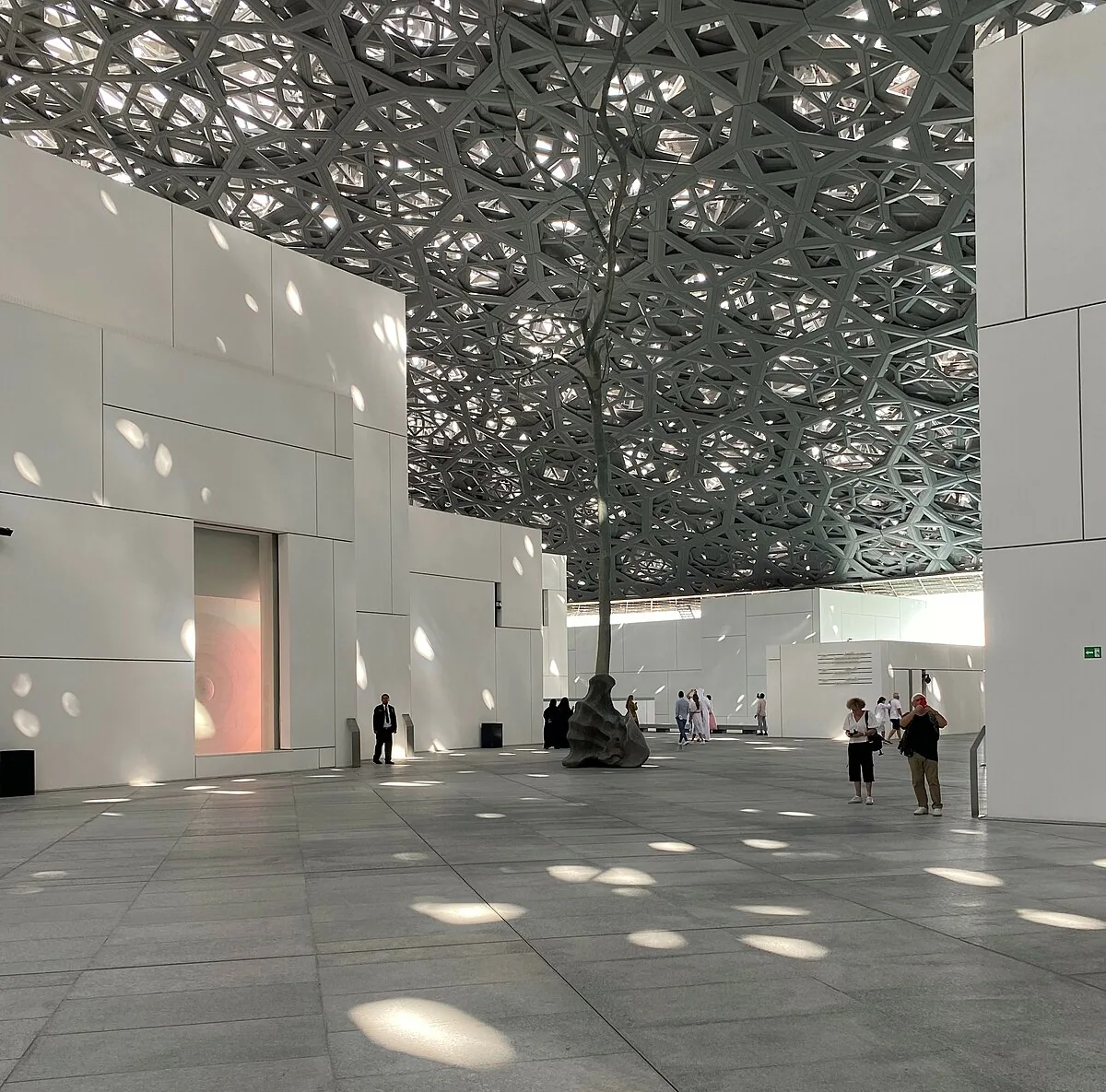
“A celestial map of the zodiac, rendered in millions of tiny glass tesserae, gazes down from a golden dome that once looked over a crowded vegetable market.”
About Sharjah Museum of Islamic Civilization
The collection’s current home opened its doors in 2008, but the narrative began much earlier as a private passion for preserving the material history of the faith. Originally founded in 1996 in a different district, the museum was relocated to the Souq al-Majarrah to give the artifacts the architectural gravitas they deserved. The souq itself had been a landmark of the 1980s, known for its distinct golden roof. During the conversion, architects had to balance the preservation of the market's vaulted ceilings with the climate-control needs of delicate 7th-century manuscripts. This labor of love resulted in a space that feels both ancient and revitalized, successfully housing everything from early Islamic pottery to the complex astronomical clocks that once dictated the prayer times across a vast empire.
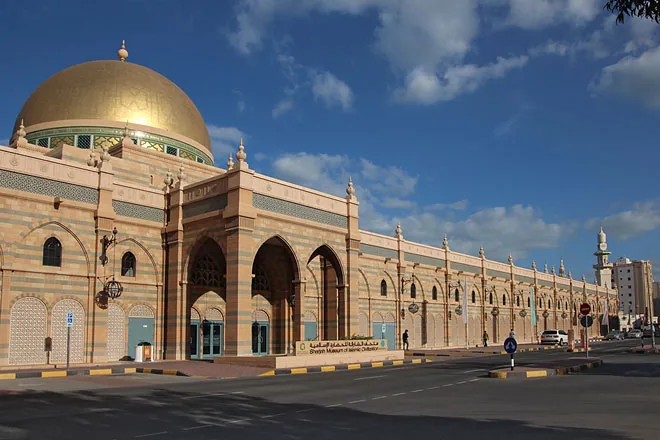
Golden mosaics shimmer beneath a central dome
Golden mosaics shimmer beneath a central dome that anchors the Sharjah waterfront, housed within a building that once was a packed traditional souq. The Sharjah Museum of Islamic Civilization occupies a imposing long-form structure on the Majarrah Waterfront, its facade a warm sand color that glows intensely during the golden hour. Unlike the clinical white cubes of modern galleries, this space feels grounded in the commerce and limestone textures of the old city. Over five thousand artifacts are arranged across two expansive floors, tracing the intellectual and spiritual arc of a culture that bridged the gap between ancient philosophy and the Renaissance. It functions as a quiet sanctuary where the rhythmic lapping of the creek outside provides a constant, meditative backdrop to the heavy weight of history kept within these glass cases.
Golden mosaics shimmer beneath a central dome that anchors the Sharjah waterfront, housed within a building that once was a packed traditional souq.
Why it matters
Sharjah transformed this specific site in 2008, moving the collection from an older, smaller facility into the renovated Souq al-Majarrah. The building itself is a piece of heritage, preserving the long, arched hallways where merchants once traded textiles and spices. This transition was part of a broader push by the Emirate to cement its status as the cultural capital of the region, focusing on education rather than mere spectacle. The architecture retains the traditional wind-tower motifs and the grand central dome, which is decorated on the interior with a celestial mosaic representing the zodiac. By repurposing a marketplace into a house of wisdom, the museum mirrors the historical reality of the Islamic Golden Age, where centers of trade were inseparable from centers of learning and scientific inquiry.
Visiting Sharjah Museum of Islamic Civilization
Stepping into the Ibn Al-Haytham Gallery of Science and Technology, There is a sharp sense of wonder at the intricate brass astrolabes and early surgical tools that look surprisingly modern. On all sides, the air is cool and still, carrying a faint scent of polished wood and old parchment. It becomes clear how the light filters through the high clerestory windows, catching the glint of gold dinars from the Umayyad caliphate. Sounds are hushed, with the occasional echo of footsteps on the marble floors and the soft murmur of visitors contemplating the Kiswah, the heavy black silk cloth that once draped the Kaaba in Mecca. The highlight for many is the walk directly under the central dome, where you must look up to see the vibrant blue and gold mosaic of the night sky, a detail that turns a simple hallway into a cosmic experience.
Reaching the museum involves a drive
Reaching the museum involves a drive through the heart of old Sharjah, a district defined by its traditional architecture and noisy street life. It sits prominently on Corniche Street, easily accessible by taxi or the Sharjah sightseeing bus which stops directly in front of the main entrance. For those arriving from Dubai, the journey takes roughly forty minutes outside of peak traffic hours, following the E11 highway north. Parking is available in the large public lots along the waterfront, allowing for a scenic walk past the dhows anchored in the creek before entering the museum’s cool, cavernous interior.
Reaching the museum involves a drive through the heart of old Sharjah, a district defined by its traditional architecture and noisy street life.
The Experience
The silence first, a profound departure from the chaotic honking and heat of the Sharjah Corniche just outside the heavy doors. As you move through the galleries, the shadows of the arched doorways create a rhythmic visual pace, leading you deeper into rooms filled with the scent of history and quietude. Visitors often breeze past the smaller clay shards, but if you look closely, you can see the thumbprints of potters from a thousand years ago permanently fired into the glaze. At mid-morning, the sun hits the central atrium at such an angle that the entire hallway seems to dissolve into a soft, honey-colored light. It is a place where you feel the intellectual pulse of the past, realizing that the digital world we inhabit was built on the foundations of the mathematics and optics displayed in these quiet halls.
Why It Matters
The museum matters because it provides a tangible correction to the narrow view of history often taught in the West. It holds a period when the Islamic world was the global steward of medicine, algebra, and astronomy, preserving the works of the Greeks while innovating entirely new fields of study. Culturally, it acts as a dignified anchor for Sharjah, emphasizing the Emirate’s commitment to intellectual heritage over the fleeting allure of modern glass towers.
Why Visit
Pitch this to the traveler who finds the high-octane malls of Dubai exhausting. Come here for the human scale of the artifacts, the hand-written letters, the worn coins, and the ancient maps. It offers a depth of context that you simply won't find at the taller, flashier landmarks nearby, making the complex history of the Middle East feel intimate and understandable.
✦ Insider Tips
- 1
Look for the display of early Islamic glass; the iridescent sheen on the bottles is actually a result of the chemical breakdown of the glass over a thousand years of burial.
- 2
The museum cafe offers one of the best unobstructed views of the dhows on the creek, making it a perfect spot for a mint tea after your tour.
- 3
Pay attention to the 'Kiswah' section; the embroidery is made of real gold and silver threads and is changed every single year in Mecca.
- 4
Check the local prayer times before visiting, as the museum remains open but the surrounding area becomes significantly quieter and more atmospheric during these windows.