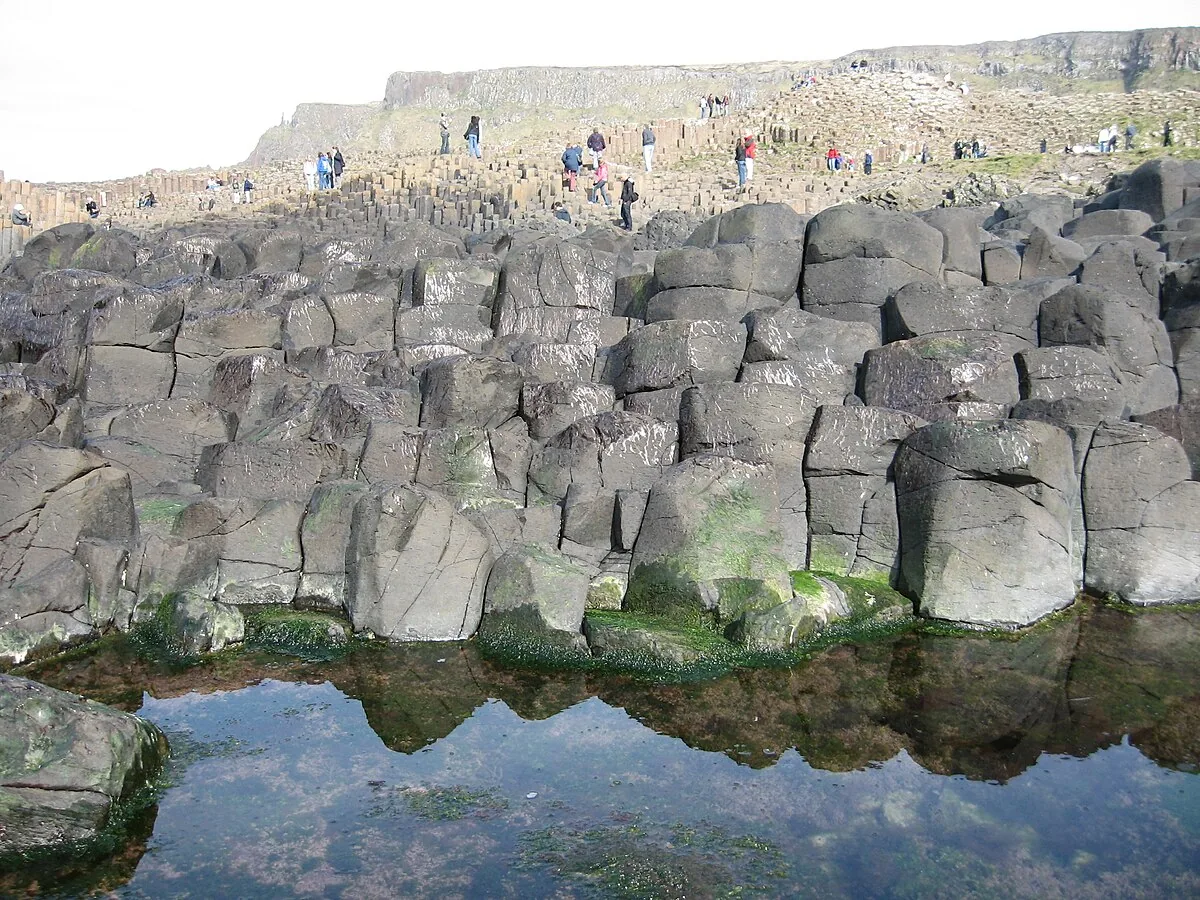
Around 40,000 basalt columns in a regular hexagonal pattern on Northern Ireland's north coast were formed by volcanic cooling 60 million years ago, the same process that created an identical formation in Scotland across the water, which Irish mythology explains as the two ends of a giant's demolished bridge.
About Giant's Causeway
The columns formed 60 million years ago as lava cooled and contracted. The geological explanation was contested until the eighteenth century; the Fionn mac Cumhaill legend offered a more culturally satisfying account of why the same formation appears on both sides of the North Channel.
What Giant's Causeway actually is
The Giant's Causeway on the north Antrim coast of Northern Ireland is a formation of approximately 40,000 basalt columns produced by ancient volcanic activity, packed together in a regular hexagonal pattern along the shoreline and extending into the sea. The columns were formed around 60 million years ago when lava flows cooled and contracted, fracturing into the geometric pattern that characterizes basalt, the same process that formed similar formations at Staffa in Scotland, which sits directly across the North Channel. The causeway is Northern Ireland's only UNESCO World Heritage Site.
The geological explanation for the hexagonal columns was not accepted until the eighteenth century; before that, Irish mythology provided the most satisfying account, that the causeway was built by the giant Fionn mac Cumhaill to allow him to walk to Scotland to fight his Scottish rival Benandonner. When Benandonner came looking for a fight, Fionn's wife disguised him as a baby; Benandonner, concluding that if the baby was this large the father must be enormous, fled back to Scotland, destroying the causeway behind him. The myth, like the geology, explains why the formation appears on both sides of the North Channel: Staffa's Fingal's Cave is the Scottish end of the same story.
The walk from the National Trust visitor center descends to the shoreline and the main causeway formation, the Grand Causeway, where the columns are most densely packed and most accessible. The surrounding cliff path extends several kilometres in each direction, with formations named by shape: the Organ (vertical columns suggesting organ pipes), the Giant's Boot, the Wishing Chair (a natural throne among the columns). The columns themselves are remarkably climbable, the flat hexagonal tops make secure footing across the formation, and most visitors spend time sitting on them at water level. The coastal path to the east of the causeway offers cliff-top views back over the formation.
The Giant's Causeway is near Bushmills on the north Antrim coast, about sixty miles north of Belfast. A National Trust shuttle bus runs from Bushmills village; the Causeway Coastal Route by car is the most scenic approach. The Causeway & Glens Railway runs from Coleraine to Bushmills in summer.
The Experience
Walk the National Trust path to the Grand Causeway formation, climb the flat hexagonal column tops at water level, walk the extended coastal path for cliff-top views back over the formation, and find the named feature formations including the Organ and the Giant's Boot.
Why It Matters
Northern Ireland's only UNESCO World Heritage Site, a geological formation of exceptional regularity whose scale and accessibility make it one of the most significant natural sites in the British Isles.
Why Visit
The experience of sitting on the flat hexagonal basalt columns at sea level, with the North Channel in front and the cliff formations behind, is the one that photographs of the causeway consistently undersell. The scale only registers when you're among the columns.
✦ Photo Gallery
Best Season
🌤 May through September for the most reliable weather, though the Atlantic coast of Northern Ireland can be dramatic in any season. Summer weekends are the busiest; weekday morning visits are significantly quieter.
Quick Facts
Best time to visit
May through September for the most reliable weather, though the Atlantic coast of Northern Ireland can be dramatic in any season. Summer weekends are the busiest; weekday morning visits are significantly quieter.
Getting there
In Giant's Causeway, United Kingdom; reach Giant's Causeway first, then continue to the site.
Location
Giant's Causeway, United Kingdom
Type
attraction
Coordinates
55.2408°, -6.5117°
Insider Tips
- 1
The cliff path above the causeway gives the best elevated view of the column formation, walk up before or after descending to the shoreline level.
- 2
The formation is genuinely climbable on the flat hexagonal tops, appropriate footwear makes this much safer and more enjoyable.
- 3
The visitor center is National Trust managed; NT members enter free. Non-members pay for parking and center entry.
- 4
The Bushmills distillery is ten minutes' drive from the causeway, the world's oldest licensed whiskey distillery combines naturally with a coastal walk.