“A Roman bathing complex built around a spring that has flowed at 45°C for ten thousand years was completely forgotten after Roman Britain's collapse, rebuilt over by medieval Bath, rediscovered in the Victorian period, and still fed by the same natural spring today.”
About Roman Baths
The Romans built over an indigenous sacred spring, identifying the local goddess Sulis with Minerva. The complex operated from the first to early fifth century CE before silting up and disappearing beneath medieval Bath. Victorian excavation revealed the extent of the buried complex still intact below the Georgian city.
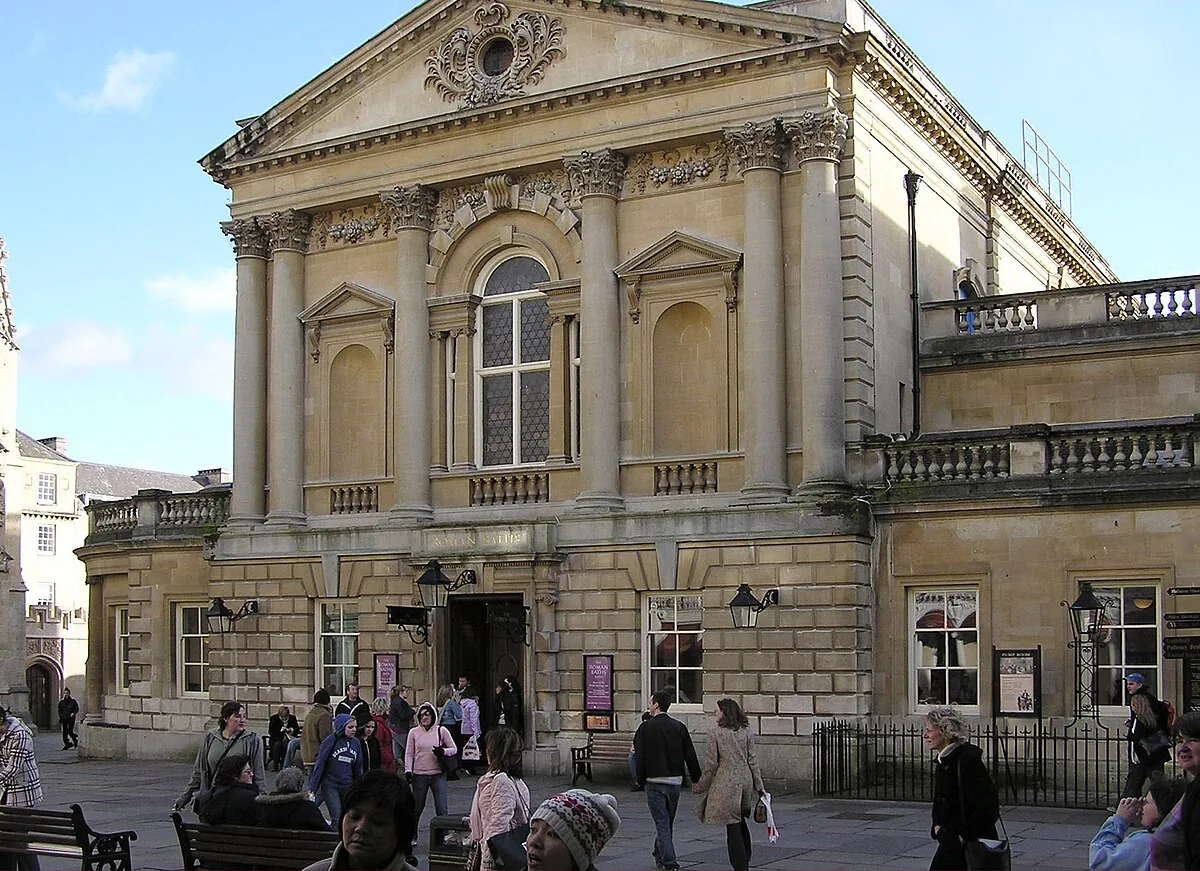
The Roman Baths at Bath, Somerset, are among the best-preserved ancient bathing complexes in northern Europe, a religious and social site built around a natural hot spring that has flowed at a constant 45°C for at least ten thousand years. The Roman town of Aquae Sulis developed from the first century CE around the sacred spring dedicated to the goddess Sulis Minerva, and the bathing complex, temple precinct, and drainage system that survive below modern street level represent two centuries of continuous construction and use.
The spring at Bath was sacred to the indigenous Britons before the Romans arrived; the Romans identified Sulis, the local deity, with their own Minerva and built a formal temple and bathing complex over the site, a practice of religious accommodation that helped ease the transition from indigenous to Roman religion. The complex was built primarily in the first and second centuries CE and remained in use until the decline of Roman Britain in the early fifth century. After the Romans left, the complex gradually silted up and was forgotten; medieval Bath built over it, and the extent of the Roman remains was not appreciated until the late Victorian period when archaeological excavation began revealing the scale of what lay beneath the Georgian streets.
The site is partially underground, the Roman levels are below the current city surface, creating the unusual experience of descending into the past through the fabric of a Georgian spa town above. The Great Bath, a lead-lined pool measuring 29 by 12 metres, is open to the sky and still filled with the natural spring water, which runs green with algae in daylight. The Roman drain and overflow systems are visible and still functioning. The sacred spring chamber holds the remains of thousands of curse tablets, lead sheets thrown into the water inscribed with requests to Sulis Minerva, mostly asking for the recovery of stolen goods, that are among the most personal Roman documents to survive from Britain.
Bath is 115 miles west of London, reachable by Great Western Railway from London Paddington in approximately ninety minutes. The Roman Baths are in the city center, adjacent to Bath Abbey, a five-minute walk from the train station.
Bath is 115 miles west of London, reachable by Great Western Railway from London Paddington in approximately ninety minutes.
The Experience
Descend to the Roman level below current street height, stand beside the green-algae Great Bath still filled with 45°C spring water, read the translated curse tablets thrown into the sacred spring by Romans requesting divine justice, and view the drainage system still functioning after two thousand years.
Why It Matters
One of the best-preserved Roman religious and bathing complexes in northern Europe, with its original spring still flowing, a site where Roman engineering, indigenous religion, and two thousand years of continuous water flow coexist.
Why Visit
The curse tablets are among the most personal Roman documents to survive from Britain, ordinary people asking Sulis Minerva to punish whoever stole their cloak or their money. They give the site a human dimension that imperial monuments rarely provide.
✦ Insider Tips
- 1
The audio guide narrated by Bill Bryson is entertaining and informative, worth the additional charge.
- 2
The curse tablet translations on display are remarkable, read them carefully rather than skimming.
- 3
The Thermae Bath Spa above the Roman Baths lets you swim in rooftop pools fed by the same spring, book separately for a complete experience.
- 4
Bath Abbey, immediately adjacent, is worth fifteen minutes after the Roman site for the complete picture of how the same sacred location was used across two thousand years.