A Prince of Wales built an Indian palace on the Sussex coast between 1787 and 1823 with Chinese-decorated interiors, Queen Victoria sold it to Brighton Council in 1850 because it was too public and too cramped, and the council has run it as a tourist attraction ever since.
About Royal Pavilion
George IV's forty-year building campaign transformed a neoclassical villa into John Nash's Indian-exterior fantasy completed in 1822. Nash applied the same theatrical sensibility here that he was simultaneously using on Regent Street. Victoria's 1850 sale to Brighton Corporation preserved the building as a public attraction.
A royal commission
The Royal Pavilion in Brighton is a royal pleasure palace built between 1787 and 1823 for the Prince of Wales, later George IV, in an architectural style that combines Indian exterior forms, onion domes, minarets, and Mughal arches, with Chinese-influenced interiors of remarkable decorative intensity. The exterior looks like an Indian palace transported to the English seaside. The interior looks like the fantasy of a prince who spent more money than anyone thought wise and had an absolute commitment to the proposition that excess was better than restraint.
“The exterior looks like an Indian palace transported to the English seaside.”
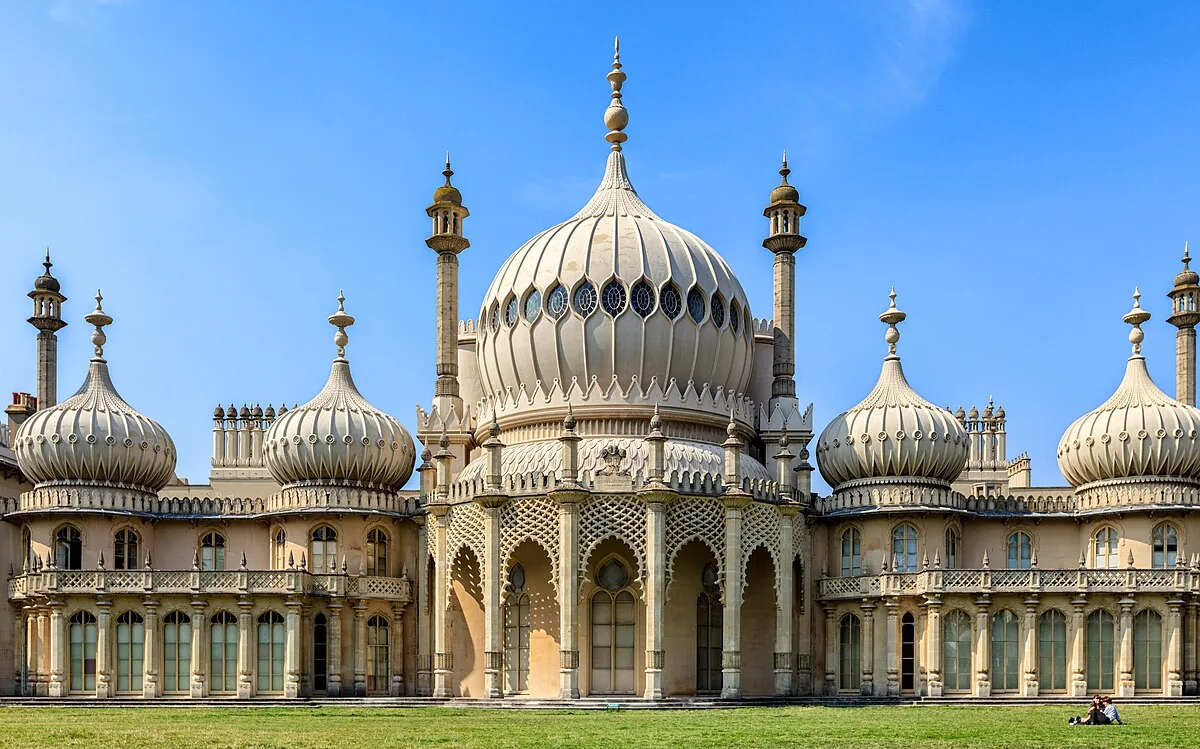
Royal Pavilion, United Kingdom
George IV's relationship with Brighton began in 1783 when he first visited the fashionable seaside resort and decided to build a marine residence there. The original structure was a neoclassical villa; successive campaigns transformed it over forty years under the architects Henry Holland and then John Nash, whose Indian exterior redesign of 1815-1822 produced the building visible today. Nash, working simultaneously on Regent Street and Regent's Park in London, brought the same theatrical sensibility to Brighton that he was applying to the capital's urban fabric. The Pavilion was sold to Brighton Corporation in 1850 by Queen Victoria, who found it too public and too cramped for her family's needs.
The Banqueting Room
The Banqueting Room is the interior's centerpiece, a dining room with a chandelier suspended from a palm tree canopy and a ceiling painting of flying Chinese dragons, designed to create the impression that the room is an exotic outdoor pavilion. The Music Room has a domed ceiling of gilded scallop shells and wall paintings of Chinese scenes. The kitchen, large, light, and equipped with the most advanced cooking technology of 1821, including a cast iron range and steam heating, was designed by the prince's chef and is one of the finest surviving Regency kitchen interiors in Britain. The exterior gardens have been restored to the Regency plan. Brighton is fifty minutes from London Victoria or London Bridge by Southern or Thameslink trains. The Royal Pavilion is in central Brighton, a fifteen-minute walk from the station. Brighton's seafront and The Lanes shopping quarter are immediately adjacent.
The Experience
Stand in the Banqueting Room under the chandelier suspended from a palm canopy with flying Chinese dragons painted overhead, walk the Music Room's gilded scallop dome, inspect the advanced 1821 kitchen with its cast iron range, and walk the restored Regency gardens.
Why It Matters
The most architecturally eccentric royal building in Britain, a marriage of Indian exterior and Chinese interior that represents Regency taste at its most uninhibited, preserved as a public attraction in central Brighton.
Why Visit
The Banqueting Room chandelier, suspended from a cast-iron palm tree canopy, weighing a tonne, with dragons overhead, is the single most theatrical interior element in any English royal building. The kitchen is a serious history-of-technology exhibit dressed in Regency theatrical garb.
Insider Tips
- 1
The audio guide is well-produced and explains the iconographic programs of the interiors that would otherwise be merely decorative.
- 2
The kitchen is frequently undervisited by people focused on the state rooms, it's one of the finest Regency-period working kitchen interiors in Britain.
- 3
The Lanes shopping quarter immediately adjacent provides the Brighton cultural experience that the Pavilion's royal context doesn't, the combination makes a full day.
- 4
Brighton's seafront and pier are five minutes' walk from the Pavilion, a natural finish to a visit in any weather.