York Minster contains approximately half of all surviving medieval stained glass in England, including a Great East Window the size of a tennis court depicting the entire story from Genesis to Revelation, completed in 1408.
About York Minster
A wooden baptistery stood on this site in 627 CE; the current Gothic building was constructed over 250 years from 1220. The Reformation spared more of the stained glass than at most English cathedrals; a 1984 fire damaged the south transept; the Roman foundations beneath the building include a column from the hall where Constantine was proclaimed Emperor in 306 CE.
About York Minster
York Minster is the largest Gothic cathedral in northern Europe, built over a period of 250 years from 1220 to 1472 and covering the full range of Gothic architectural development from Early English to Perpendicular. The minster contains the largest collection of medieval stained glass in England, approximately half of all surviving medieval stained glass in the country, including the Great East Window, completed in 1408 and depicting the beginning and end of all things from Genesis to Revelation in a window the size of a tennis court.
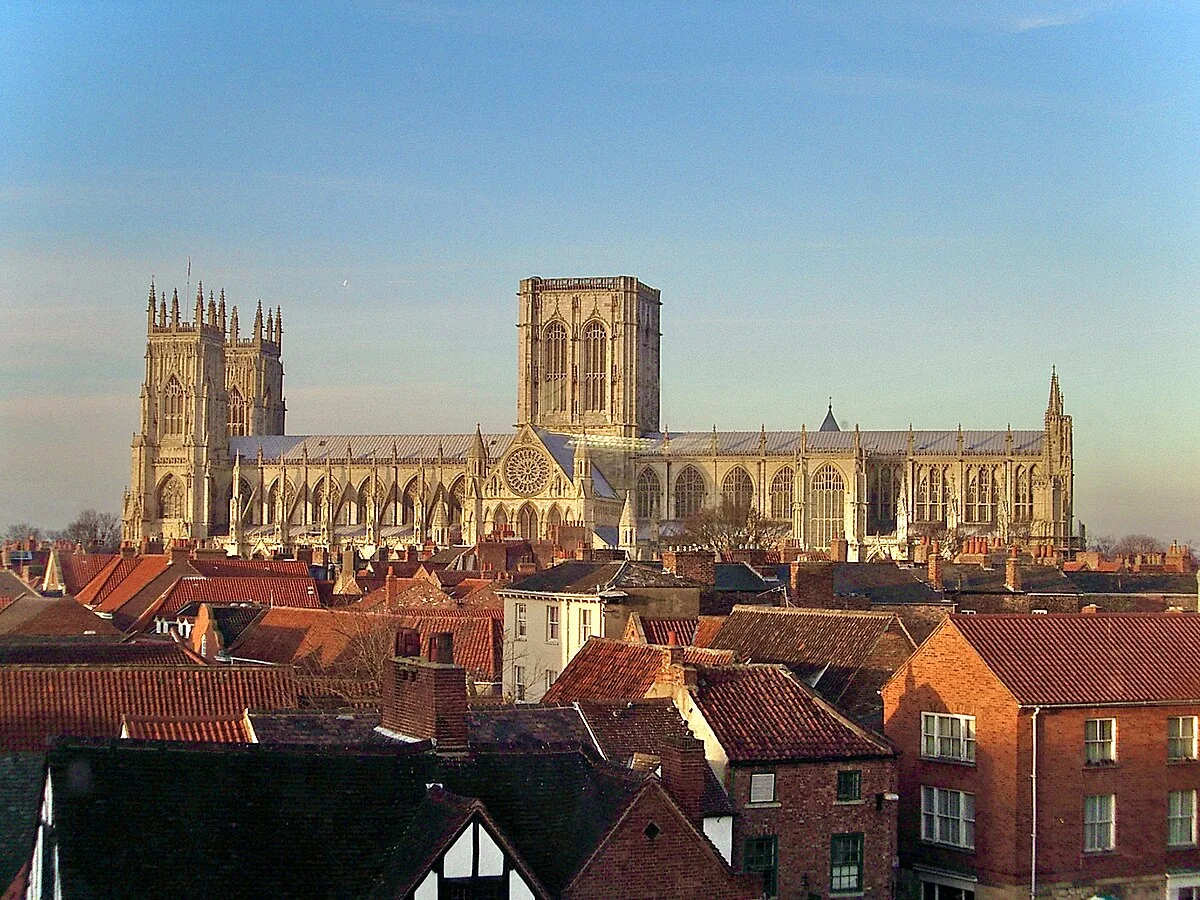
York Minster, United Kingdom
wooden baptistery built, 627
Christianity in York predates the minster itself: the first church on this site was a wooden baptistery built in 627 CE for the baptism of King Edwin of Northumbria. The current building replaced an earlier Norman cathedral and took shape across five significant construction campaigns that left visible evidence in the nave's Early English style, the transepts' later Gothic forms, and the chapter house's elaborate Geometric Decorated work. The cathedral survived the Reformation largely intact, York's civic importance and the pragmatism of its chapter meant that the stained glass was not destroyed as systematically as at many other English cathedrals. A fire in 1984 caused serious damage to the south transept and roof; the restoration took four years.
Commissioned by Emperor in
The Great East Window requires positioning oneself far enough down the nave to read the full composition, 311 individual panels, nine metres wide and twenty-three metres high, covering the entire apocalyptic narrative from Genesis to Revelation. The Chapter House is a separate building accessible from the north transept cloister and has a spectacular vaulted ceiling with no central pillar. The undercroft museum beneath the minster reveals the Roman foundations, including a column from the Roman headquarters building around which Constantine was proclaimed Emperor in 306 CE, alongside Norman and medieval building phases. The central tower can be climbed for views over York's rooflines.
York is approximately two hours from London King's Cross by LNER express train. The Minster is in the city center, a ten-minute walk from York station. The city is entirely walkable within the medieval walls.
“York is approximately two hours from London King's Cross by LNER express train.”
The Experience
View the Great East Window from far enough down the nave to read the full 311-panel composition, visit the pillarless Chapter House via the north transept cloister, descend to the undercroft for the Roman foundations and the Constantine connection, and climb the central tower for York city views.
Why It Matters
The largest Gothic cathedral in northern Europe and the repository of approximately half of England's surviving medieval stained glass, a building whose construction spans the full range of English Gothic architectural development.
Why Visit
The Great East Window at the scale of a tennis court, depicting the entire biblical apocalypse in glass from 1408, is a work that photographs consistently fail to convey. Standing far down the nave to read the full composition is a different experience from the close-up images that dominate guide books.
Insider Tips
- 1
View the Great East Window from the crossing or beyond, closer viewing makes the individual panels impossible to read as a whole composition.
- 2
The Chapter House is accessed from the north transept and is easy to miss, follow the cloister signs specifically.
- 3
The undercroft museum requires a separate ticket but is among the most significant Roman finds accessible in any English cathedral.
- 4
York's city walls (free to walk) make a natural complement to the minster visit, the full circuit takes about two hours.