“Chicago houses a more significant collection of French Impressionist masterpieces than almost any museum in France, thanks to a group of 19th-century Midwesterners with very avant-garde taste.”
About Art Institute of Chicago
The museum's growth mirrored Chicago's rise as a global powerhouse. After the Great Fire of 1871, the city was desperate to prove its cultural worth, leading to the construction of the Michigan Avenue building on 'made land' composed of city rubble. Throughout the 20th century, the collection grew through massive private bequests, such as the Helen Birch Bartlett Memorial Collection, which brought Seurat's 'Sunday on La Grande Jatte' to the city. Today, it remains one of the largest and oldest art museums in the United States, serving as both a public gallery and a world-renowned research institution.
Art Institute of Chicago in short
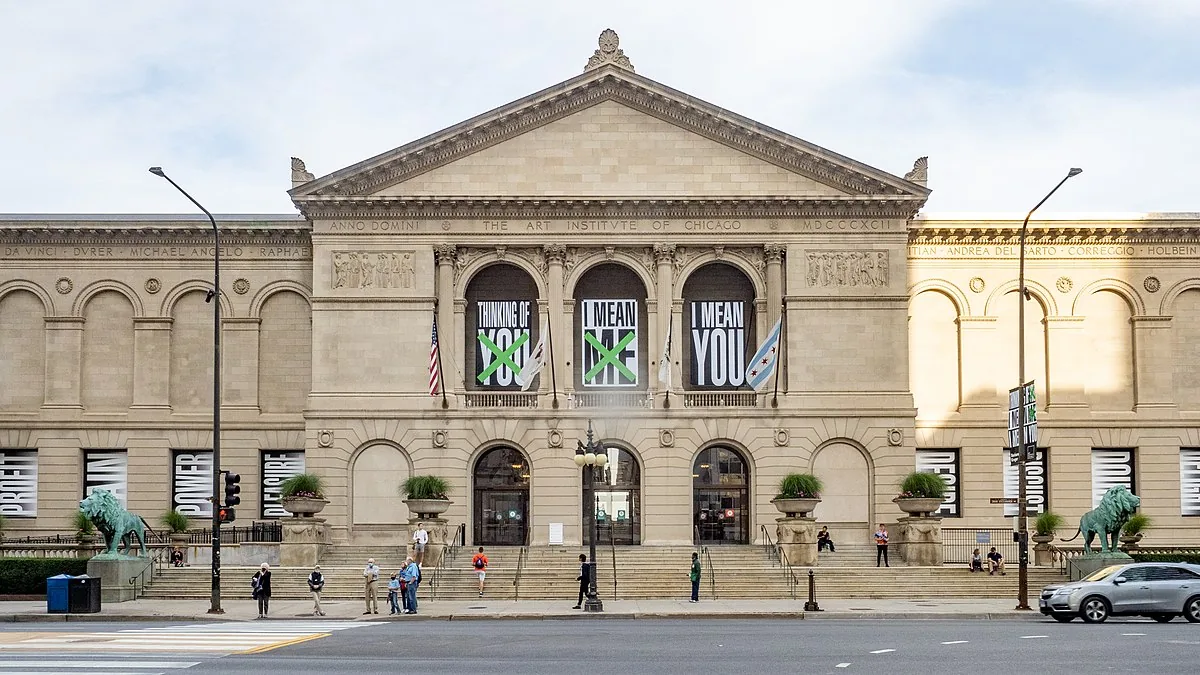
Two bronze lions stand guard on Michigan Avenue, flanking the grand limestone entrance of a museum that houses the definitive visual record of the human experience. The Art Institute of Chicago is a sprawling complex that bridges the gap between 19th-century Beaux-Arts grandeur and 21st-century light-filled minimalism. Inside, the collection spans five thousand years, but it is the museum's exceptional concentration of Impressionist and Post-Impressionist masterpieces that draws the global crowds. From the haunting solitude of Hopper’s diner to the pointillist vibration of Seurat’s park, the galleries contain the images that have come to define our collective cultural memory. The architecture of the city outside is matched by the masterpieces of the world inside.
Two bronze lions stand guard on Michigan Avenue, flanking the grand limestone entrance of a museum that houses the definitive visual record of the human experience.
Founded, 1879
Founded in 1879 as both a museum and a school, the institution moved to its current home in 1893, a building originally constructed for the World’s Columbian Exposition. The trustees made a series of bold, early bets on the then-radical French Impressionists, acquiring works that European museums were still ignoring. This foresight turned Chicago into an unlikely epicenter for French art. Over the decades, the museum has expanded through several major additions, most notably the Modern Wing designed by Renzo Piano in 2009. This 'flying carpet' of glass and steel added much-needed space for the museum's massive collection of contemporary art, creating a seamless connection between the historic campus and the neighboring Millennium Park.
The air is cool
The air is cool and filtered, smelling faintly of floor wax and the quiet hum of climate control. The rhythmic, muted clicking of heels on marble and the low, hushed tones of guided tours. Moving through the Impressionist galleries, the sudden, bright energy of the colors as they interact with the soft, diffused light from the skylights. First, the incredible texture of the oil paint on Van Gogh’s self-portrait, a physical depth that no digital image can convey. The light in the Modern Wing is airy and weightless, contrasting with the dark, heavy woods of the Thorne Miniature Rooms. From front of Grant Wood’s 'American Gothic,' the familiarity of the image is replaced by the surprising intensity of the real-life brushstrokes.
The museum sits in central downtown
The museum sits in central downtown Chicago, directly on the 'Loop' and easily accessible by all 'L' train lines. The Washington/Wabash station is just a block away, while the Metra commuter rail stops directly beneath the nearby Millennium Park. For those staying in the city center, it is a pleasant walk from most major hotels. The museum's two entrances, the historic one on Michigan Avenue and the modern one on Monroe Street, allow visitors to choose which century they want to start their journey in.
The museum sits in central downtown Chicago, directly on the 'Loop' and easily accessible by all 'L' train lines.
The Experience
The sense of meditative calm as you enter the Chagall Windows room, where the deep blue stained glass transforms the light into a spiritual experience. Audibly, the of the city's elevated trains is a distant, industrial background that makes the silence of the galleries feel more intentional. First, the way the museum layout forces you to encounter different eras, such as walking from an ancient Egyptian tomb into a room of mid-century abstract expressionism. Most people rush to the 'Nighthawks' painting, but the real quietude is found in the Asian art wing’s rock garden. The moment when you cross the Nichols Bridgeway into the park is when the art and the city finally merge.
Why It Matters
The Art Institute is a global pillar of art history and conservation. It preserves icons of American identity while providing a comprehensive look at global creative traditions. Culturally, it is the crown jewel of Chicago, proving that the 'City of Broad Shoulders' has a heart built of delicate brushstrokes and visionary ideas.
Why Visit
What makes it worth the trip: you can't truly know these paintings until you stand three inches away from them. It is one of the few places on earth where you can see the entire arc of human creativity, from ancient pottery to contemporary video art, in a single afternoon. It is a masterclass in seeing the world through other people's eyes.
✦ Insider Tips
- 1
Head straight to the top floor of the Modern Wing for the Impressionist galleries as soon as the doors open to see the Seurat in total silence.
- 2
Don't miss the Thorne Miniature Rooms in the basement; they are a bizarre and stunningly detailed tour of interior design through the ages.
- 3
Check out the Chicago Stock Exchange Trading Room, which was salvaged and rebuilt inside the museum as a tribute to the city's architectural heritage.
- 4
The Nichols Bridgeway offers a free, high-altitude walk from the museum's third floor directly into Millennium Park.
- 5
Download the museum's app for the 'under-the-radar finds' tour, which highlights incredible pieces that are often overlooked by the crowds chasing the famous icons.