Six million years of erosion have peeled back the Earth's crust to reveal a basement of rock that was cooling before the first multicellular life ever appeared.
About Grand Canyon National Park
The canyon began as a series of smaller gorges that eventually linked together as the Colorado River found its path toward the Gulf of California. While European discovery happened by accident during the Coronado expedition, the indigenous Havasupai and Hopi tribes have never left, viewing the canyon as a sacred place of emergence. In the early 20th century, the Fred Harvey Company and architect Mary Colter defined the 'Parkitecture' style, building structures like Lookout Studio that blend seamlessly into the canyon’s jagged profile. Today, it serves as a global laboratory for climate science and geological study.
Pictures fail to capture the sheer psychological weight
Pictures fail to capture the sheer psychological weight of the space between the rims. The Grand Canyon acts as a vertical desert, a mile-deep gash in the high plateau of northern Arizona where the Colorado River has spent six million years grinding through two billion years of planetary memory. From the edge, the scale defies human perspective, making the massive rock towers within the gorge look like mere pebbles. The canyon creates its own weather, its own silence, and a color palette that shifts from bruised purple to burning ochre in the time it takes for a cloud to pass. It remains the ultimate lesson in the persistence of water against the stubbornness of stone.
“Pictures fail to capture the sheer psychological weight of the space between the rims.”
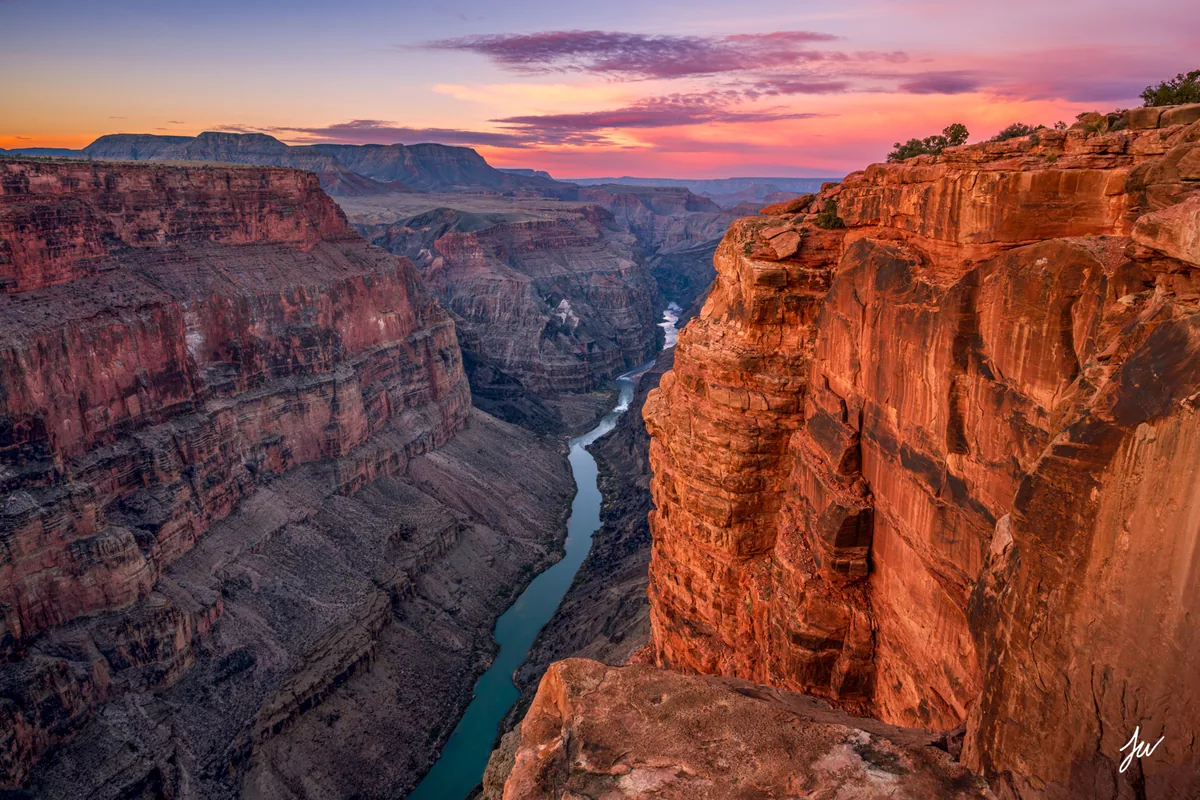
Grand Canyon National Park, United States
the canyon's rapids, 1869
Geologist John Wesley Powell famously navigated the canyon's rapids in 1869 with one arm and a wooden boat, but the human story here began twelve thousand years ago with the Paleo-Indians. Ancestral Puebloans built granaries in the limestone cliffs long before the first Spanish explorers arrived in 1540 and promptly turned back, declaring the area impassable. President Theodore Roosevelt later fought tooth and nail to protect it, famously stating that man could only mar it. The park became a national symbol in 1919, preserving a geological record that reveals nearly half of the Earth's history in its exposed strata.
The air feels thin and dry, smelling faintly of baked juniper and pinyon pine. The rhythmic croak of a raven catching a thermal and the surprising, heavy silence that blankets the chasm. Tracing the Rim Trail, The gritty texture of Kaibab limestone under your boots and the sudden chill of a breeze rising from the depths. Right off, the way the light at dawn hits the Vishnu Schist at the bottom, turning the oldest rocks on the continent a deep, velvet black. Shadows move like liquid across the buttes, transforming the landscape so completely every hour that it never feels like the same place twice. The piece that stays with you is the realization of the river below, a thin silver thread responsible for all this massive destruction.
Most travelers arrive via the South Rim
Most travelers arrive via the South Rim, which is accessible from Flagstaff or Williams via Highway 64. The Grand Canyon Railway offers a vintage train experience that departs from Williams, bypassing the entrance station traffic. The North Rim, though only ten miles away as the crow flies, requires a four-hour drive around the canyon and remains closed during the winter months due to heavy snowpack.
“Most travelers arrive via the South Rim, which is accessible from Flagstaff or Williams via Highway 64.”
The Experience
A strange, primal hum in your chest as the sun dips below the horizon and the canyon walls begin to glow with internal heat. The hum of a distant rockfall, miles away, echoes like a muffled gunshot through the still evening air. First, the tiny specks of white on the canyon floor that turn out to be massive tents, highlighting the terrifying depth of the gorge. The bulk of visitors look only at the far horizon, but the real magic is in the side canyons where desert bighorn sheep navigate ledges no wider than a handspan. That final blue hour, when the abyss turns into a sea of indigo, is when the park’s true power is felt.
Why It Matters
The Grand Canyon stands as the world's most complete geological record. It is a cultural touchstone for the American West and a sacred ancestral home for eleven different tribes. Beyond the geology, it represents the birth of the modern conservation movement, proving that some landscapes are too significant to be exploited for profit.
Why Visit
Visit the Grand Canyon because your brain needs to be recalibrated by something that isn't man-made. It is the only place that can make your loudest problems feel quiet through sheer, unadulterated scale. You come here to stand on the edge of the world and remember what it feels like to be small.
Insider Tips
- 1
Walk at least half a mile down the Bright Angel Trail to escape the rim noise and feel the canyon walls begin to tower over you.
- 2
Fill your water bottles at the trailheads rather than buying plastic; the park's spring water is some of the purest in the desert.
- 3
Use the free shuttle buses to reach Hermit Road, as private vehicles are restricted and the overlooks there offer the most dramatic sunset angles.
- 4
Look for the California condors near Lookout Studio; these birds with nine-foot wingspans are often mistaken for small airplanes.
- 5
Bring a headlamp if you plan to stay for sunset; the walk back to the parking lots becomes pitch black almost instantly.