“In the middle of a modern financial hub, a simple red brick line on the sidewalk guides you through the exact spots where a handful of rebels started a world-changing war.”
About Freedom Trail
The sites on the trail were not always cherished; the Old State House was once used as a commercial space, and the Old South Meeting House narrowly escaped demolition in the 1870s. The trail itself was born from a post-war desire to boost tourism and reclaim the city's identity as the 'Cradle of Liberty.' Each of the sixteen stops is owned by various entities, including the National Park Service and private non-profits, coordinated through the Freedom Trail Foundation. Over the decades, the trail has expanded its narrative to include the stories of women, African Americans, and immigrants who also shaped Boston's revolutionary history. It remains a living classroom where the echoes of 1776 are still audible over the noise of the 21st century.
What Freedom Trail actually is
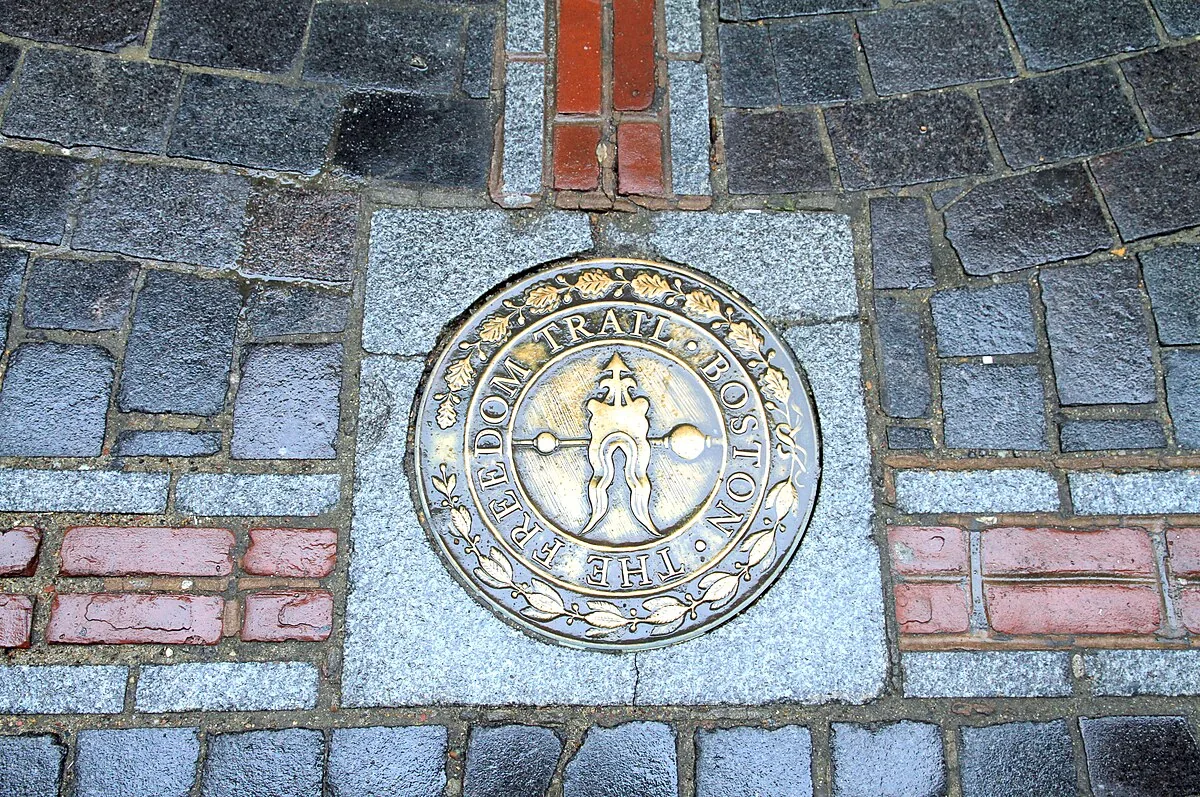
A simple line of red bricks, embedded in the winding sidewalks of Boston, is a chronological tether to the birth of a nation. The Freedom Trail is a two-and-a-half-mile walking route that connects sixteen of the most significant sites of the American Revolution. It begins at the lush, sprawling Boston Common and ends across the river at the towering Bunker Hill Monument. Along the way, the trail ducks into 18th-century meeting houses, skirts past the site of the Boston Massacre, and climbs the gangplank of the USS Constitution. This is not a static museum, but a path woven into the fabric of a modern, functioning city, where historic burial grounds sit adjacent to glass-and-steel office towers and high-end cafes.
A simple line of red bricks, embedded in the winding sidewalks of Boston, is a chronological tether to the birth of a nation.
William Schofield, who, 1951
The trail was the brainchild of local journalist William Schofield, who in 1951 suggested a pedestrian path to connect the city's disparate historic landmarks. Before this, many of the sites were falling into neglect or were difficult for tourists to find in Boston's notoriously tangled street layout. The route takes you through the very rooms where Samuel Adams and James Otis argued for independence, such as Faneuil Hall and the Old South Meeting House. It passes the home of Paul Revere, the oldest house in downtown Boston, and the Old North Church, where the lanterns were hung to warn of the British approach. The trail was officially recognized in 1958 and has since become a global archetype for how cities can preserve and present their history in an accessible, walkable format.
The air is a mixture of salty harbor wind and the scent of roasting coffee from the North End’s Italian bakeries. The clatter of the MBTA trains, the chatter of costumed guides, and the occasional blast of a ship’s horn from the waterfront. Walking the trail, the transition from the smooth concrete of the financial district to the bumpy, historic cobblestones of the North End. At once, the contrast between the dark, weathered gravestones of the Granary Burying Ground and the bright, polished brass of the State House dome. The light in the late afternoon catches the red brick of the Old State House, making it glow against the shadows of the surrounding skyscrapers. From the deck of the USS Constitution, the smell of tar and old wood provides a visceral connection to the naval battles of 1812.
The trail is best accessed via the MBTA
The trail is best accessed via the MBTA 'T' system, with the Park Street station being the most logical starting point at Boston Common. Because the trail is a linear path through some of the busiest parts of Boston, driving is strongly discouraged due to the lack of parking and the complexity of the one-way streets. The route is entirely self-guided, marked by a continuous red line on the ground, though many visitors choose to join the popular guided walks led by historians in period dress who provide theatrical context to each stop.
The trail is best accessed via the MBTA 'T' system, with the Park Street station being the most logical starting point at Boston Common.
The Experience
You feel a shiver of history as you stand on the balcony of the Old State House, where the Declaration of Independence was first read to the people of Boston. Audibly, the of your footsteps on the narrow, winding streets of the North End makes the city feel intimate and ancient. The opening note is the weathered detail on the 'tombstones' of Paul Revere and John Hancock, which are surprisingly modest for such towering figures. Just about everyone rush through the North End, but the real charm is stopping for a cannoli while looking at the steeple of the Old North Church. The moment you cross the Charlestown Bridge and see the masts of the 'Old Ironsides' is when the scale of the journey finally hits you.
Why It Matters
The Freedom Trail is the physical manifestation of American democratic ideals. It serves as a narrative spine for the city of Boston, ensuring that the origins of the United States are never more than a few steps away from the present. Culturally, it is the most successful example of heritage tourism in the world, proving that history is best understood when it is walked.
Why Visit
Visit the Freedom Trail because it allows you to inhabit history rather than just observing it through glass. It offers a rare, continuous thread of storytelling that connects the 17th, 18th, and 21st centuries in a single afternoon. You go for the history, but you stay for the vibrant, living neighborhoods that have grown up around these monuments.
✦ Insider Tips
- 1
Do not try to see all sixteen sites in one go; pick four or five to enter and just enjoy the walk past the others.
- 2
The USS Constitution is an active-duty Navy ship, so you will need a valid government ID to board and should expect a security screening.
- 3
Look for the 'Boston Massacre Site' marker near the Old State House; it is often overlooked because it is embedded in the middle of a busy traffic island.
- 4
Visit the Granary Burying Ground just before it closes to avoid the large school groups and experience the eerie silence of the historic graves.