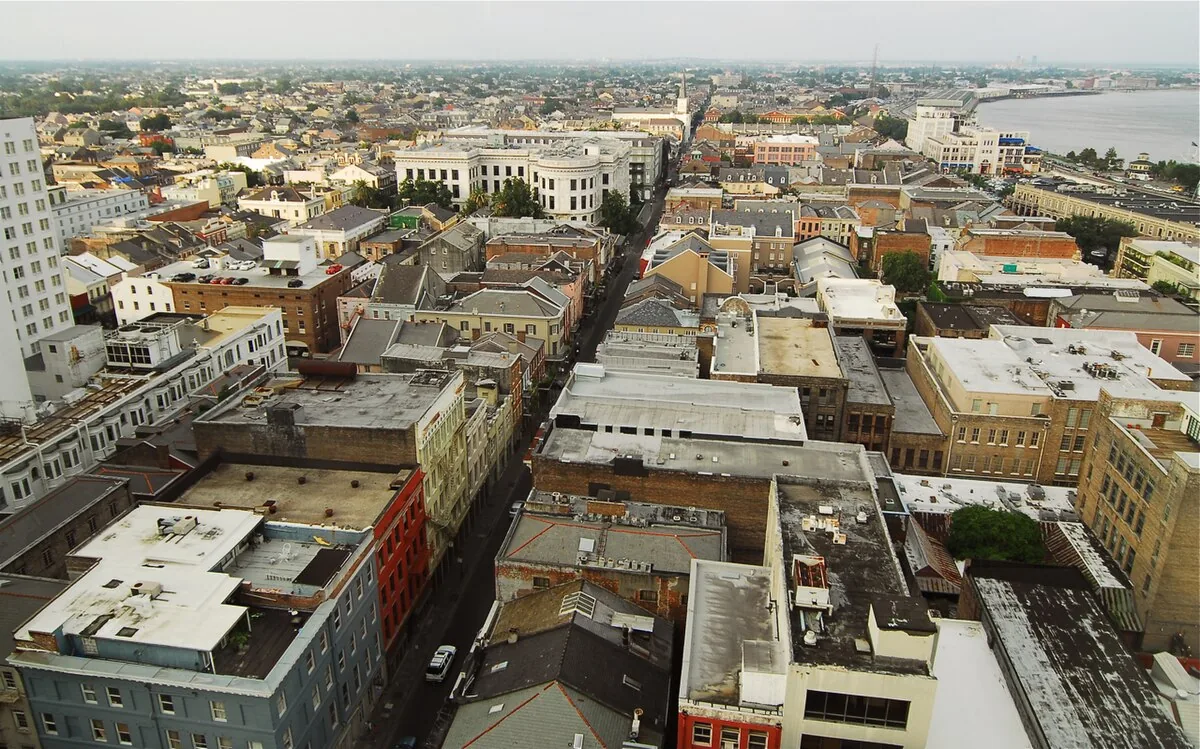
Nearly every building in the French Quarter was actually built by the Spanish after the original French city burned to the ground twice in less than a decade.
About French Quarter
The district served as a strategic military outpost before evolving into a wealthy mercantile hub fueled by the river trade. After the fires, the Spanish implemented strict building codes, requiring thick brick walls and ceramic roof tiles, which created the Mediterranean aesthetic we see today. In the 1800s, the Quarter was a crossroads of Free People of Color, French aristocrats, and Sicilian immigrants, each adding layers to the local cuisine and music. The establishment of the Vieux Carré Commission in 1936 ensured that this architectural gumbo remained untouched by modern skyscrapers.
French Quarter in short
Rainwater dances on cast-iron balconies while the heavy, humid air of the Mississippi River clings to the brightly colored stucco walls of the Vieux Carré. Most people expect a French theme park, but the architecture here speaks a Spanish dialect, a result of the Great Fires that reshaped the district in the late 18th century. Creolized culture defines every square inch of these seventy-eight blocks, from the gas lanterns flickering at midday to the sudden, brassy roar of a second-line parade. Streets like Royal and Chartres offer a quiet, antique dignity that contrasts sharply with the neon chaos of Bourbon Street. Life here moves at a different tempo, dictated by the heat, the cocktails, and a deep-seated respect for the city's ghosts.
“Rainwater dances on cast-iron balconies while the heavy, humid air of the Mississippi River clings to the brightly colored stucco walls of the Vieux Carré.”
French Quarter, United States
Jean-Baptiste Le Moyne de Bienville founded
Jean-Baptiste Le Moyne de Bienville founded the settlement in 1718, choosing a crescent of high ground that had long been a portage site for the indigenous Chitimacha. While the name honors the original French colonists, two catastrophic fires in 1788 and 1794 meant that the Spanish, who ruled the territory at the time, were the ones to rebuild the district with fire-resistant brick and those iconic courtyards. Along the Louisiana Purchase in 1803, the Quarter became a European enclave in an increasingly American city, preserving its Catholic traditions and linguistic quirks. By the early 20th century, the neighborhood had fallen into a state of romantic decay, attracting bohemians like Tennessee Williams and William Faulkner, who helped ignite the preservation movement that protects the district today.
A thick, intoxicating perfume of blooming jasmine, stale beer, and the powdered sugar of fresh beignets. The rhythmic scrape of a washboard player on a street corner and the distant, mournful lowing of a steamship on the river. Down the narrow sidewalks, The uneven texture of the flagstones and the sudden, cool breeze that escapes from a lush, hidden courtyard. Right off, the intricate patterns of the ironwork, which cast geometric shadows against the weathered facades. The light at dusk turns the Mississippi a muddy gold, while the streetlights begin to cast a soft, cinematic glow over the damp pavement. From Jackson Square, the three spires of St. Louis Cathedral loom with a quiet, chalky whiteness against the deepening purple sky.
Arrival into New Orleans usually happens
Arrival into New Orleans usually happens via Louis Armstrong International Airport, followed by a twenty-minute drive into the city center. Once inside the Quarter, cars are more of a liability than an asset due to the pedestrian-only zones and tight alleyways. The St. Charles Streetcar, the oldest continuously operating line in the world, provides a scenic entry point from the Garden District, dropping you right at the edge of Canal Street. Walking remains the only way to absorb the neighborhood's sensory details, though a mule-drawn carriage offers a slower, historical perspective.
“Arrival into New Orleans usually happens via Louis Armstrong International Airport, followed by a twenty-minute drive into the city center.”
The Experience
You feel the city's pulse change as you move from the morning's quiet coffee rituals to the evening's neon-lit jazz frenzy. Audibly, the of a lone trumpet echoing off the brick walls in a quiet alleyway creates a cinematic stillness that stays with you. The opening note is the small details, like the 'horse hitches' still embedded in the curbs and the way the humidity makes the paint peel in artful, colorful flakes. People generally look at the balconies, but the real heart of the Quarter is behind the heavy wooden doors, where private fountains splash in shaded gardens. The moment the sun sets and the gas lamps hiss to life is when the neighborhood feels most like its 19th-century self.
Why It Matters
The French Quarter is a rare surviving example of a colonial Latin city in the United States. It functions as a living archive of Creole culture, architecture, and music that cannot be found anywhere else. Culturally, it is the birthplace of jazz and proof of the endurance of community through floods, fires, and the relentless passage of time.
Why Visit
The textures and the timing. You can’t replicate the feeling of a New Orleans afternoon anywhere else, where the boundaries between public and private life dissolve over a Sazerac. It is the only place where history feels like a participant in the conversation rather than a museum exhibit.
Insider Tips
- 1
Walk the Quarter at sunrise to see the streets being hosed down and the architecture in its purest, quietest state before the crowds arrive.
- 2
Avoid Bourbon Street after dark if you want to hear real music; head instead to the clubs on Frenchmen Street just across Esplanade Avenue.
- 3
Look for the 'scupper' holes at the base of the buildings, designed to drain the frequent and sudden torrential rains of the Gulf Coast.
- 4
Eat your beignets at the back of Cafe Du Monde to watch the river traffic while you avoid the longest tourist lines at the front.
- 5
Tuck into the Historic New Orleans Collection on Royal Street for a free look at the intricate maps that charted the city's early survival.