“Inside this modest red-brick room, fifty-six men signed a document that was effectively their own death warrant if the revolution failed.”
About Independence Hall
The building was the tallest in Philadelphia when it was completed, its steeple serving as a landmark for ships on the Delaware River. During the British occupation of Philadelphia in 1777, the hall was used as a prison and a hospital for American POWs, many of whom died within its walls. The Liberty Bell, which originally hung in the tower, was rung to mark the first public reading of the Declaration in Independence Square. In 1948, the hall became the centerpiece of the first National Historical Park in the U.S., and in 1979, it was designated a UNESCO World Heritage site for its global impact on the development of democracy.
What Independence Hall actually is
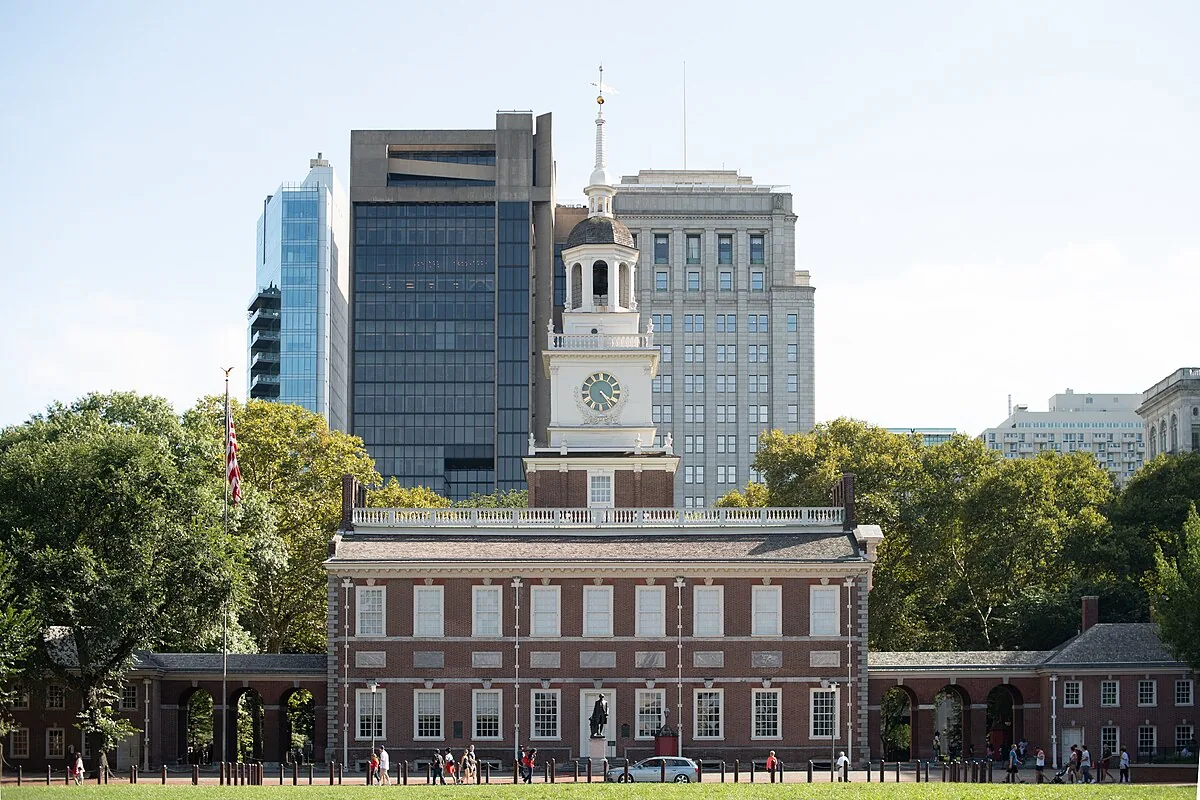
In central Philadelphia's historic district, a red-brick Georgian building with a white steeple is the delivery room of the United States. Independence Hall is where both the Declaration of Independence and the U.S. Constitution were debated and signed, making it the most politically significant structure in the nation. The architecture is a study in 18th-century restraint, with symmetrical windows and a modest bell tower that once housed the Liberty Bell. Inside, the Assembly Room is preserved with period-accurate furniture, including the 'Rising Sun' chair where George Washington presided over the Constitutional Convention. It is a surprisingly small space for the birth of such vast ideas, a place like a quiet library where a very loud argument once took place.
In central Philadelphia's historic district, a red-brick Georgian building with a white steeple is the delivery room of the United States.
Originally built as the Pennsylvania State House
Originally built as the Pennsylvania State House in 1732, the building was designed by Edmund Woolley and Andrew Hamilton to house the colonial government. In 1775, it became the meeting place for the Second Continental Congress, where a group of wealthy radicals decided to commit treason against the British Crown. Thomas Jefferson wrote the Declaration in a nearby boarding house, but it was within these brick walls that the words were finally approved in the sweltering heat of July 1776. Eleven years later, the same room hosted the Constitutional Convention, where delegates spent four months in secret sessions creating a new framework for government. The building narrowly escaped demolition in the early 19th century when the city of Philadelphia bought it from the state to preserve it as a shrine to the revolution.
The air is cool and smells faintly of linseed oil and old paper. The rhythmic, hollow clack of shoes on the original heart-pine floors and the distant tolling of the clock in the tower. Through the Assembly Room, The intimacy of the space, realizing that the founders were sitting close enough to touch one another while they argued. Leading with the green baize cloths on the tables and the quill pens, which make the room look like the occupants just stepped out for a meal. The light filters through the large windows, illuminating the dust motes in a way that makes the room feel like an old oil painting. Within the hallway, the transition from the noisy modern city outside to this quiet, preserved 1700s interior is jarring and profound.
Independence Hall is located on Chestnut
Independence Hall is located on Chestnut Street between 5th and 6th Streets in Independence National Historical Park. It is easily accessible via Philadelphia’s SEPTA subways and buses, specifically the 5th Street/Independence Hall station on the Market-Frankford Line. Entry is by timed tour only, and tickets are required year-round. While the tickets are free, they often sell out early in the day, so reserving them online in advance is the only way to guarantee a spot inside the Assembly Room.
Independence Hall is located on Chestnut Street between 5th and 6th Streets in Independence National Historical Park.
The Experience
An odd surge of civic gravity as you look at the 'Rising Sun' chair, remembering Benjamin Franklin’s observation that the sun on the backrest was rising, not setting, on the new republic. The hum of the tour guide’s voice is the only thing that breaks the stillness of the Assembly Room, where the air feels thick with the ghosts of Hamilton, Madison, and Adams. The small fireplaces that would have been the only source of heat during the brutal Philadelphia winters. The most memorable moment is standing in the long corridor and looking through the back door into the square, imagining the roar of the crowd when the Declaration was first read aloud. It is a place that makes the 18th century feel reachable.
Why It Matters
Independence Hall is the secular birthplace of modern democracy. It is where the transition from subject to citizen was first codified in law. Culturally, it remains the standard-bearer for American identity, its simple red-brick walls representing the transition from monarchical rule to a government of the people.
Why Visit
Visit Independence Hall because it is the only place where you can stand in the actual room where the American experiment began. Unlike museums that show you artifacts behind glass, this is the stage itself. It provides a human perspective on the founders, showing that they were just men in a room trying to solve an impossible problem.
✦ Insider Tips
- 1
Arrive at the security screening at least 45 minutes before your timed entry, as the lines can be unpredictably long during peak hours.
- 2
Visit the Liberty Bell Center across the street first; the exhibit provides the necessary emotional context before you enter the Hall.
- 3
Look for the original inkstand on the table in the Assembly Room; it is the one actually used to sign the Declaration and the Constitution.
- 4
Walk through the Great Essentials Exhibit in the West Wing to see original printed copies of the documents after your tour.
- 5
If tickets are sold out, you can still view the exterior and Independence Square, where the first public readings of the Declaration took place.