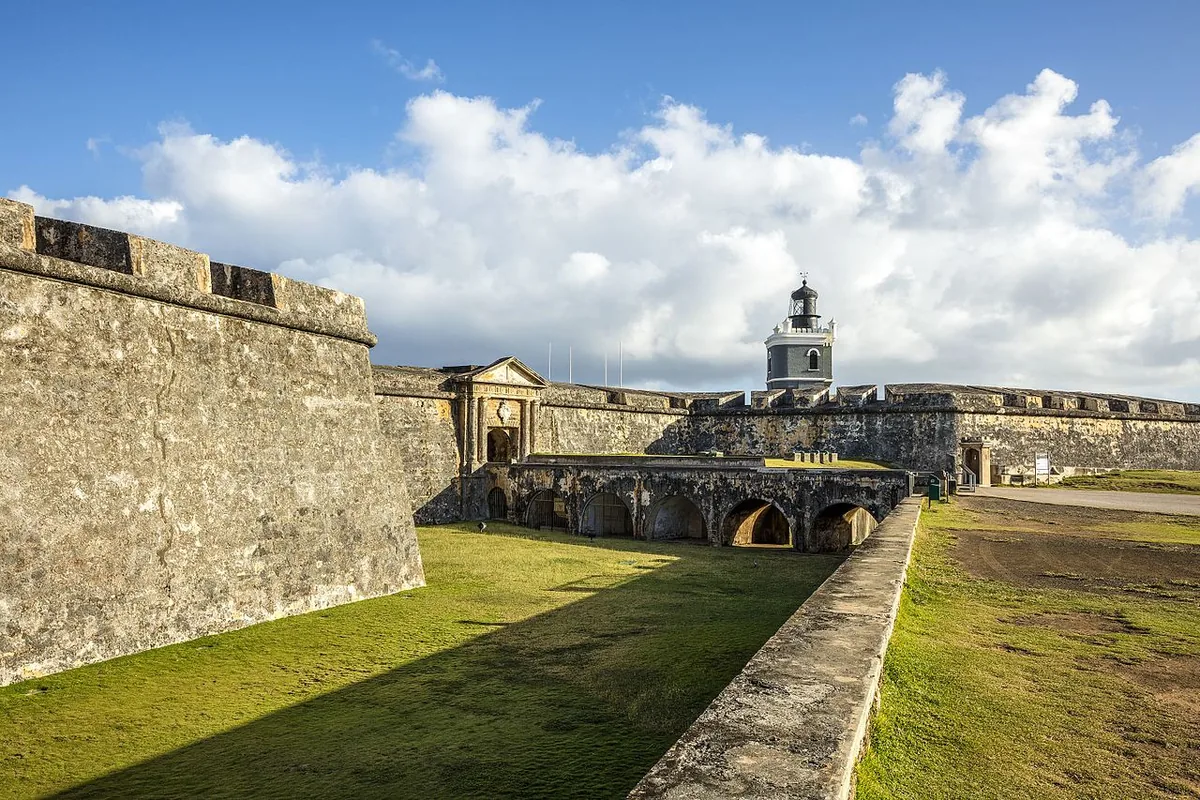
“These walls were so thick and the cannons so numerous that for three centuries, no naval force on earth could successfully fight its way into San Juan harbor.”
About La Fortaleza and San Juan National Historic Site
Work on the walls was a gargantuan task that lasted over 250 years, utilizing stone quarried directly from the coastal cliffs. El Morro's design is a masterpiece of the 'Italian style' of fortification, featuring bastions and batteries that could crossfire on any ship entering the bay. San Cristóbal, completed in 1783, was even more complex, designed as a series of independent defensive layers that could be defended even if the outer walls fell. La Fortaleza, while initially a fort, evolved into a Renaissance-style palace that has housed over 170 governors, representing the continuity of political power on the island.
What this is
Massive sandstone walls rise from the churning Atlantic surf, their weathered surfaces housing five hundred years of Caribbean colonial history. The fortifications of Old San Juan, anchored by the sprawling Castillo San Felipe del Morro and Castillo San Cristóbal, form the most formidable defensive system in the Americas. Connecting these giants is a three-mile curtain of stone and the palatial La Fortaleza, the oldest executive mansion in continuous use in the Western Hemisphere. The site is a labyrinth of dark tunnels, dizzying ramparts, and circular sentry boxes known as garitas that look out over the blue horizon. The strategic coldness of military engineering meets the vibrant, salt-stained beauty of the Puerto Rican coast.
Massive sandstone walls rise from the churning Atlantic surf, their weathered surfaces housing five hundred years of Caribbean colonial history.
of San Juan, 1533
Spain began fortifying the islet of San Juan in 1533, recognizing that the deep-water harbor was the 'key to the Antilles.' La Fortaleza was built first, but its location deep inside the bay proved poorly chosen for defense, leading to the construction of El Morro on the rocky headland. Over the centuries, the walls were tested by the British, the Dutch, and eventually the Americans during the Spanish-American War of 1898. Engineers constantly expanded the site, adding the 'outworks' of San Cristóbal in the late 18th century to protect against land attacks. These walls were so effective that San Juan became known as the 'unconquerable city,' remaining a Spanish stronghold until the island was ceded to the United States.
The air is a constant battle between the humid tropical heat and the fierce, salt-laden trade winds that whip across the grass-covered esplanades. From somewhere comes the rhythmic crashing of waves against the base of the cliffs and the snapping of the massive flags atop the ramparts. Inside the interior tunnels of San Cristóbal, the sudden drop in temperature and the damp, claustrophobic weight of the masonry. Straight away, the hundreds of colorful kites, or chiringas, flown by local families on the vast lawn in front of El Morro, their strings dancing in the Atlantic gale. The light at mid-afternoon turns the sandstone a deep, fiery orange, contrasting with the brilliant turquoise of the sea. From a garita, the view of the horizon makes like a 17th-century sentinel watching for the white sails of a hostile fleet. The historic site is located on the western tip of Old San Juan, easily reached by taxi or rideshare from the main cruise ship piers or the Luis Muñoz Marín International Airport. A free trolley service circulates through the old city, dropping visitors at the entrances to both major forts. The district is best explored on foot, though the steep cobblestone streets and intense sun require a slow pace and frequent stops in the shaded plazas.
The Experience
You feel the immense scale of the Spanish Empire as you climb the spiral ramps designed for dragging heavy cannons to the upper tiers. The sound of the wind through the gun ports is a haunting, lonely noise that reminds you of the soldiers who spent years stationed in these stone rooms. The opening note is the 'Devil's Sentry Box,' a garita perched dangerously close to the sea, where legends say sentinels would mysteriously vanish during the night. Most people focus on the forts, but the walk along the Paseo del Morro at sea level gives you a terrifying sense of how high the walls actually are. The moment when the sun sets behind the lighthouse is the time when the stone seems to hold the most history.
You feel the immense scale of the Spanish Empire as you climb the spiral ramps designed for dragging heavy cannons to the upper tiers.
Why It Matters
This site is the premier example of Spanish military architecture in the New World and a UNESCO World Heritage site. It represents the centuries-long struggle for control over the Caribbean and the bridge between European imperial ambitions and the development of a distinct Puerto Rican identity. It is a physical record of the island's transition from a military outpost to a modern commonwealth.
Why Visit
It is the only place in the United States where you can walk through a genuine medieval-style walled city. It offers a scale and an age that feels more European than American, all set against a dramatic tropical backdrop. You go to see the point where the Old World stopped and the New World began.
✦ Insider Tips
- 1
Buy one ticket at El Morro and use it to get into San Cristóbal for free on the same day; they are part of the same National Park unit.
- 2
Walk the 'Paseo del Morro' trail outside the city walls at sunset for the most dramatic views of the fortress rising from the ocean.
- 3
Look for the ancient graffiti inside the tunnels of San Cristóbal, including drawings of Spanish ships carved into the stone by bored soldiers.
- 4
Visit the Santa María Magdalena de Pazzis Cemetery, located just outside the walls, to see the stunning white marble tombs against the blue sea.