What started as a desperate public protest over the price of onions in 1907 evolved into a nine-acre labyrinth that now is the heartbeat of the Pacific Northwest.
About Pike Place Market
Pike Place has survived fires, the Great Depression, and the forced internment of its many Japanese-American farmers during World War II. The market's 'Down Under' was once a series of stables and storage areas, now transformed into a rabbit warren of shops selling everything from magic tricks to vintage comic books. In 1971, the market became the birthplace of a small coffee shop called Starbucks, which still operates its original storefront nearby. The 1971 voter initiative that saved the market also created a historic district, protecting its unique character from the skyscrapers that now hem it in on three sides. It is a rare example of a public space that has successfully resisted gentrification by focusing on the 'meet the producer' philosophy.
A neon 'Public Market' sign glows red over
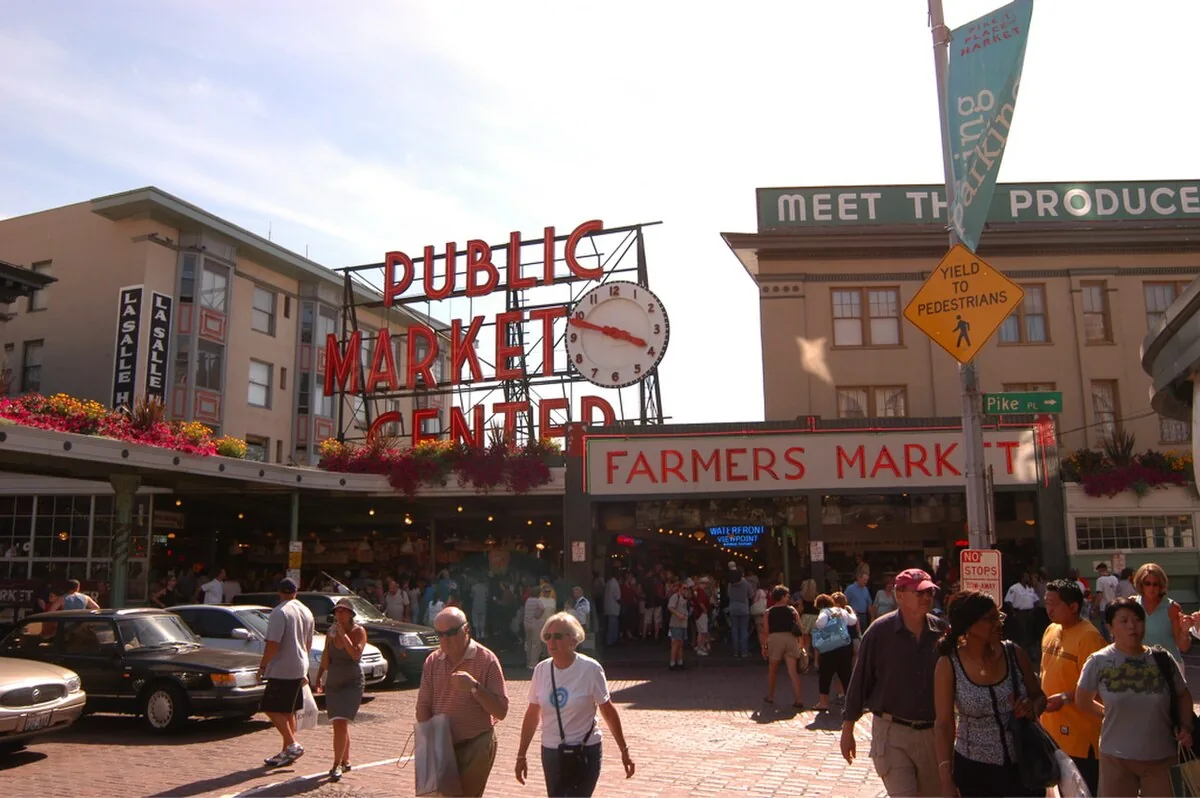
A neon 'Public Market' sign glows red over the cobblestones of Pike Place, marking the entrance to a chaotic, multi-level maze of commerce and culture. Pike Place Market is the soul of Seattle, a sprawling collection of farmer's stalls, fishmongers, artisan shops, and hidden restaurants overlooking Elliott Bay. Unlike the sterile shopping malls of the suburbs, this is a tactile, sensory explosion where the floor is often wet from melted ice and the air smells of lilies and smoked salmon. Here a giant bronze pig named Rachel is a collection box for social services, and where the 'flying fish' are not a gimmick but a high-speed efficiency of trade. From the famous gum wall in the basement to the rooftop gardens, the market is a vertical city within a city.
market was born, 1907
The market was born in 1907 out of a populist revolt against soaring onion prices. Disgruntled citizens demanded a place to buy directly from farmers, bypassing the middlemen who were price-gouging the city's residents. On the first day, only eight farmers showed up with their wagons, but they were nearly mobbed by ten thousand eager shoppers who bought everything in minutes. In the 1960s, the market narrowly escaped being demolished for a concrete office park, saved by an architect named Victor Steinbrueck and a grassroots 'Save the Market' campaign. Today, it remains one of the oldest continuously operated public farmers' markets in the United States, governed by a charter that ensures it remains a place for 'the small guy' to do business.
The air is a dizzying swirl of fresh roasted coffee, salty sea breeze, and the sweet, heavy musk of thousands of cut flowers. In your ears is the rhythmic, booming shouts of the fishmongers, the clatter of wooden crates, and the eclectic music of street buskers echoing through the covered arcades. Through the lower levels, the cool, damp air of the 'Down Under' and the smooth, worn wood of the railings. The vibrant piles of seasonal produce, glossy cherries in June, deep orange pumpkins in October, arranged with artistic precision. The light filters through the glass-topped stalls in dusty shafts, illuminating the faces of locals and tourists alike. At the railing of the North Arcade, the view of the ferries crossing the Puget Sound provides a moment of calm above the market's internal frenzy.
The market is located
The market is located at the foot of Pike Street on the Seattle waterfront, easily accessible on foot from any downtown hotel. The Link Light Rail stops at Westlake Station, which is just a four-block walk from the market entrance. For those arriving by ferry, the walk up from the Colman Dock is steep but takes you through the newly revitalized waterfront park. Parking is notoriously difficult and expensive in the immediate vicinity, so using public transit or a rideshare service is highly recommended to avoid the headache of the narrow, one-way streets.
The Experience
A surge of energy the moment you step under the clock, where the noise of the city is replaced by the roar of the market. The hum of a salmon hitting a scale after a thirty-foot toss is a uniquely Seattle percussion. The secret gardens on the upper decks where residents grow vegetables in the middle of the commercial chaos. The bulk of visitors stay on the main level, but the real treasure is found in the 'Down Under' levels, where the shops are weirder and the air is quieter. The moment you find a seat at a hidden counter with a view of the water and a bowl of chowder is when you truly understand why people never want to leave.
Why It Matters
Pike Place Market is more than a tourist destination; it is a vital social service hub and a bastion of independent business. It houses low-income seniors, operates a medical clinic, and provides a preschool, all funded by the activity of the stalls. Culturally, it is the anchor of Seattle’s identity, representing the city’s roots in labor, agriculture, and maritime trade.
Why Visit
Visit Pike Place because it is the antithesis of a sanitized, corporate experience. It is messy, loud, and undeniably authentic. You go for the fish-throwing and the original Starbucks, but you stay for the incredible diversity of food and the chance to buy a bouquet of flowers that costs less than a latte.
✦ Photo Gallery
Best Season
🌤 September is the best time to visit, as the harvest is at its peak with Washington apples and dahlias, and the summer crowds have finally begun to dissipate.
Quick Facts
Best time to visit
September is the best time to visit, as the harvest is at its peak with Washington apples and dahlias, and the summer crowds have finally begun to dissipate.
Getting there
In Seattle, United States; reach Seattle first, then continue to the site.
Location
Seattle, United States
Type
attraction
Coordinates
47.6094°, -122.3417°
Insider Tips
- 1
Go before 9:00 AM to see the farmers setting up their stalls and to enjoy the market before the cruise ship crowds arrive.
- 2
The 'Gum Wall' is located in Post Alley under the market; it is gross, colorful, and makes for a strangely compelling photo.
- 3
Skip the massive line at the 'original' Starbucks and go to the Pike Place Roast counter inside the market for better coffee and zero wait.
- 4
Look for the staircase leading down to the 'Secret Garden' on the western side of the market for a quiet place to eat your market finds.
- 5
Carry small bills; while many vendors now take cards, the flower and produce stalls operate much faster if you have cash ready.