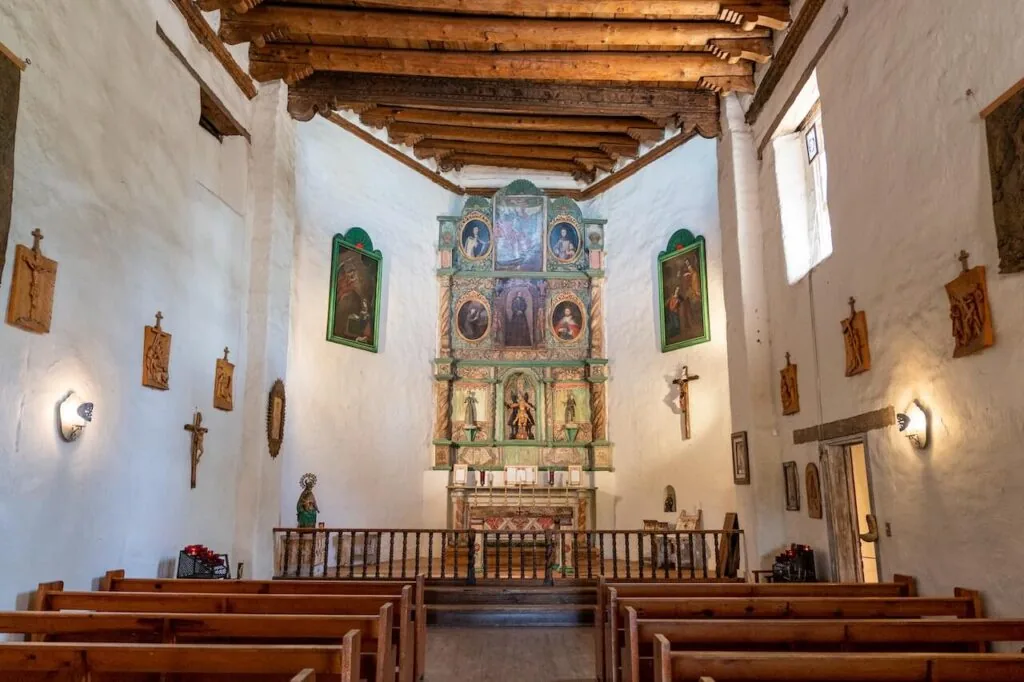
Hidden within these humble mud walls is a bell that weighs nearly eight hundred pounds and a ceiling held up by timbers that were already old when the American Revolution began.
About San Miguel Chapel
San Miguel was built by and for the Tlaxcalan people, whose particular fusion of indigenous Mexican and Spanish traditions defined the early culture of the region. The chapel’s survival is a minor miracle; after the 1680 revolt, it stood as a roofless ruin for over a decade before being re-roofed in 1710. The altar screen was installed in 1798 and features a statue of Saint Michael the Archangel that was carved in Mexico. In the 1950s, a major restoration revealed the original stone foundations, proving that the chapel’s site had been sacred even before the first adobe bricks were laid.
Adobe walls nearly five feet thick provide
Adobe walls nearly five feet thick provide a cool, silent refuge from the high-desert sun of Santa Fe. San Miguel Chapel, often cited as the oldest church in the continental United States, is a humble brown structure that anchors the historic Barrio de Analco. Unlike the grand cathedrals of the East Coast, this is a building of earth, straw, and heavy timber, reflecting the architectural survival tactics of the early Spanish colonists and their Tlaxcalan allies. The interior is dim and intimate, lit by candles that flicker against 18th-century buffalo-hide paintings and a massive wooden reredos. The weight of centuries is physically felt in the uneven floors and the scent of old wood, a small but mighty survivor of revolts, neglect, and the desert's harsh elements.
Construction likely began, 1610
Construction likely began around 1610, shortly after the founding of Santa Fe, to serve the Tlaxcalan Indians who accompanied the Spanish from Mexico. The original chapel was partially destroyed in 1680 during the Pueblo Revolt, a massive indigenous uprising that forced the Spanish to flee the territory for twelve years. When the Spanish returned in 1692, they rebuilt the chapel, adding the massive 'San José' bell in the mid-19th century. Over the years, the building has been encased in brick to protect the adobe from erosion and then painstakingly restored to its traditional appearance. It remains an active site of pilgrimage and prayer, a continuous thread of faith that has survived through four different national flags.
The air is still and smells of beeswax , pinon smoke, and the dry, dusty scent of sun-baked adobe. From somewhere comes the occasional, heavy tolling of the historic bell and the rhythmic creak of the ancient wooden floorboards under your feet. Walking toward the altar, The sudden silence of the thick walls, which block out the noise of the surrounding city as effectively as stone. The primitive, soulful carvings on the vigas, the massive ceiling beams, which were hewn by hand four hundred years ago. The light is soft and golden, filtering through small windows that emphasize the shadows in the corners of the nave. Within the center of the chapel, the intimacy of the space makes less like a tourist and more like a participant in a very old ritual.
The chapel is located on Old
The chapel is located on Old Santa Fe Trail, just a few blocks south of the main Plaza. It is a primary landmark in the Barrio de Analco, Santa Fe's oldest residential neighborhood, and is easily reached on foot from most downtown hotels. For those arriving from outside the city, the Rail Runner Express train connects Albuquerque to the Santa Fe Depot, from which the chapel is a pleasant fifteen-minute walk through the historic district.
The Experience
A profound sense of the desert's quiet as you step inside, the temperature dropping ten degrees instantly thanks to the massive adobe insulation. Audibly, the of your own breathing becomes audible in the stillness, punctuated only by the crackle of a votive candle. The incredible detail on the 'San José' bell, which sits on the floor of the nave rather than in the tower to protect its fragile weight. The moment you ring the bell and hear its deep, cracked resonance is when the history becomes real. Most people spend five minutes here, but the real power of the place is found by sitting in a back pew and watching the light move across the ancient paintings.
Why It Matters
San Miguel Chapel is the architectural heart of the Indo-Hispanic Southwest. It represents the confluence of Spanish, Mexican, and Puebloan cultures and serves as the oldest surviving evidence of European settlement in the American interior. Culturally, it is a monument to the resilience of the adobe tradition and the enduring spiritual life of the New Mexican people.
Why Visit
Visit San Miguel because it is the antithesis of the modern megachurch. It is small, dark, and made of the very earth it stands on. It offers a rare opportunity to see a building that has been continuously maintained by the same community for over four centuries, providing a sense of permanence that is hard to find in America.
✦ Photo Gallery
Best Season
🌤 December is magical; the neighborhood is lined with farolitos and the smell of woodsmoke from nearby fireplaces makes the walk to the chapel feel like stepping back in time.
Quick Facts
Best time to visit
December is magical; the neighborhood is lined with farolitos and the smell of woodsmoke from nearby fireplaces makes the walk to the chapel feel like stepping back in time.
Getting there
In Santa Fe, United States; reach Santa Fe first, then continue to the site.
Location
Santa Fe, United States
Type
attraction
Insider Tips
- 1
Ask the docent for a wooden mallet to gently strike the 'San José' bell; the sound is unique and is said to bring a blessing to those who hear it.
- 2
Look for the small 'window' in the floor near the altar that shows the original stone and adobe foundations from the 1600s.
- 3
Visit the 'Oldest House' across the street after the chapel to see how the regular citizens of the same era lived in the Barrio de Analco.
- 4
Check the schedule for the occasional acoustic concerts held inside; the thick walls provide some of the best natural sound in Santa Fe.
- 5
Don't miss the 18th-century paintings on buffalo hide and elk skin, which were used because traditional canvas was impossible to get in the frontier desert.