“Savannah is the only city in America that was spared from burning during the Civil War because it was too beautiful for a Union general to destroy.”
About Savannah Historic District
Oglethorpe’s plan was revolutionary because it gave every resident equal access to green space, a concept far ahead of its time. The city’s wealth was built on the cotton trade, which is still evident in the massive warehouses along Factors Walk, where bridges connect the bluffs to the riverfront. After decades of decline in the mid-20th century, the city was revitalized by the Savannah College of Art and Design, which purchased and restored dozens of crumbling historic buildings. Today, the district is a living classroom of architectural styles, from Greek Revival to Second Empire, all held together by the original 1733 plan. It remains a city that values its ghosts and its gardens in equal measure.
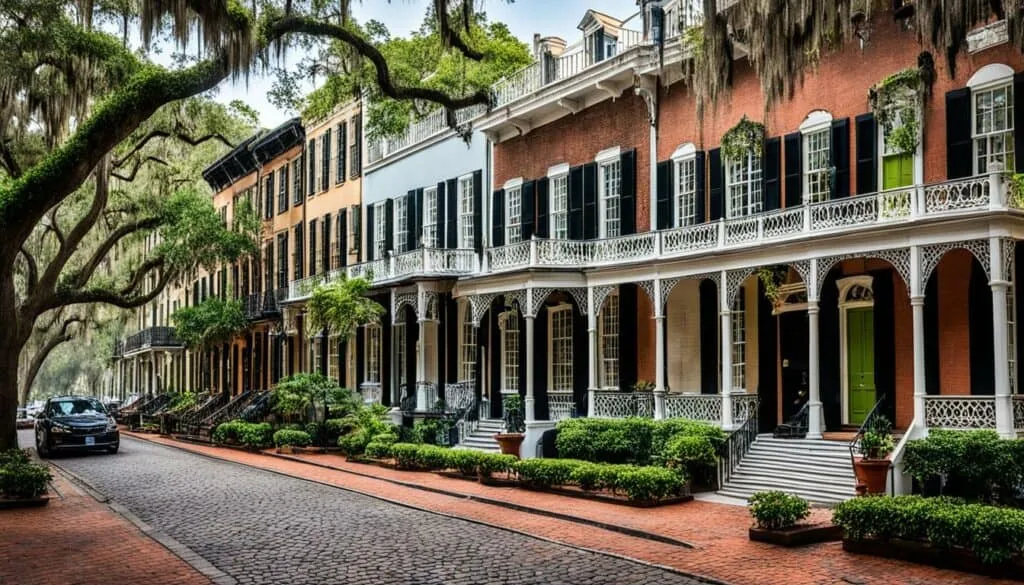
Spanish moss hangs in heavy, grey curtains from the branches of ancient live oaks, casting flickering shadows across twenty-two distinct cobblestone squares. The Savannah Historic District is a masterpiece of urban planning, a grid of green parks and Regency-style mansions that feels more like a shared garden than a city. This is the largest National Historic Landmark District in the United States, where the architecture ranges from the Federal-style Davenport House to the soaring, Gothic-revival spires of the Cathedral Basilica of St. John the Baptist. There is a persistent, genteel decay to the place, where the humidity of the Georgia coast softens the edges of the brickwork and the scent of jasmine drifts through the iron gates. It is a city that has perfected the art of the slow walk and the evening cocktail.
Spanish moss hangs in heavy, grey curtains from the branches of ancient live oaks, casting flickering shadows across twenty-two distinct cobblestone squares.
General James Oglethorpe founded Savannah in 1733,
General James Oglethorpe founded Savannah in 1733, laying out a unique 'Ward' system that integrated public squares into every neighborhood to ensure light, air, and communal defense. Unlike most colonial cities that grew organically into a mess of alleys, Savannah was a deliberate experiment in utopian design. During the Civil War, the city famously escaped destruction when General William Tecumseh Sherman was so moved by its beauty that he offered it as a Christmas gift to President Lincoln rather than burning it. In the 1950s, a group of seven women formed the Historic Savannah Foundation to save the Isaiah Davenport House from being turned into a parking lot, sparking one of the most successful preservation movements in American history.
The air is thick and sweet , a combination of pluvialis mud from the Savannah River and the heavy perfume of Southern magnolias. The rhythmic 'clop-clop' of horse-drawn carriages and the distant, melodic chime of church bells echoing through the squares. The walk along Jones Street, the uneven rise and fall of the old bricks and the sudden, cool dampness that settles under the massive oak canopies. Right off, the 'Savannah Gray' bricks, which have a unique, muted hue because they were made from the local river clay. The light at dusk is ethereal, filtered through the moss to create a greenish-gold glow that makes the city feel like an underwater kingdom. From Monterey Square, the surrounding mansions look like silent witnesses to two centuries of scandals and celebrations.
Savannah/Hilton Head International Airport
Savannah/Hilton Head International Airport is a short twenty-minute shuttle ride from the historic center. Once you arrive, the city is best explored on foot or via the free 'Dot' shuttle that loops through the district. Parking is difficult and discouraged within the historic core, as the narrow streets and squares were designed for pedestrians and horses. For those arriving from the coast, riverboats still dock at River Street, providing a dramatic entry point at the base of the steep stone bluffs.
Savannah/Hilton Head International Airport is a short twenty-minute shuttle ride from the historic center.
The Experience
The sense of peaceful suspension as you sit on a bench in Forsyth Park, watching the water spray from the great white fountain. Sound-wise of the wind through the Spanish moss is a dry, whispering noise that adds to the city’s gothic atmosphere. The 'haint blue' paint on the undersides of porch ceilings, a Gullah-Geechee tradition meant to ward off evil spirits. The majority flock to the River Street bars, but the real heart of the city is in the quiet squares like Calhoun or Troup, where the tourists rarely go. The moment when the cicadas begin their evening chorus is when the city’s Southern humidity feels most like a warm, familiar embrace.
Why It Matters
The Savannah Historic District is a global model for historic preservation and urban design. It preserves not just buildings, but a specific way of living that prioritizes community space and natural beauty. Culturally, it is the guardian of Lowcountry history, blending African, European, and indigenous influences into a unique coastal identity that is reflected in its food, its stories, and its streets.
Why Visit
Visit Savannah because it is the only city in America that feels like it belongs in a dream. It is a place of high drama and slow movements, where the architecture is as lush as the landscape. You go to lose yourself in the squares and find a version of the South that is as sophisticated as it is eccentric.
✦ Insider Tips
- 1
Take advantage of the city's open-container laws in the historic district, which allow you to walk between the squares with a cocktail in a plastic cup.
- 2
Explore 'Factors Walk', the hidden network of bridges and alleys behind the riverfront, to see the original cobblestones made from ships' ballast.
- 3
Book a tour of the Mercer-Williams House to see the setting of the famous book 'Midnight in the Garden of Good and Evil.'
- 4
Avoid the tourist-heavy River Street for dinner and head instead to the restaurants on Broughton or Liberty Street where the locals eat.
- 5
Visit the Bonaventure Cemetery at the edge of the city to see the most spectacular examples of funerary art and moss-draped live oaks.