“The residents of this city spent forty-seven days living in man-made caves to survive a rain of iron, only to surrender on the Fourth of July.”
About Vicksburg National Military Park
Vicksburg was the most important strategic point in the Western Theater, described by Abraham Lincoln as the 'key' to the war. The battle was a test of endurance for both soldiers and civilians, who were reduced to eating mules and rats as supplies ran dry. The National Military Park was one of the first in the country to be meticulously mapped by the veterans themselves, who returned decades later to place markers exactly where their lines had stood. In the 1960s, the USS Cairo was miraculously raised from the bottom of the Yazoo River, providing the world with its only surviving example of a City-class ironclad. Today, the park serves as a bridge between the trauma of the past and the peaceful, rolling landscape of the modern South.
Vicksburg National Military Park in United States
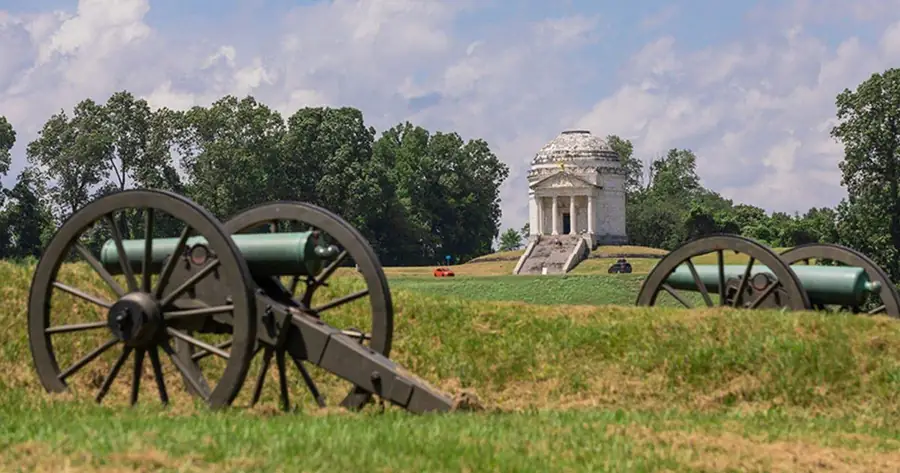
Rolling green hills, deeply scarred by trenches and earthworks, overlook a bend in the Mississippi River where the fate of the American Civil War was decided. Vicksburg National Military Park is a sixteen-mile loop of memory, dotted with over 1,300 monuments, markers, and plaques that commemorate the forty-seven-day siege of 1863. This is a landscape of profound topographical complexity, where the steep loess bluffs provided a natural fortress for the Confederate defenders. The park is home to the USS Cairo, a salvaged Union ironclad that looks like a ghost ship rising from the earth under its massive protective canopy. The strategic importance of the 'Gibraltar of the Confederacy' is made visible through the sheer effort required to traverse its terrain.
Rolling green hills, deeply scarred by trenches and earthworks, overlook a bend in the Mississippi River where the fate of the American Civil War was decided.
General Ulysses S
In the summer of 1863, General Ulysses S. Grant realized that taking Vicksburg was the key to split the Confederacy in two and gain control of the Mississippi River. After several failed direct assaults, he settled into a brutal siege that forced the city's residents to live in caves to escape the constant Union shelling. On July 4, 1863, the same week as the Union victory at Gettysburg, the city finally surrendered. The park was established in 1899 to preserve the site for historical study and as a memorial to the soldiers from both sides. Many of the most elaborate monuments were funded by individual states, resulting in a unique open-air gallery of late 19th-century sculpture and architecture that tells the story of each regiment’s experience.
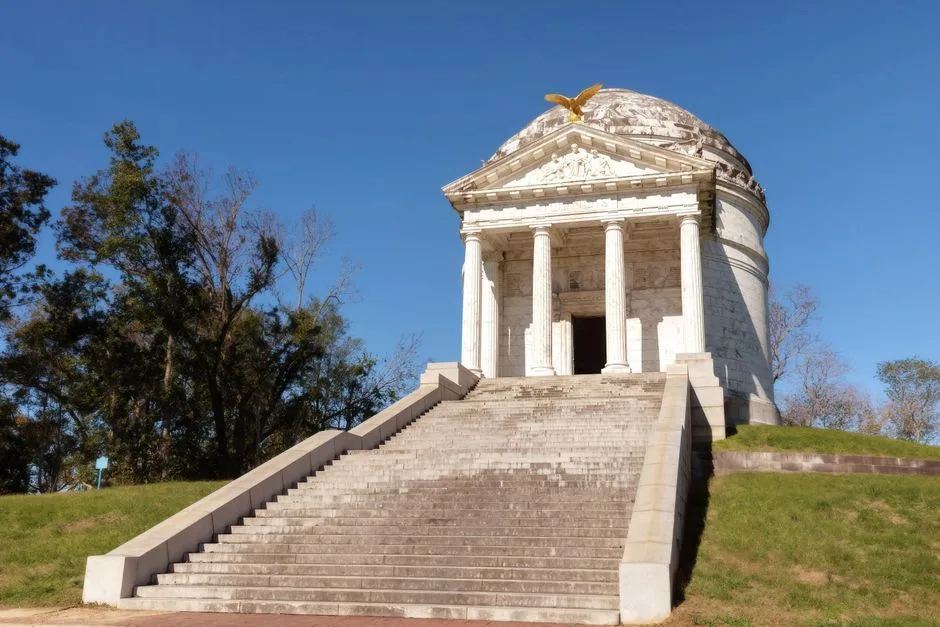
The air is often heavy and humid, smelling of damp earth and the sweet, thick scent of Southern magnolias. In your ears is the constant, shrill buzz of cicadas and the occasional call of a red-tailed hawk circling the open fields. Tracing the tour road, The dramatic steepness of the ridges and the claustrophobic depth of the remaining trenches. What you catch first is the stark contrast between the white marble of the Illinois State Memorial and the dark, rusted iron of the USS Cairo's cannons. The light at mid-afternoon filters through the Spanish moss of the cemetery’s trees, creating long, somber shadows across the rows of small, square headstones. From the Shirley House, the only wartime structure left in the park, the domesticity of the building against the backdrop of earthworks is a haunting visual irony.
The park is located just off
The park is located just off Interstate 20 in Vicksburg, Mississippi, making it an easy stop for those traveling between Jackson and Shreveport. The visitor center marks the beginning of the one-way tour road, which is best navigated by car or bicycle due to the intense hills and humidity. For those who want a deeper understanding, the park offers a cell phone tour that provides audio accounts of the battle at various stops, though hiring a licensed battlefield guide for a private car tour is the most immersive way to navigate the complex history and geography.
The park is located just off Interstate 20 in Vicksburg, Mississippi, making it an easy stop for those traveling between Jackson and Shreveport.
The Experience
You feel a heavy, contemplative silence as you enter the Vicksburg National Cemetery, where over 17,000 Union soldiers are buried, most in graves marked only by a number. Sound-wise of the wind through the pines is the only thing that breaks the stillness of the ridges. The standout is the incredible craftsmanship of the monuments, from the soaring obelisks to the life-sized bronze figures of weary infantrymen. Most people spend their time at the USS Cairo, but the real power of the park is found by walking into the woods to find the original Confederate earthworks. The moment you look out from the bluffs and see how the river has shifted its course since 1863 is when the passage of time becomes truly tangible.
Why It Matters
Vicksburg is the site where the American Civil War was strategically won. It represents the transition to modern 'total war' and the immense human cost of national reunification. Culturally, it is a significant repository of American commemorative art and a somber reminder of the fragility of peace.
Why Visit
Visit Vicksburg National Military Park to see the most intensely sculpted battlefield in the world. It offers a geographical lesson in why history happens where it does, providing a visceral sense of the struggle that maps cannot convey. You go for the history, but you stay for the eerie, beautiful stillness of the Mississippi hills.
✦ Insider Tips
- 1
Start your visit at the USS Cairo museum at the far end of the park to avoid the crowds that bunch up at the main entrance visitor center.
- 2
Walk the short trail into the 'Loess' soil cuts to see the unique, vertical-walled canyons that made the terrain so difficult for soldiers to cross.
- 3
Look for the Illinois Monument; you can walk inside the massive dome and hear your own voice echo off the names of every soldier from the state.
- 4
Take the time to drive to the 'South Fort' for a view of the river that explains exactly why the Confederate batteries were so effective.