Under the auroral oval, the temperature often plunges to forty degrees below zero, yet the sight of a neon-green sky makes you forget that your eyelashes have frozen into delicate ice crystals.
About Aurora Village
The land surrounding the village has been a traditional hunting and gathering ground for the Yellowknives Dene First Nation for generations, characterized by its proximity to the mineral-rich waters of Great Slave Lake. In the late twentieth century, this specific patch of the boreal forest was selected for its lack of light pollution and its clear, unobstructed views of the northern horizon. Don Morin established the village at the turn of the millennium, precisely as solar activity was reaching a peak, drawing international attention to the Northwest Territories. The architecture of the tipis was a deliberate choice to honor the nomadic heritage of the region, utilizing a design that has shed wind and snow for centuries. Today, the village operates under a land-use permit that emphasizes environmental stewardship, ensuring that the heavy foot traffic of modern tourism does not scar the ancient mosses and lichens of the taiga.
What Aurora Village actually is
Silhouetted against the indigo velvet of the subarctic sky, twenty-one white tipis glow like enormous paper lanterns from within. Aurora Village sits on the edge of the Canadian Shield, just outside the frontier town of Yellowknife, where the bedrock is billions of years old and the air is so dry it crackles. This landscape is a cathedral of spruce and granite, purposefully positioned directly beneath the Auroral Oval. Here, the terrestrial world seems to shrink under the weight of an infinite celestial ceiling. The scent of woodsmoke from traditional wood-burning stoves drifts across the frozen lake, offering a fragrant, warm contrast to the sharp, metallic bite of the northern wind. Every element of this place is designed to facilitate a quiet, reverent observation of the heavens, transforming a rigorous arctic survival experience into a moment of profound stillness.
“Silhouetted against the indigo velvet of the subarctic sky, twenty-one white tipis glow like enormous paper lanterns from within.”
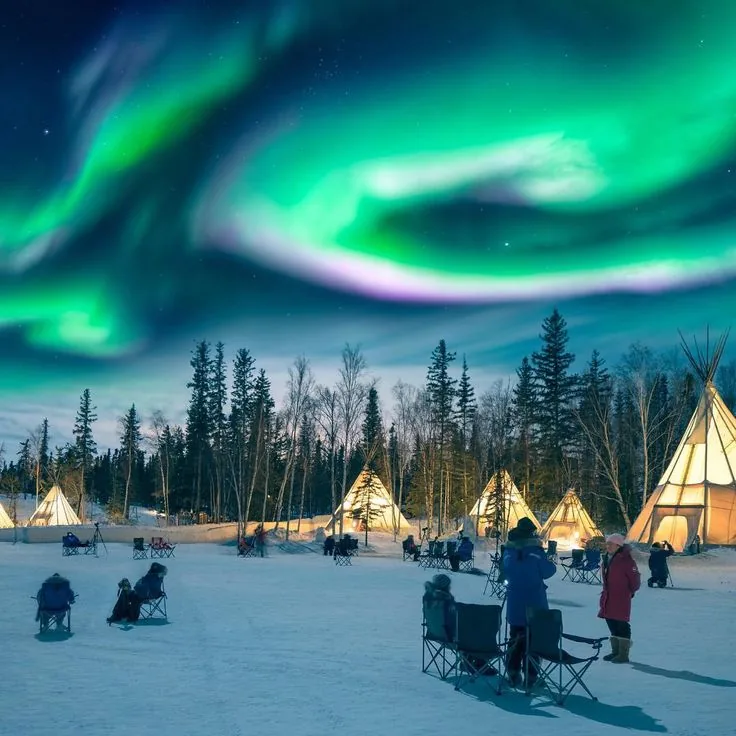
Aurora Village, Canada
Founded this site, 2000
Don and Tessa Morin founded this site in 2000, long before northern lights tourism became a global phenomenon. Don, a former Premier of the Northwest Territories with deep roots in the North, envisioned a place where the grandeur of the tundra could be experienced with the hospitality of a traditional Dene camp. The village began as a modest gathering of tipis but evolved into a world-class destination that respects the delicate ecology of the taiga. It remains a family-owned operation, rooted in the philosophy that the lights are not just a spectacle, but a rhythmic part of the land’s spiritual life. Over the years, the site has was a bridge between high-tech astronomical observation and ancient northern traditions, providing a space where solar winds and cultural stories meet in the dark.
Reaching this remote sanctuary starts
Reaching this remote sanctuary starts with a flight to Yellowknife, a town that is the entry point to the high arctic. From the city center, a shuttle bus navigates the winding Ingraham Trail, a road that carves through the rugged terrain of the Canadian Shield. The journey takes about twenty minutes, moving away from the orange glow of streetlights into a deep, natural darkness. Travelers arrive at a secluded clearing where the trees part to reveal the glowing tipis, a transition like stepping through a portal into a different century. The drive back in the early hours of the morning often features a final display of the lights through the bus windows, a parting gift from the North.
Visiting Aurora Village
The crunch of dry snow under your heavy arctic boots is the only sound that accompanies you walking toward the lake shore. What lands is the way the silence seems to deepen as the temperature drops, a stillness so absolute it feels heavy against your eardrums. Inside the tipis, the roar of the woodstove and the dry heat on your cheeks provide a sanctuary from the forty-below cold outside. You get a rough texture of the canvas and the warmth of a steaming cup of maple tea before the call comes that the sky has begun to move. Stepping back into the night, The first faint, milky ribbons of green stretching across the constellations. A surge of adrenaline as the colors intensify, shifting from lime to emerald and occasionally fringed with a rare, fleeting violet. Almost all visitors are busy adjusting tripods, but the real power of the village is felt when you lie back on a heated viewing seat and let the movement of the sky fill your entire field of vision. Right away, the way the light reflects off the frozen surface of the lake, turning the ice into a shimmering, spectral mirror. The element that stays with you is when the lights begin to 'dance,' pulsing with a frantic, silent energy that makes the stars seem to flicker in time with the cosmic wind. It is a physical realization of the earth’s place in a much larger, wilder universe.
The Experience
The air tastes of pure, biting oxygen and woodsmoke, a combination that heightens every sense as you wait in the dark. The sense is the intense, localized heat of the woodstove through your parka when you duck inside the tipi, a brief respite that makes the return to the cold feel like a fresh adventure. Beginning with the way the snow reflects the green of the sky, turning the entire landscape into a surreal, monochromatic dreamscape. Most travelers overlook the subtle sounds of the ice on the lake, which can groan and pop under the weight of the deep freeze like a living creature. A weight of the silence when the wind stops, a quiet so profound you can hear the beating of your own heart. The moment that stays with you is when the aurora crowns directly overhead, fanning out in all directions like a vibrant, shimmering umbrella of light that makes the vastness of the arctic feel intimately small.
Why It Matters
Aurora Village matters as a premier gateway for understanding the intersection of solar physics and northern cultural heritage. It is a landmark that doesn't rely on stone or steel, but on the preservation of darkness and the celebration of a natural phenomenon. Humanly, it works as a place where people from every corner of the globe gather in shared silence to witness a spectacle that has inspired human wonder since the dawn of time.
Why Visit
This village because it offers the most reliable and comfortable vantage point for the northern lights on the planet. You go to see the sky, but you stay for the experience of the deep arctic winter delivered with a warmth that defies the thermometer. No other location provides this combination of traditional tipi aesthetics and specialized viewing technology in the middle of the auroral zone.
Insider Tips
- 1
Arrive early to secure a spot in the heated outdoor seats, which rotate 360 degrees so you can follow the movement of the lights without standing up.
- 2
Avoid using any white light or flash on your camera, as it ruins the night vision of everyone around you for at least twenty minutes.
- 3
Ask the staff to help you adjust your camera settings inside the tipi before you head out, as fingers become clumsy and batteries drain rapidly in the extreme cold.
- 4
Look for the 'Dene cultural talk' around the fire to understand the traditional stories and names for the lights you are witnessing.
- 5
Wear your base layers and wool socks even inside the heated shuttle, as the cold can seep through the floorboards during the drive out into the wilderness.