“Four centuries of French history sit encased within nearly three miles of British stone ramparts, creating a North American city that speaks with the accent of a Loire Valley village.”
About Vieux-Québec
Champlain’s initial fur-trading post quickly evolved into a sophisticated colonial capital, governed by the Catholic Church and the French Crown until the mid-18th century. The fall of the city in 1759 changed the political map of the continent, yet the subsequent British administration realized that the city's unique geography required a rare hand. Lord Dufferin, the Governor General in the 1870s, famously intervened to stop the demolition of the city walls, arguing that their historic value far outweighed the convenience of modern road expansion. His vision paved the way for the district to be recognized as a UNESCO World Heritage site in 1985. The stone buildings today, many with thick walls designed to withstand both cannon fire and the brutal Canadian winter, represent a architectural hybrid found nowhere else in the world.
What Vieux-Québec actually is
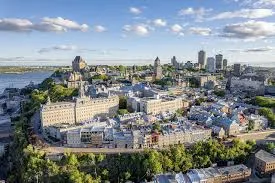
Copper roofs turned sea-foam green by centuries of North Atlantic rain define the silhouette of the only fortified city north of Mexico. Vieux-Québec clings to the granite cliffs of Cap Diamant, a stone sentinel that has spent four hundred years watching the Saint Lawrence River widen toward the sea. Inside the limestone gates feels like a deliberate retreat from the glass and steel of modern Canada into a labyrinth of 17th-century masonry. The Upper Town bristles with military might and the towering presence of the Château Frontenac, while the Lower Town hides in the shadow of the cliff, its narrow streets smelling of woodsmoke and expensive wool. Every footfall on the uneven cobblestones echoes against walls that have survived sieges, fires, and the slow grind of ice ages.
Copper roofs turned sea-foam green by centuries of North Atlantic rain define the silhouette of the only fortified city north of Mexico.
a wooden 'habitation', 1608
Samuel de Champlain chose this narrow point in the river to plant a wooden 'habitation' in 1608, unwittingly founding the heart of New France. The landscape dictated the architecture; the colonists built upward, stacking stone houses along the cliffside to create a tiered society where the clergy and governors looked down from the heights. Throughout the 1700s, the city became a chess piece in the imperial struggle between France and Britain, culminating in the decisive battle on the Plains of Abraham in 1759. When the British took control, they chose to strengthen rather than demolish the French fortifications, creating the massive stone circuit that still encloses the district today. This preservation was not an act of nostalgia but of strategic necessity, ensuring that the French soul of the city remained encased within a British shell.
The air atop the Dufferin Terrace carries
The air atop the Dufferin Terrace carries a sharp, bracing chill even in mid-summer, mixed with the faint, sweet scent of crepes from nearby street vendors. The vibration of the funicular as it hums between the two levels of the city, a mechanical heartbeat connecting the regal heights to the maritime docks below. Light in the late afternoon turns the gray limestone to a warm, buttery gold, illuminating the narrow windows of the Petit-Champlain district. Looking toward the river, the massive scale of the Saint Lawrence makes the colonial ships of the past feel brave and impossibly small. Inside the Notre-Dame des Victoires church, the silence is so heavy The flickering of prayer candles against the stone. At first, the deep ruts in the cobblestones carved by generations of iron-rimmed wheels, a physical record of four centuries of trade. People generally rush to the main squares, but the moment that stays with you is usually found in a quiet alleyway in the Latin Quarter, where the sound of a distant violin competes with the rustle of ivy against an ancient wall. Arrival by rail at the Gare du Palais offers the most cinematic entrance, as the station’s chateau-style architecture prepares you for the stone ramparts just up the hill. Travelers coming from Jean Lesage International Airport can reach the old walls within twenty minutes by taxi, though the true experience begins when you leave the car behind. Navigating the district is a vertical endeavor, best accomplished by wandering the 'Breakneck Steps' or using the funicular to bridge the gap between the cliffside and the shore. Every street is a climb, turning a simple afternoon stroll into a slow-motion discovery of hidden courtyards and tucked-away chapels.
The Experience
The sound of church bells from the Basilica-Cathedral ripples through the streets at noon, momentarily drowning out the clatter of horse-drawn carriages on the stone. You get the temperature drop as you descend into the narrow canyons of the Lower Town, where the cliff face stays damp and mossy even in the dry heat of July. The intricate ironwork of the balconies and the way the locals switch seamlessly between languages in the cafes of Rue Saint-Jean. Most visitors ignore the small details like the 'S' shaped iron ties on the house facades, which were originally designed to pull the stone walls together during the shifting of the earth. You get a weight of the past when you touch the cold, rough cannons along the ramparts, their muzzles still pointed toward the river. The element that lingers is often the walk along the Governor's Promenade at sunset, where the wind coming off the water reminds you that this city was built as a fortress first and a home second.
The sound of church bells from the Basilica-Cathedral ripples through the streets at noon, momentarily drowning out the clatter of horse-drawn carriages on the stone.
Why It Matters
Vieux-Québec serves as the living cradle of French civilization in North America, a cultural bastion that has resisted linguistic and architectural assimilation for centuries. It matters because it is a rare example of a colonial fortified city that remains entirely functional, rather than being relegated to a theme park. Humanly, it represents the endurance of the 'Canadien' spirit, surviving the harshest winters and several empires with its elegance intact.
Why Visit
Go because this is the only place on the continent where you can get lost in a medieval European layout without crossing the Atlantic. While other cities boast 'historic districts,' Quebec’s old soul is not a facade; it is built into the very bedrock of the cliff. You come to see the castle-like hotel, but you stay because the city makes you feel like a character in a centuries-old story.
✦ Insider Tips
- 1
Board the ferry to Lévis just before sunset to capture the most iconic photograph of the city skyline and the Château Frontenac reflecting off the river.
- 2
Walk the full length of the city walls starting at the St. Louis Gate; it offers a view into private hidden gardens that you can't see from the street level.
- 3
Order the 'sucre à la crème' from a local patisserie for a concentrated taste of traditional Quebecois sugar-craft that dates back to the pioneers.
- 4
Enter the Holy Door at the Notre-Dame de Québec Basilica-Cathedral, but check the liturgical calendar as it is only unsealed during specific Jubilee years.
- 5
Seek out the Rue des Remparts for a quieter walk that avoids the main tourist throngs while offering the best perspective of the lower harbor.