“One woman spent twenty years hauling topsoil into a desolate limestone pit, eventually burying her husband’s cement business beneath a million blooming perennials.”
About Butchart Gardens
When the limestone deposits on the Tod Inlet estate were depleted in 1904, Jennie Butchart saw a canvas where others saw a scar. She began by planting sweet peas and ivy to soften the jagged edges of the quarry walls, eventually commissioning designers to help her realize a grander vision of global garden styles. The Japanese Garden, finished in 1912 with the help of Isaburo Kishida, became a masterpiece of water and stone, while the Rose Garden took over the former kitchen vegetable patch in 1929. Throughout the mid-century, the gardens survived the labor shortages of the war years and emerged as a primary engine for Vancouver Island's tourism. In 2004, a century after the first seeds were sown, the site was officially designated a National Historic Site of Canada, honoring its unique status as a monumental achievement in reclamation and design.
About Butchart Gardens
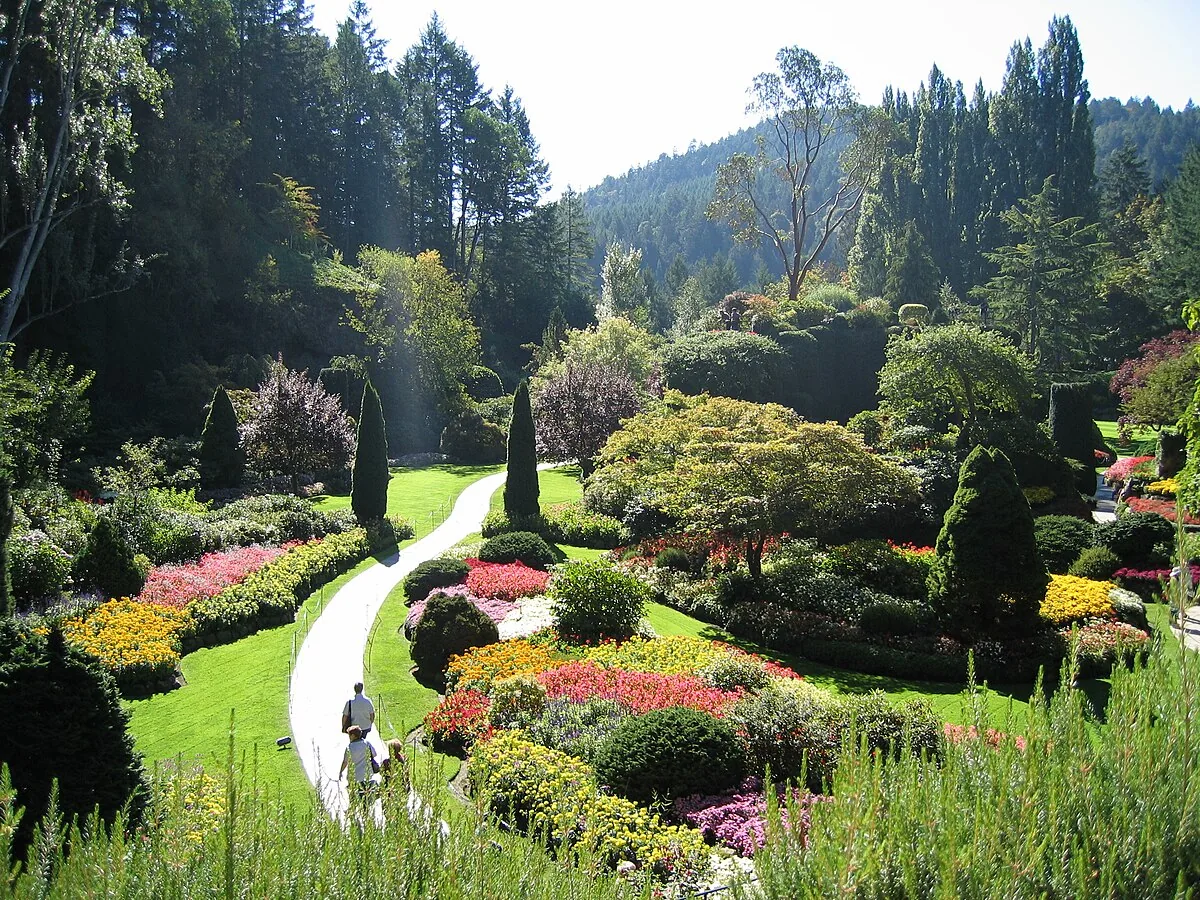
Deep within a jagged limestone scar on Vancouver Island, a lush explosion of flora defies the industrial history of the land. Butchart Gardens represents a rare act of ecological contrition, where a former limestone quarry was painstakingly transformed into a verdant sanctuary. The sheer rock walls that once echoed with dynamite blasts now provide a dramatic, moss-covered backdrop for cascading ivies and meticulously groomed floral displays. Passing through the gates, the air undergoes a sudden shift, thickening with the heavy perfume of thousand-variety roses and the cool moisture of hidden fountains. Every turn reveals a different horticultural world, from the geometry of the Italian Garden to the peaceful, shaded paths of the Japanese Garden, all connected by a common thread of obsessive, generational care.
Deep within a jagged limestone scar on Vancouver Island, a lush explosion of flora defies the industrial history of the land.
began her project, 1904
Jennie Butchart began her project in 1904 out of a simple desire to beautify the desolate pit left behind by her husband’s exhausted Portland cement business. As the quarry reached the end of its useful life, she began hauling in topsoil by horse and cart, literally carpeting the limestone floor with the foundations for what would become the Sunken Garden. Between 1906 and 1929, the estate expanded into a global botanical destination, welcoming the public with a hospitality that became the family's hallmark. The transition from industrial grit to botanical grace was completed in 1921 with the addition of the Italian Garden on the family's former tennis court. Today, the site remains under the private ownership of the Butchart descendants, preserving a legacy that began as a personal garden but evolved into a national historic treasure.
The soundscape is a delicate layer of gravel
The soundscape is a delicate layer of gravel crunching underfoot mixed with the rhythmic splash of the Ross Fountain, which sends plumes of water high into the air. You catch the way the light filters through the giant Western Red Cedars, casting dappled patterns across the velvet-green lawns. The scent profile is an ever-changing fabric; a sudden breeze might carry the sharp citrus of a rare shrub or the deep, musky fragrance of late-blooming peonies. Standing at the lookout above the Sunken Garden, the scale of the transformation becomes visceral as you gaze down into the verdant bowl of the old quarry. The meticulous precision of the edging and the way the colors are grouped to create a sense of movement across the beds. Just about everyone focus on the height of summer, but the true spirit of the place is found in the quiet corners of the Japanese Garden at dusk, where the sound of the stream drowns out the distant chatter of the crowds. What stays with you is watching the thousands of hidden lights flicker to life during an evening walk, turning the petals into glowing lanterns and the trees into towering shadows.
Reaching the gardens involves a twenty-minute
Reaching the gardens involves a twenty-minute drive north from Victoria through the rolling hills and vineyards of the Saanich Peninsula. Many travelers prefer the cinematic approach by water, taking a seaplane or a boat into Brentwood Bay and walking up from the private cove. During the peak months, a shuttle service runs frequently from the Inner Harbour, allowing you to leave the city behind for the floral seclusion of the valley. The entrance is marked by an unassuming gate that gives little hint of the kaleidoscopic world waiting just a few yards beyond the tree line.
Reaching the gardens involves a twenty-minute drive north from Victoria through the rolling hills and vineyards of the Saanich Peninsula.
The Experience
The air feels remarkably still at the base of the Sunken Garden, as if the quarry walls have trapped a century of quiet. What you catch first is the velvet texture of the petals and the absolute absence of dust, proof of the night crews that wash the leaves of the larger trees by hand. A sense of the temperature fluctuate as you move from the open, sun-drenched Italian Garden into the cool, dark canopy of the original forest trails. Most travelers overlook the small bronze plaques that denote the history of the individual trees, some of which were personally planted by the Butcharts over a hundred years ago. The spray from the fountains on a hot afternoon, a sharp, cooling contrast to the heavy floral scents that dominate the air. The piece that lingers is the sight of the garden at night, when the 'Magic of Lanterns' transforms the flora into a surreal, neon-hued landscape that feels like a dream of the Edwardian era.
Why It Matters
Butchart Gardens matters as a physical a product of the power of environmental restoration long before the concept entered the public consciousness. It is a cultural landmark that bridges the gap between the industrial exploitation of the frontier and a modern appreciation for aesthetic preservation. Humanly, it represents a single family's century-long commitment to a landscape that was once considered worthless.
Why Visit
The value here is that this is the only place where you can stand at the bottom of an industrial ruin and see a masterpiece of horticultural engineering instead of rubble. While other gardens are built on flat land, the verticality of the quarry walls gives Butchart a depth and drama that makes every other botanical display feel two-dimensional in comparison.
✦ Insider Tips
- 1
Arrive late in the afternoon to see the transition from daylight to the spectacular evening illumination without having to pay for two separate visits.
- 2
Look for the 'Star Pond' in the Italian Garden, where the points of the star are aligned with the cardinal directions of the estate.
- 3
Book the high tea in the dining room weeks in advance to secure a table overlooking the private gardens of the original Butchart residence.
- 4
Rub the nose of the 'Tacca' bronze boar near the entrance for luck, a tradition that has polished the metal to a brilliant gold over decades.
- 5
Visit the seed shop near the exit to buy the specific 'Butchart Mix' of flower seeds, which are harvested and packaged on-site by the gardening staff.