“More than six hundred tons of luminous Spanish alabaster were hand-carved to create a glowing path that leads visitors from the darkness of the earth toward a spire of pure light.”
About Canadian Museum for Human Rights
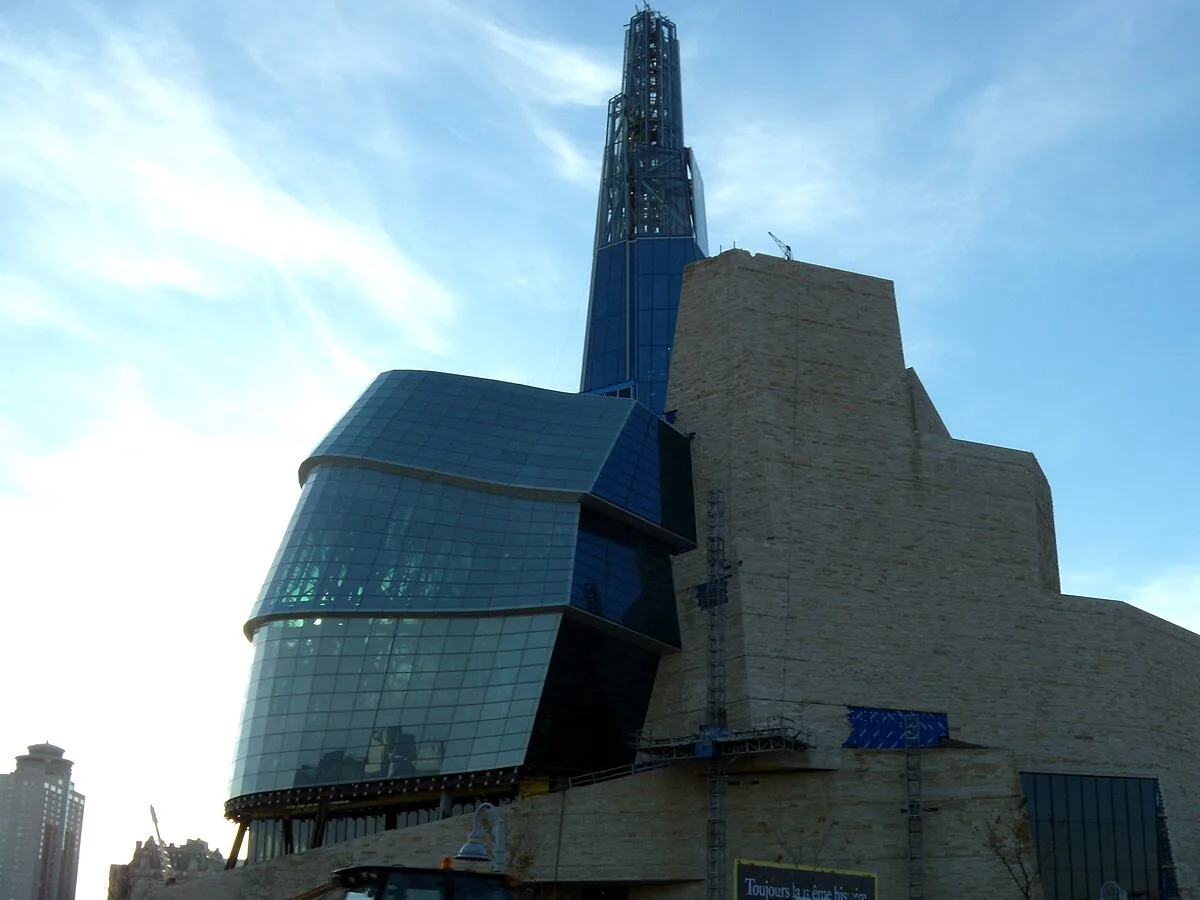
Ground broke on this ambitious project in 2009 after years of spirited debate regarding the museum's content and its placement on land long considered sacred by the Anishinaabe and Cree peoples. Architect Antoine Predock won an international competition with a design that sought to represent the 'humanity in nature,' using local Tyndall stone embedded with prehistoric fossils to connect the structure to the Manitoba landscape. The museum faced significant pressure to balance a multitude of global and domestic human rights narratives, leading to a complex series of galleries that opened to the public in September 2014. Since then, it has functioned as a physical laboratory for social justice, constantly evolving its digital and physical exhibits to reflect contemporary struggles. The construction of the glass 'Cloud' alone took years of precision engineering, as each of the 1,600 panes of glass had to be uniquely cut to fit the twisting, organic shape of the facade.
In brief
Antoine Predock designed a mountain of stone and glass that erupts from the prairie soil at the historic junction of the Red and Assiniboine rivers. The Canadian Museum for Human Rights dominates the Winnipeg skyline not through sheer height, but through a radical, jagged geometry like a geological event. Hundreds of massive glass panes wrap around the structure like the wings of a dove, contrasting sharply with the heavy, dark Tyndall stone base that anchors the building to the earth. Inside, the architecture dictates your emotional journey, forcing you to move from the shadows of subterranean galleries toward the blinding light of the summit. The environment feels cool and quiet, shielded from the prairie winds, while the scent of damp limestone reminds you that you are standing on ground that has been a meeting place for thousands of years.
Antoine Predock designed a mountain of stone and glass that erupts from the prairie soil at the historic junction of the Red and Assiniboine rivers.
the ground broken, 2008
Israel Asper, a philanthropist and media mogul, dreamed of a place that would serve as a global beacon for human rights, though he did not live to see the ground broken in 2008. The site itself, known as The Forks, proved to be an archaeological collection, revealing over 400,000 artifacts that speak to six millennia of Indigenous history. This forced the museum to confront its own themes before a single girder was placed, as the construction required deep sensitivity to the sacredness of the land. Opening its doors in 2014, it became the first national museum established outside of the National Capital Region. The engineering was a colossal feat, requiring over 1,300 tons of glass to create the Cloud, a transparent shroud that symbolizes the fragility and transparency required for justice to flourish.
The journey begins in the darkness
The journey begins in the darkness of the Roots gallery, where the low ceilings and somber lighting evoke the weight of the struggles depicted within. The first thing you register is the texture of the Spanish alabaster ramps that crisscross the central atrium; they glow with a soft, ethereal light, guiding your ascent like ribbons of hope. As you climb higher, the galleries open up, and the stories shift from the heavy silence of systemic oppression to the vibrant, noisy activism of the modern era. Sound-wise is a sophisticated mix of hushed whispers, recorded testimonies, and the distant echo of footsteps on stone. Reaching the Garden of Contemplation provides a physical and emotional pause, where basalt columns and water features offer a sanctuary for reflection. The opening note is the way the light play changes throughout the day, casting sharp, angled shadows across the concrete surfaces. Almost all visitors find themselves drawn instinctively to the Israel Asper Tower of Hope, a glass spire that offers an unobstructed view of the surrounding plains. From the top, The immense scale of the horizon and the quiet power of the rivers below. The piece that stays with you is the transition from the heavy, intellectual labor of the exhibits to the clarity of the summit, where the architecture finally releases you into the sky. Navigating to the museum is an effortless task from anywhere in downtown Winnipeg, as the glass spire acts as a permanent compass. It sits at the heart of The Forks, a busy public space easily reached via the city's transit system or a short walk from Union Station. For those arriving by car, several lots surround the site, though the most atmospheric approach is on foot across the Esplanade Riel bridge. This pedestrian walkway provides the perfect vantage point to watch the museum’s glass skin catch the first or last rays of the sun, turning the building into a glowing lantern against the prairie dusk.
The Experience
The sound of water trickling over black basalt in the Garden of Contemplation offers a rare moment of auditory peace after the intense emotional weight of the galleries. You come across a temperature change as you move from the stone-clad lower levels into the sun-drenched glass upper reaches, a physical manifestation of the journey from shadow to light. You register the way your own shadow stretches across the alabaster ramps, making you feel like an active participant in the architecture rather than just a witness. Most travelers overlook the fossils of ancient sea creatures embedded in the Tyndall stone walls, a silent reminder of the deep time that predates all human conflict. The vastness of the prairie sky through the glass panes of the Cloud, which seems to bring the weather itself into the museum’s interior. The bit that lingers is standing in the Tower of Hope, where the silence is absolute and the 360-degree view of Winnipeg makes the world feel both fragile and remarkably interconnected.
The sound of water trickling over black basalt in the Garden of Contemplation offers a rare moment of auditory peace after the intense emotional weight of the galleries.
Why It Matters
The Canadian Museum for Human Rights is the only museum in the world devoted exclusively to the evolution and celebration of human rights as a global concept. It matters because it shifts the focus from artifacts to ideas, using architecture as a primary storytelling device. Culturally, it serves as a massive, permanent classroom that challenges every visitor to confront the darker chapters of history while offering a tangible path toward collective reconciliation.
Why Visit
See this site because it is an architectural marvel that manages to make the abstract concept of justice feel physical and navigable. You go for the striking silhouette on the skyline, but you stay because the museum forces a visceral, emotional response that few other institutions can replicate. It offers a rare opportunity to stand at the crossroads of history and look forward with a renewed sense of human possibility.
✦ Insider Tips
- 1
Follow the alabaster ramps upward on foot rather than taking the elevator to experience the architectural transition from darkness to light as the designer intended.
- 2
Look for the prehistoric marine fossils visible in the Tyndall stone blocks near the main entrance; they are millions of years old.
- 3
Spend at least twenty minutes in the Garden of Contemplation to decompress after the Holocaust and Holodomor galleries before heading to the summit.
- 4
Visit during the 'Golden Hour' just before sunset to see the light move through the glass Cloud, turning the interior ramps into glowing ribbons.
- 5
Check the museum's app for a specialized 'Architecture Tour' to understand the complex symbolism behind every material, from the roots of the building to its glass peak.