“A massive yellow cedar carving of a raven discovering humanity in a clamshell sits beneath a concrete canopy designed to echo the very tide that brought it ashore.”
About Museum of Anthropology
The institution began in 1947 in the basement of the university library, but its soul was forged in the 1970s when architect Arthur Erickson was commissioned to build a home for the growing collection. He envisioned a structure that would mimic the traditional cedar longhouses of the Northwest Coast, using modern materials to celebrate indigenous engineering. The museum gained international fame with the 1980 unveiling of Bill Reid's 'The Raven and the First Men,' a sculpture carved from a single giant block of yellow cedar that took five years to complete. Between 2023 and 2024, the Great Hall underwent a massive seismic upgrade, a delicate feat of engineering that saw the entire glass-and-concrete structure reinforced to protect the priceless totem poles from the volatile geology of the Pacific Rim. This history is one of constant evolution, moving from a space of collection to a space of collaboration and cultural rebirth.
What Museum of Anthropology actually is
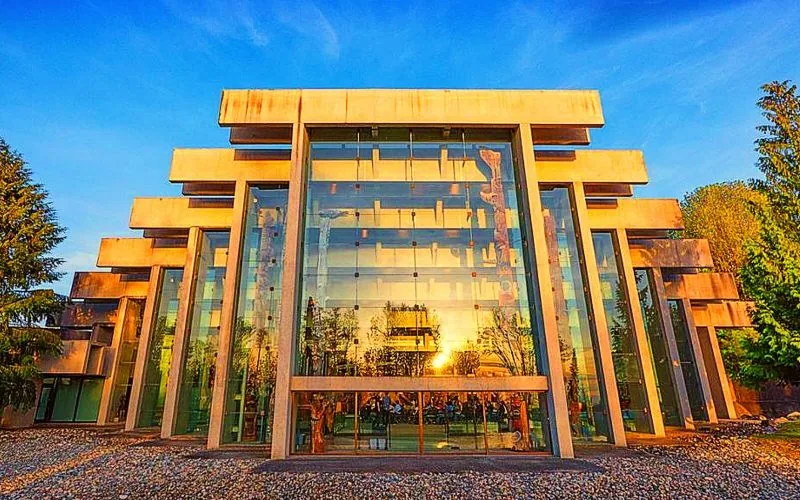
High atop the cliffs of Point Grey, the concrete and glass of Arthur Erickson’s architectural masterpiece seem to dissolve into the hazy skyline of the Salish Sea. The Museum of Anthropology (MOA) at the University of British Columbia is a bridge between the deep past of the Northwest Coast and the sharp clarity of modern design. Unlike the windowless vaults of traditional museums, this space uses fifty-foot glass walls to bring the forest, the water, and the shifting grey light of Vancouver directly into the Great Hall. Massive cedar totem poles stand inside this luminous atrium, their weathered faces looking out toward the very shorelines where they were first raised. Inside, the space carries the faint, dry fragrance of ancient cedar and the cool, sterile scent of polished stone, creating a sanctuary where human creativity feels as vast as the landscape itself.
High atop the cliffs of Point Grey, the concrete and glass of Arthur Erickson’s architectural masterpiece seem to dissolve into the hazy skyline of the Salish Sea.
Erickson drew his inspiration
Erickson drew his inspiration from the traditional post-and-beam architecture of the Haida people, translating timber logic into a staggering composition of poured concrete. When the museum opened in 1976, it challenged the colonial concept of the museum as a cabinet of curiosities, instead positioning itself as a place of living heritage. Bill Reid, perhaps the most influential Haida artist of the twentieth century, worked closely with the institution, ultimately housing his magnum opus, The Raven and the First Men, within its walls. The museum sits on the ancestral, unceded territory of the Musqueam people, and recent decades have seen a profound shift in its mission. It has transformed into a site of active reconciliation, where indigenous communities collaborate on the care and interpretation of their own ancestral treasures, ensuring the stones and woods tell their own stories.
Walking down the gentle ramp toward the Great
Walking down the gentle ramp toward the Great Hall, the ceiling rise and the world open up until the scale of the totem poles begins to dwarf your own presence. The opening note is the way the light changes every few minutes; a passing cloud can turn the cedar from a warm honey hue to a somber, metallic grey. Overhead, the space is one of hushed footsteps and the low, resonant hum of a space designed for contemplation. In the Multiversity Galleries, thousands of objects are stored in visible glass drawers, allowing you to feel the sheer density of human ingenuity from every corner of the globe. Stepping outside to the museum grounds, The smell of salt spray from the Pacific mixing with the earthy scent of the surrounding forest. The reconstructed Haida houses stand in a meadow of tall grass, their silvered wood reflecting the afternoon sun. Visitors generally focus on the large-scale carvings, but the real magic is found in the smaller cases holding delicate argillite sculptures and intricate bentwood boxes. A sense of profound stillness by the reflecting pool, where the concrete beams are mirrored in the water, blurring the line between the built environment and the natural world. What sticks with you is the realization that these objects were never meant to be silent; they are vessels of law, lineage, and survival.
Reaching the museum requires a trip
Reaching the museum requires a trip to the western edge of the UBC campus, a journey that takes you through the dense, green corridors of Pacific Spirit Regional Park. From downtown Vancouver, the #4 or #14 bus provides a direct link, though many prefer to cycle along the shoreline of Spanish Banks for a more dramatic approach. Once on campus, a short walk toward the cliffs reveals the museum's low, horizontal profile. The arrival feels like a departure from the city's frantic pace, a slow immersion into a landscape where the mountains of the North Shore provide a permanent, jagged backdrop.
Reaching the museum requires a trip to the western edge of the UBC campus, a journey that takes you through the dense, green corridors of Pacific Spirit Regional Park.
The Experience
Within the Great Hall is charged with the weight of the massive carvings, a presence that feels more like a forest than an exhibition. Part of the cool temperature of the concrete against the warmth of the cedar, a tactile contrast that defines the building's spirit. The moment that hits is how the totems are arranged not by height, but by their relationship to the sea and the sky, their hollowed backs revealing the labor of the carvers. Most travelers overlook the small Musqueam carvings near the entrance, yet these local pieces anchor the entire museum to the land beneath your feet. First, the way your own reflection appears in the glass walls, placing you momentarily within the landscape alongside the ancestors. What sticks with you is the view from the back of the building at high tide, where the architecture seems to reach out and touch the Salish Sea, making the museum feel like a vessel moored on the edge of the continent.
Why It Matters
The Museum of Anthropology is a global benchmark for indigenous collaboration, proving that a museum can be a place of healing rather than just a vault for the past. It matters because it houses the world's most significant collection of Northwest Coast art in an environment that respects the cultural context of the work. Humanly, it represents a bridge between the brutalist ambitions of the 1970s and the ancient, enduring wisdom of the First Nations.
Why Visit
See this site because it is the only place where the architecture is as significant a narrative as the artifacts it contains. While other galleries are closed-off boxes, this museum invites the Pacific breeze and the coastal light to participate in the experience. You go for the Bill Reid sculptures, but you stay because the building makes you feel the immense scale of the coast's history.
✦ Insider Tips
- 1
Head straight to the Multiversity Galleries and pull out the glass drawers to see the hidden objects that aren't on main display.
- 2
Walk the trail behind the museum down toward the beach; the cliffs offer a unique perspective on the museum's concrete pylons from below.
- 3
Look for the Bill Reid rotunda at noon, when the overhead light perfectly illuminates the intricate details of the raven's wings.
- 4
Check the Musqueam 'Teaching Poles' at the museum's entrance first to understand the specific history of the land the building sits on.
- 5
Visit the museum's shop for genuine indigenous-made jewelry; it is widely considered one of the best sources for authentic West Coast artistry in Canada.