A Protestant architect built this Catholic masterpiece with such obsessive devotion that he converted to the faith on his deathbed just to ensure his bones could be buried beneath its azure nave.
About Notre-Dame Basilica
This was originally home to a modest 17th-century chapel, but as Montreal transformed into a global trading hub, the Sulpician fathers commissioned James O'Donnell to build something that reflected the city's newfound stature. Between 1824 and 1829, the limestone exterior rose as the largest house of worship in North America, a title it held for decades. However, the interior remained surprisingly bare until the 1870s, when Victor Bourgeau was hired to bring a more emotional, French-inspired Gothic aesthetic to the space. He spent years overseeing the installation of the intricate wood carvings and the iconic blue ceiling. Throughout the 20th century, the basilica hosted some of Canada's most significant cultural moments, including the funeral of Prime Minister Pierre Elliott Trudeau and the wedding of Celine Dion, evolving from a local parish into a national stage for the Quebecois identity.
What Notre-Dame Basilica actually is
Passing through the heavy oak doors into the nave of Montreal’s grandest sanctuary feels less like entering a building and more like stepping inside a massive, sapphire-hued jewel box. While the exterior displays the sober, twin-towered restraint of Gothic Revival limestone, the interior is an explosion of azure, scarlet, and gold leaf. Every surface seems to vibrate with deep, saturated color, illuminated by thousands of flickering candles and sunlight filtered through stained glass that tells the secular history of the colony rather than just biblical parables. The setting is cool and carries a permanent, faint sweetness of frankincense and old wood. It remains the spiritual anchor of Old Montreal, a place where the grandeur of French Catholicism was reimagined with a wild, North American vibrance.
“Passing through the heavy oak doors into the nave of Montreal’s grandest sanctuary feels less like entering a building and more like stepping inside a massive, sapphire-hued jewel box.”
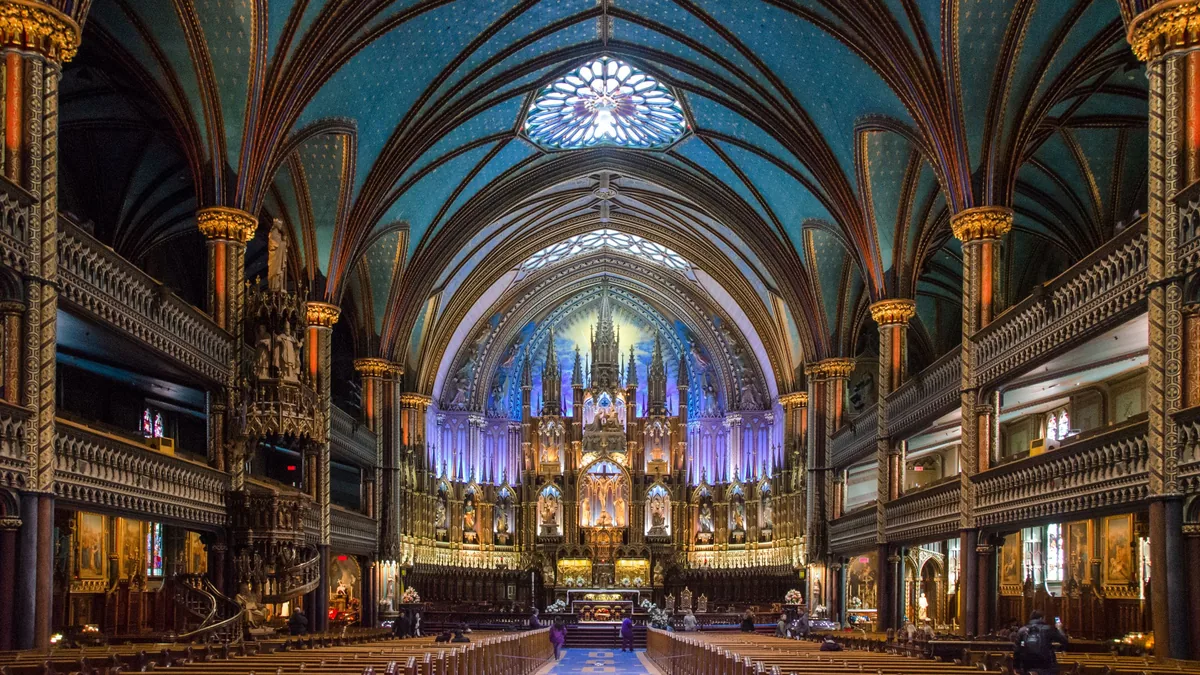
Notre-Dame Basilica, Canada
arrived in Montreal, 1823
Irish-American architect James O'Donnell arrived in Montreal in 1823 to replace a small, aging parish church that could no longer contain the city's burgeoning congregation. O'Donnell was a Protestant, yet he was so moved by the majesty of his own creation that he converted to Catholicism on his deathbed just to be buried beneath the floorboards of the nave. The structure was largely completed by 1829, but the psychedelic interior we see today was a later masterstroke by Victor Bourgeau in the late 1870s. Bourgeau abandoned the initial plan for a drab, neo-classical look in favor of a polychrome dreamscape inspired by the Sainte-Chapelle in Paris. In 1982, Pope John Paul II elevated the church to the status of a minor basilica, cementing its role as a site of national pilgrimage and a survivor of the city's many fires and social upheavals.
A low, reverent murmur fills
A low, reverent murmur fills the cavernous space, occasionally punctuated by the distant, metallic ring of a coin falling into a votive box. It becomes clear how the ceiling, painted a deep midnight blue and studded with 24-karat gold stars, creates the illusion of an infinite night sky stretching above the pews. The hand-carved linden wood of the pulpit spirals upward like a delicate vine, a product of the obsessive craftsmanship of the 19th-century artisans who labored here. The immense volume of the room as your eyes travel up to the Casavant Frères organ, its seven thousand pipes looking like a silver forest against the back wall. Moving toward the rear, finding the Chapel of Notre-Dame du Sacré-Cœur, which offers a starkly modern contrast with its massive bronze altarpiece that survived a devastating arson attack in 1978. Straight off, the light here is warmer, bouncing off the polished wood and contemporary metalwork. Just about everyone stay near the main altar, but the real power of the basilica is felt in the side aisles, where the stained glass captures scenes of early Montrealers building their homes in the snow. What stays with you is the transition back out into the grey granite streets of the city, where the daylight feels strangely muted after the chromatic intensity of the nave. Reaching the basilica is a simple walk to the heart of Place d'Armes in Old Montreal, easily accessible via the Orange line of the Metro at the Place-d'Armes station. From the station, you emerge into the historic district and follow the sight of the twin towers, 'Perseverance' and 'Justice,' which loom over the square. Pedestrian traffic is heavy during the summer months, so approaching on foot from the Saint Lawrence riverfront allows for a more gradual immersion into the colonial atmosphere of the neighborhood.
The Experience
The air is heavy with the scent of centuries of wax and the cool, stony breath of the crypts. What hits is that the light doesn't just enter the building; it is transformed by the blue-tinted windows into a liquid glow that makes the gold-leafed statues appear to float. The sense is the resonance of the massive bells in the towers, one of which, 'Jean-Baptiste,' weighs twelve tons, creating a hum that you can sense in the wood of the pews. Most travelers overlook the small, intricate carvings on the ends of the choir stalls, each depicting a different face from the 1870s congregation. You get a physical weight of the history as you walk over the brass memorial plaques set into the floor. What remains with you is the 'Aura' light show at night, when lasers and orchestral music trace the architectural lines of the carvings, turning the silent stone into a living, breathing story of light.
Why It Matters
Notre-Dame Basilica represents the artistic and religious pinnacle of New France, serving as a defiant symbol of French-Canadian culture surviving in an Anglophone continent. It matters because it is one of the few places where the history of a city’s founding is recorded in stained glass rather than just in books. Culturally, it is a masterpiece of Gothic Revival that proves how wood and color can be as imposing as marble.
Why Visit
The interior defies every expectation of a grey stone church. While other cathedrals are exercises in shadow and verticality, this one is an exercise in pure, unadulterated color. You go for the architecture, but you stay because the deep blue atmosphere creates a sense of peace that is entirely separate from the frantic tourist energy of the square outside.
Insider Tips
- 1
Book a ticket for the evening 'Aura' light show well in advance to see the interior features illuminated in a way that is impossible to appreciate during the day.
- 2
Look for the stained glass windows on the side aisles; unlike most cathedrals, these depict the founding of Montreal and the daily life of settlers rather than just saints.
- 3
Sit in the side pews near the pulpit to appreciate the 'stairway to heaven' carving, which was made from a single piece of wood.
- 4
Visit on a Sunday morning if you want to hear the massive Casavant organ in its full liturgical glory, though tourist access is restricted during mass.
- 5
Walk to the very back behind the main altar to find the Sacré-Cœur Chapel, often missed by those who are overwhelmed by the main nave.