A single set of iron doors saved a Victorian masterpiece from a catastrophic fire, leaving a lone circular library standing amidst the smoldering ruins of a nation's government.
About Parliament Hill
Ottawa was nothing more than a muddy backwater when Queen Victoria hand-picked it as the capital, largely to resolve the bitter rivalry between Montreal and Toronto. The resulting Gothic structures, designed by Thomas Fuller and Chilion Jones, were meant to project an image of stability and British heritage in the vast wilderness. After the devastating 1916 blaze, the Centre Block was reimagined in a more modern, soaring style that incorporated the Peace Tower. This tower houses a memorial chamber containing the Books of Remembrance, where the pages are turned daily to honor every Canadian soldier lost in conflict. The grounds have seen everything from the formal royal visits of the mid-century to the birth of the Canadian Charter of Rights and Freedoms in 1982, cementing the Hill as the country's emotional and political heartwood.
Parliament Hill
High above the dark, swirling currents of the Ottawa River, a triad of Gothic Revival masterpieces anchors the Canadian capital to its jagged limestone foundation. Parliament Hill is far more than a seat of government; it is a sprawling limestone campus where the Victorian obsession with pointed arches and gargoyles meets the rugged spirit of the northern frontier. The centerpiece, the Peace Tower, rises with a regal verticality that dominates the skyline, its bells casting a melodic shadow over the wide, manicured lawns below. Visitors often find themselves dwarfed by the sheer scale of the sandstone walls, which appear to change color from a dusty rose to a deep gold as the sun moves across the sky. Here the formality of law feels accessible, framed by the wilder forests of Quebec visible just across the water.
“High above the dark, swirling currents of the Ottawa River, a triad of Gothic Revival masterpieces anchors the Canadian capital to its jagged limestone foundation.”
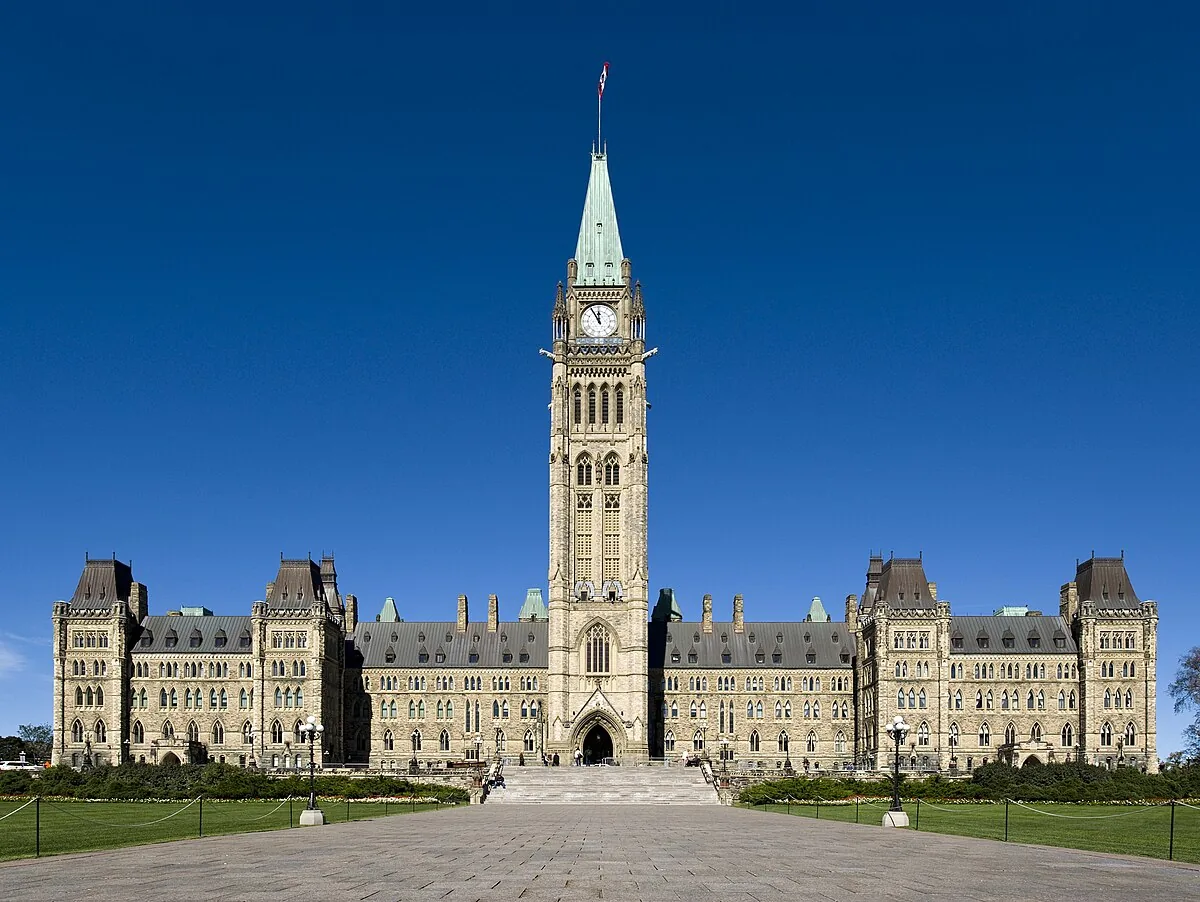
Parliament Hill, Canada
Victoria surprised everyone, 1857
Queen Victoria surprised everyone in 1857 by choosing Ottawa, then a rowdy lumber town known as Bytown, as the permanent capital of the Province of Canada. The site for the new legislature was a military barracks atop a cliff, a location chosen primarily because its height made it easier to defend against potential American aggression. Construction began in 1859, using local sandstone and a design that echoed the grandeur of Westminster but with a distinct, thicker-walled hardiness suited for Canadian winters. Disaster struck in 1916 when a massive fire gutted the Centre Block, leaving only the magnificent, circular Library of Parliament standing because a quick-thinking librarian slammed the heavy iron doors shut. The subsequent reconstruction introduced the Peace Tower, completed in 1927 as a monument to the sacrifices of the First World War, blending the scars of the past with a renewed architectural vision.
The air on the Hill often
The air on the Hill often carries the faint, nostalgic scent of damp stone and freshly cut grass, occasionally mixed with the sharp breeze blowing off the river. The history in the uneven texture of the Nepean sandstone and the heavy click of your shoes against the polished marble of the Hall of Honour. You catch is dominated by the carillon of the Peace Tower, fifty-three bells that ripple through the air with a clarity that silences the city traffic nearby. At the Centennial Flame, the warmth of the fire provides a physical anchor for the eyes while the water bubbles endlessly at its base, symbolizing a nation that spans from sea to sea. Walking behind the Centre Block reveals a quieter, more intimate side of the landmark. First, the resident cat sanctuary, a quirky tradition of the Hill, and the way the cliff drops sharply toward the Ottawa River, offering views of the Gatineau Hills that seem to stretch into infinity. People generally focus on the statues of prime ministers, but the real magic is found in the intricate carvings of indigenous flora and fauna hidden in the limestone capitals of the arches. When the sun dips low, the long shadows of the copper-roofed towers stretch across the grass, and the place takes on a quiet, scholarly atmosphere that feels ancient and permanent.
Reaching the Hill is an effortless
Reaching the Hill is an effortless stroll from any corner of downtown Ottawa, as all major streets seem to gravitate toward Wellington Street. Travelers often arrive via the O-Train to Parliament Station, emerging from the underground into the architectural theater of the capital core. Because the grounds are open to the public, you can simply walk through the gates and join the locals who use the lawn for yoga, protests, or quiet lunches. The most cinematic approach is from the Rideau Canal locks, where you can climb the stairs and watch the Gothic silhouettes emerge gradually against the sky.
“Reaching the Hill is an effortless stroll from any corner of downtown Ottawa, as all major streets seem to gravitate toward Wellington Street.”
The Experience
Sound comes first: the carillon bells doesn't just fill the air; it vibrates through the limestone beneath your feet, creating a sensory bridge between the earth and the sky. You come across a sudden transition from the bright, open expanse of the lawn to the cool, incense-quiet interior of the library, where the scent of old paper and white oak reaches back to 1876. What hits is the way the light catches the green copper roofs, a color that perfectly mirrors the evergreen forests visible on the northern horizon. Most travelers overlook the small wooded path that skirts the edge of the cliff, where the noise of politics fades into the rustle of maple leaves. What grabs you is the intricate gargoyles that leer down from the eaves, each one a unique character carved by masons who clearly possessed a sense of humor. What sticks with you is standing by the Centennial Flame at dusk, watching the fire dance on the surface of the water while the Gothic towers turn into dark, sharp silhouettes against a violet sky.
Why It Matters
Parliament Hill is the physical manifestation of Canadian democracy, a rare space where the halls of power remain fundamentally open to the citizens they serve. It matters because its architecture bridges the gap between European heritage and a uniquely North American landscape. Humanly, it represents a commitment to memory, from the fire-scarred library to the names inscribed in the Peace Tower, serving as a permanent anchor for a diverse and vast nation.
Why Visit
The rare chance to walk the halls of a G7 government without the feeling of being an intruder. While other capitals are hidden behind concrete barriers, the Hill invites you to lie on its grass and touch its ancient stones. You go for the Gothic drama, but you stay for the strange, peaceful harmony of a forest cliff that became a capital.
Insider Tips
- 1
Arrive at the Centennial Flame exactly fifteen minutes before the hour to hear the full carillon concert from the Peace Tower without the mid-day crowds.
- 2
Look for the hidden 'parliamentary cats' structures on the west side of the cliff, a small nod to the felines that once patrolled the grounds.
- 3
Take the guided tour of the Library of Parliament specifically to see the intricate wood carvings of the central dome; it is the only part of the original building that survived the 1916 fire.
- 4
Walk the 'Lovers' Walk' trail along the edge of the cliff for the best uncrowded views of the river and the Alexandra Bridge.
- 5
Visit during a summer evening for the sound and light show, which uses the facade of the Centre Block as a massive, high-definition canvas.