“Forty years of back-breaking labor in the subarctic cold produced a fortress so formidable that the French fleet eventually conquered it without a single cannon being fired in defense.”
About Prince of Wales Fort
The Hudson’s Bay Company originally built a modest wooden post here in 1717, but the threat of European conflict prompted the shift to a massive stone star-fortress. Between 1731 and 1771, masons hauled limestone from nearby quarries, creating walls that spanned eleven meters at the base. Samuel Hearne, the famous explorer who had trekked to the Arctic Ocean, was the governor when the French Admiral La Pérouse arrived in 1782. Hearne’s decision to strike the colors saved his men from slaughter, though it led to the fort's partial destruction. The site lay in ruins for over a century until the Canadian government began restoration efforts in the 1930s, turning the scorched stone shell into a National Historic Site that preserves the era of the great fur trade rivalries.
A royal commission
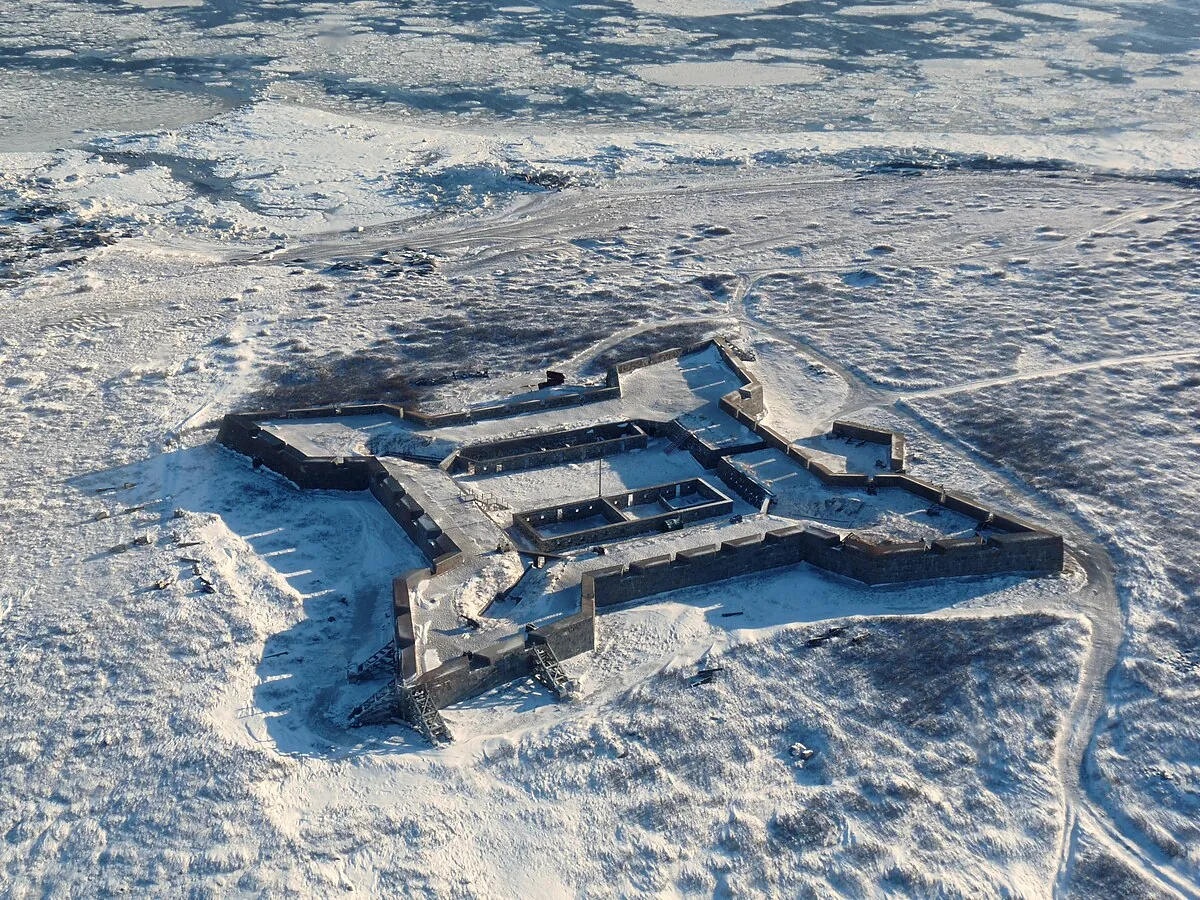
Massive star-shaped ramparts of grey limestone rise defiantly from the windswept tundra where the Churchill River meets the icy expanse of Hudson Bay. Prince of Wales Fort represents a colossal miscalculation of imperial ambition, a stone fortress built with a European obsession for permanence in a landscape defined by shifting ice and seasonal migration. On all sides, A biting clarity, smelling of salt spray and the wild, sharp musk of the subarctic. At the top of the jagged shoreline, The immense weight of the three-meter-thick walls, which seem both indestructible and strangely fragile against the backdrop of the infinite horizon. This is a place of stark contrasts, where the rigid geometry of British military engineering is slowly being weathered by the relentless freeze-thaw cycles of the North.
Massive star-shaped ramparts of grey limestone rise defiantly from the windswept tundra where the Churchill River meets the icy expanse of Hudson Bay.
Construction began, 1731
Construction began in 1731 under the direction of the Hudson’s Bay Company, taking an agonizing forty years to complete as workmen struggled against the short building seasons and the bone-chilling cold. The company intended the fort to be an impregnable depot for the lucrative fur trade, yet its grandest historical moment ended in a silent surrender. In 1782, three French warships appeared through the mist; the governor, Samuel Hearne, realizing he was hopelessly outnumbered and outgunned, surrendered the fort without firing a single shot. The French attempted to demolish the structure with explosives, but the stones were so expertly fitted that they merely settled into the scorched, slumped ruins you see today. It remains a monument to a global chess game played out on the loneliest edge of the continent.
The wind is a constant, vocal
The wind is a constant, vocal companion, whistling through the empty gun embrasures and rattling the dry lichen that clings to the stones. First, the deep scars in the limestone where 18th-century sailors carved their names, a desperate bid for immortality in a place that feels utterly indifferent to human presence. In your ears of the bay is a low, grinding churn, especially when the pack ice begins to move. Inside the central courtyard, the silence is heavy, broken only by the crunch of gravel under your boots as you explore the skeletal remains of the officer’s quarters. Walking along the top of the ramparts, The forty-two cannons still pointing out toward the water, their iron barrels pitted by centuries of salt. A large share of visitors are scanning the distance for the white ghost of a polar bear, but the real power of the fort is felt in the small details, like the precise dovetailing of the masonry. The isolation of the men who lived here, trapped between the stone walls and a wilderness that offered no mercy. The detail that stays with you is looking through a narrow portal at the endless tundra, realizing that for the men stationed here, that view was both a prison and the most beautiful thing they would ever see. Arrival at this remote sentinel requires a journey to Churchill, Manitoba, a town with no road access from the south. Travelers must fly in or take the two-day train journey across the muskeg. From Churchill, the fort is reached by boat across the river, a transit that often involves sightings of white beluga whales during the summer months. Because of the local polar bear population, you cannot wander these stones alone; you must be accompanied by a guide armed with more than just historical facts, ensuring that your encounter with the past doesn't involve a dangerous meeting with the living symbols of the North.
The Experience
The air tastes of cold iron and salt, a sharp mixture that stings the nostrils and heightens every sense. The sense is the vibration of the bay's power through the soles of your shoes as the tide hammers against the outer battery. Right away, the strange, vibrant colors of the arctic moss, phosphorescent oranges and deep reds, growing in the crevices of the grey masonry. Most travelers look toward the sea, but you should look at the ground to find the hand-chiseled signatures of the masons who knew they would likely never return home. A trace of the history not as a dry list of dates, but as a physical presence in the cold shadows of the magazine room. The piece that lingers is when the wind drops for a split second and the absolute, profound stillness of the North settles over the stones, making the 18th century feel close enough to touch.
The air tastes of cold iron and salt, a sharp mixture that stings the nostrils and heightens every sense.
Why It Matters
Prince of Wales Fort is a rare architectural survivor of the global struggle for the North American fur trade. It matters because it anchors the history of the Hudson’s Bay Company, once the largest landowner on earth, to a physical, tangible ruin. Humanly, it remains proof of to the sheer stubbornness of European expansion, attemptedly imposing an iron-age permanence upon a shifting, nomadic landscape.
Why Visit
This fort because it offers a visceral encounter with isolation that you cannot find in the curated castles of Europe. You go for the polar bears and the belugas, but you stay because standing on these ramparts gives you a terrifyingly beautiful perspective on the scale of the world. It is the only place where you can touch 18th-century history while watching a wild, prehistoric landscape unfold around you.
✦ Insider Tips
- 1
Look for the signature of Samuel Hearne carved into the rocks at Sloop Cove, located just a short boat ride from the main fort.
- 2
Bring binoculars not just for the bears, but to see the intricate masonry joints on the upper tiers that have survived three hundred winters.
- 3
Stay close to your guide at all times, as polar bears often use the high stone walls as windbreaks and can be nearly invisible against the grey rock.
- 4
Visit during a late summer evening if the boat schedule allows, as the low sun turns the grey limestone into a glowing, warm amber.