“A 110-million-year-old dinosaur was found so perfectly mummified in an Alberta oil mine that researchers could still see the pattern of its scales and the contents of its last meal.”
About Royal Tyrrell Museum
The Badlands remained a quiet secret until Joseph Tyrrell's 1884 encounter with a carnivore skull changed the trajectory of Canadian science. Throughout the early 20th century, rival bone-hunters competed to ship carloads of fossils to museums in New York and London, a period now known as the Great Canadian Dinosaur Rush. The Royal Tyrrell Museum was finally established in the mid-1980s to keep these treasures on the land where they were found. It began as a bold architectural project to house massive skeletons like the 13-meter-long Camarasaurus. In the decades since, it has become a global leader in research, particularly after the 2011 discovery of the Nodosaur by a heavy equipment operator, which provided the world with its best-preserved dinosaur specimen. This history is one of constant, accidental discovery, where a walk through a coulee can still lead to a breakthrough that changes our understanding of the planet.
What Royal Tyrrell Museum actually is
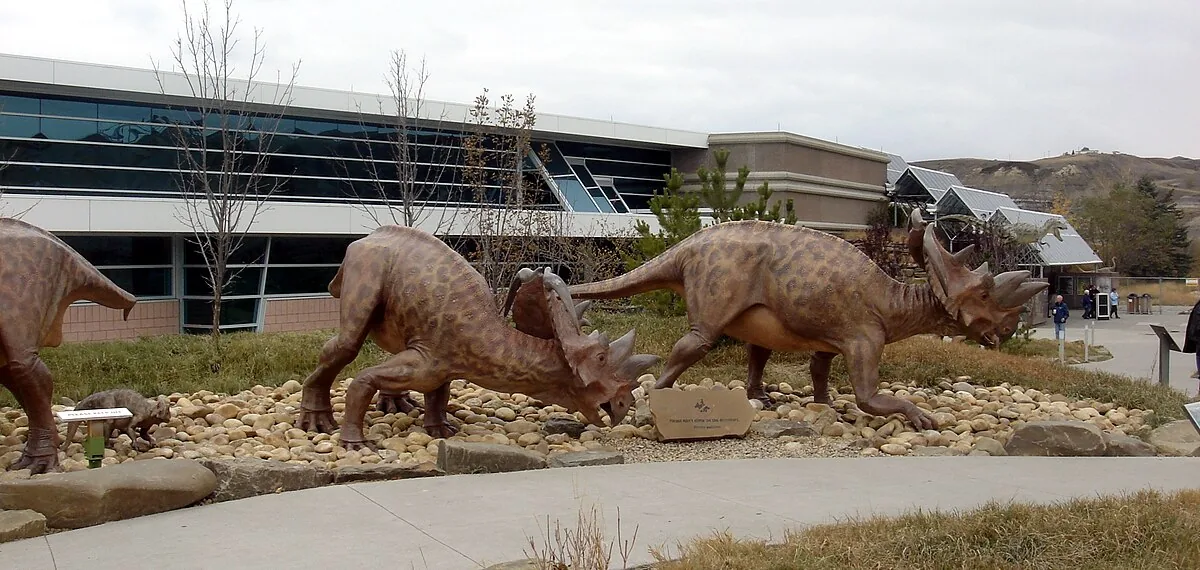
Deep in the sun-baked coulees of the Canadian Badlands, the earth has a habit of surrendering its oldest secrets. The Royal Tyrrell Museum of Palaeontology doesn't just sit on the landscape; it is carved into the very strata of the Horseshoe Canyon Formation, a sprawling temple to deep time. Here, the air is dry and carries the scent of sagebrush and weathered clay. The surrounding hills are striped with iron-rich reds and coal-seam blacks, looking like a giant, multi-layered cake left out in the desert rain. Inside, the transition from the harsh light of the Alberta plains to the cool, darkened galleries is immediate and profound. You are no longer in a modern province; you are back in the humid, subtropical swamp of the Late Cretaceous. The scale of life is measured in tons and the passage of time is visible in the rock walls right outside the glass.
Deep in the sun-baked coulees of the Canadian Badlands, the earth has a habit of surrendering its oldest secrets.
Deer River Valley, 1884
Joseph Burr Tyrrell was actually looking for coal in the Red Deer River Valley in 1884 when he stumbled upon the skull of an Albertosaurus. That singular discovery ignited a paleontology gold rush that has never ceased. The museum itself opened in 1985 and was granted its 'Royal' designation by Queen Elizabeth II in 1990, a rare honor for a scientific institution. Unlike many museums that rely on plaster casts, the Tyrrell is a working laboratory where roughly 160,000 individual specimens are housed. Every year, new fossils emerge from the surrounding hills as the soft bentonite clay erodes, meaning the story the museum tells is being rewritten with every summer storm.
The silence of the Dinosaur Hall
The silence of the Dinosaur Hall is frequently broken by the low, awe-struck murmurs of visitors standing beneath the towering skeleton of a Black Beauty, a Tyrannosaurus rex darkened to an iridescent obsidian by the minerals of its burial ground. You register the incredible detail in the Borealopelta, a mummified armored dinosaur so perfectly preserved that its skin and scales remain intact. The grain of the exhibits feels visceral; you can see the serrations on teeth and the delicate impressions of feathers trapped in stone. Walking through the Cretaceous Garden, the humidity rise moving through plants that are direct descendants of those that existed 75 million years ago. What grabs you is the light glancing off the silver-grey bones of a giant marine reptile, the Shonisaurus, which stretches nearly the entire length of its gallery. People generally rush toward the T-rex, but the real magic is watching the technicians in the Preparation Lab through the glass. them painstakingly removing rock from bone with tiny pneumatic drills, a slow-motion dance of patience that connects our world to a vanished era. The piece that stays with you is the walk back to your car at dusk, when the long shadows of the hoodoos make it easy to imagine a long-necked shadow moving against the horizon. Reaching this prehistoric sanctuary requires a drive into the heart of Drumheller, roughly ninety minutes northeast of Calgary. The descent into the valley is sudden and dramatic; the flat prairie gives way to a prehistoric canyon like a hidden world. Once you reach the valley floor, the museum is easily found along the North Dinosaur Trail. While many arrive by car, some choose to cycle the loop, though the heat of the badlands can be punishing. The approach is marked by the sight of the building's low-slung profile, which was designed to blend into the horizontal lines of the surrounding canyon walls.
The Experience
The interior the galleries is cool and remarkably still, a sanctuary from the fierce winds that whip through the Drumheller valley outside. The first thing you register is the subtle click and whir of the Preparation Lab, where scientists spend years cleaning a single fossil with needles and brushes. The immense, heavy presence of the fossils, which possess a weight and texture that plaster replicas simply cannot mimic. Most travelers overlook the micro-fossil displays, but looking through the magnifying glasses reveals the tiny teeth of mammals that survived the great extinction. What you catch first is the way the light catches the amber-colored minerals in the bone beds, making the ancient skeletons seem to glow from within. The detail that lingers is found on the outdoor interpretive trail, where you can touch the K-Pg boundary layer, a thin line of clay that marks the exact day the dinosaurs vanished from the earth.
The interior the galleries is cool and remarkably still, a sanctuary from the fierce winds that whip through the Drumheller valley outside.
Why It Matters
The Royal Tyrrell Museum is the only institution in Canada devoted solely to paleontology and houses one of the world's largest displays of complete dinosaur skeletons. It matters because it provides a tangible link to the Late Cretaceous, showcasing the biodiversity of a world that existed before the ice ages. Humanly, it reminds us of our own short tenure on a planet that has been home to giants for millions of years.
Why Visit
Check out this museum because it sits in the middle of a literal graveyard of giants, where the exhibits inside are matched by the active dig sites right outside the doors. You go to see the T-rex, but you stay because the building itself makes you feel like an interloper in a very old, very beautiful story. No other place offers this level of intimacy with the creatures that once ruled our continent.
✦ Insider Tips
- 1
Book the 'Seven Wonders of the Badlands' hike through the museum to see active excavation sites that are closed to the general public.
- 2
Look for the 'Black Beauty' Tyrannosaur, which gained its unique obsidian color from the specific manganese minerals in the local soil.
- 3
Take the short interpretive hike outside the museum before entering to understand the geological layers you will be 'traveling through' inside.
- 4
Check the museum's website for 'Late Night' events in the summer to see the skeletons illuminated by moonlight through the atrium windows.