“Twenty weathered cedar poles stand in a silent row on a remote Pacific island, slowly surrendering their carved secrets to the moss and the sea mist.”
About SGang Gwaay
Formerly known as Anthony Island, SGang Gwaay was home to the Kunghit Haida, a people whose artistry in wood and stone was the finest on the coast. The village reached its zenith in the mid-1800s, but the arrival of maritime fur traders brought a biological catastrophe that the community could not survive. By 1884, the village was silent, its inhabitants reduced from hundreds to a mere handful. In the decades that followed, several poles were removed to museums in Vancouver and Ottawa, but the most significant collection remained. In 1981, UNESCO recognized the site as a World Heritage landmark, not for its architectural preservation, but as a testimony to a vanished way of life. Today, the Haida Watchmen program ensures that the site is protected while allowing the natural cycle of birth, death, and return to the earth to continue without human interference.
What SGang Gwaay actually is
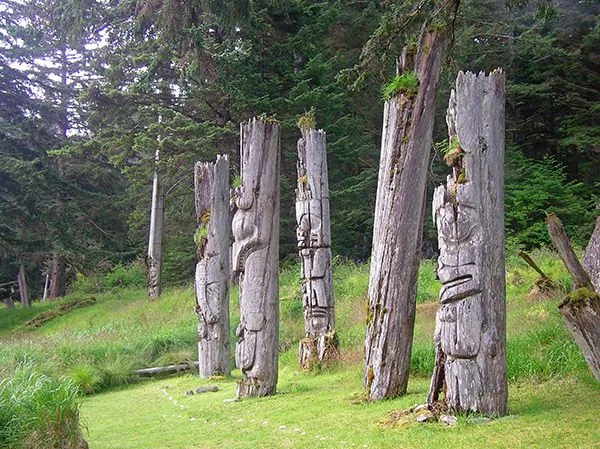
Silvered by salt air and leaning at impossible angles, the mortuary poles of SGang Gwaay Llnagaay stand as the world's most haunting remnants of a living Haida culture. This remote village site sits on a small island at the southern edge of Gwaii Haanas, where the lush temperate rainforest meets the violent surges of the Pacific. Unlike museums where artifacts are sterilized by glass, here the cedar monuments are left to the mercy of the elements. Moss creeps into the carved eyes of eagles and bears, and the forest slowly reclaims the house pits where powerful clans once feasted. The environment carries a heavy, damp stillness, broken only by the rhythmic crashing of waves and the distant whistle of a bald eagle. It represents a profound philosophy of life and decay, where greatness is marked not by permanence, but by the grace with which a culture returns to the earth.
Silvered by salt air and leaning at impossible angles, the mortuary poles of SGang Gwaay Llnagaay stand as the world's most haunting remnants of a living Haida culture.
For thousands of years, the Kunghit
Haida thrived here, their wealth measured in sea otter pelts and the massive cedar beams of their longhouses. The village was a active maritime capital until the late 19th century, when the introduction of smallpox by European traders decimated the population with a speed that defied belief. By the 1880s, the few survivors were forced to abandon their ancestral home for larger settlements to the north, leaving behind their mortuary and memorial poles. In a decision that still resonates today, the Haida Hereditary Chiefs and Parks Canada agreed not to restore or straighten the poles. They chose instead to let the cedar age naturally, honoring the Haida belief that when a pole falls, its journey is complete. This policy of 'managed decay' makes SGang Gwaay a rare site where the passage of time is treated with as much respect as the history itself.
Stepping onto the rocky shoreline
Stepping onto the rocky shoreline from a zodiak boat, you immediately feel the drop in temperature beneath the towering canopy of Sitka spruce. The Haida Watchmen, who live here as guardians, greet you with a quiet authority that shifts your perspective from tourist to guest. The way the light filters through the rain-soaked needles, casting long, liquid shadows over the grey, weathered wood of the poles. Each carving reveals itself slowly: a curve of a beak, the squatting form of a human ancestor, or the broad fins of a killer whale. Walking the perimeter of the ancient village, The deep rectangular depressions in the earth where longhouses once stood, their massive corner posts now little more than moss-covered stumps. The silence is visceral, a heavy blanket of North Pacific mist that seems to swallow the sound of your footsteps. Almost all visitors find themselves speaking in whispers, not out of a rule, but out of a natural reverence for the spirits that seem to linger in the salt-stained grain of the wood. What stays with you is looking at a pole that has begun to split, seeing a small sitka spruce seedling growing directly out of the top, literal life springing from the memorial of the dead.
Reaching this island requires a commitment
Reaching this island requires a commitment to the journey, as it is one of the most difficult sites to access in North America. Travelers usually begin in Sandspit or Skidegate, boarding a floatplane or a multi-day boat expedition that weaves through the labyrinthine fjords of Gwaii Haanas. The final approach is almost always by small inflatable boat, navigating the kelp forests and rocky outcrops that protect the village from the open sea. There are no docks or paved paths; arrival is a matter of timing the tides and respecting the volatile weather of the Edge of the World.
Reaching this island requires a commitment to the journey, as it is one of the most difficult sites to access in North America.
The Experience
The air smells intensely of crushed cedar and salt, a scent that grows stronger as the sun warms the damp wood of the monuments. A sense of the spongy texture of the ancient forest floor beneath you, a carpet of needles and moss that has been accumulating since the village was abandoned. The tiny details that the camera misses: the way the wood grain has raised like a topographical map or how the lichens have created a living skin over the face of a carved Watchman. Most travelers overlook the small stone carvings near the shoreline, focusing instead on the towering poles, but these smaller markers speak to the intimate daily lives of the people who lived here. A mark of the immense power of the Pacific as the wind whips around the point, a record of the isolation that kept this place secret for so long. The piece that stays with you is the final look back from the boat, seeing the grey poles blend perfectly into the grey trees, almost indistinguishable from the wild landscape they honor.
Why It Matters
SGang Gwaay is the most significant site for Haida monumental art in the world, serving as a physical link to a prehistoric maritime civilization. It matters because it challenges Western concepts of preservation; here, the value is in the spirit of the object rather than its physical longevity. It is still a powerful monument to the resilience of the Haida people, who continue to guard these shores as sovereign protectors of their own history.
Why Visit
The point is that this is the only place on earth where you can witness the slow, poetic death of a masterpiece. While the Louvre or the Met keep history frozen, SGang Gwaay lets it breathe and age. You go to stand at the edge of the world and feel the weight of a culture that understood that some things are too beautiful to be kept forever.
✦ Insider Tips
- 1
Engage the Haida Watchmen in conversation about their lineage; many are direct descendants of the people who once lived in the village.
- 2
Look for 'culturally modified trees' in the surrounding forest, where ancient Haida bark-stripping or plank-testing is still visible in the living wood.
- 3
Pack a high-quality waterproof bag for your electronics, as the mist can penetrate almost anything during the zodiak transit to the island.
- 4
Visit the site at low tide to see the intertidal life that provided the primary food source for the Kunghit Haida.
- 5
Limit your time at the poles to soak in the atmosphere of the forest; the silence of the island is as much a part of the landmark as the carvings themselves.