“Three faint clicks of Morse code traveled two thousand miles of ocean to reach a kite-tethered antenna on this cliff, effectively ending the isolation of the human race in 1901.”
About Signal Hill
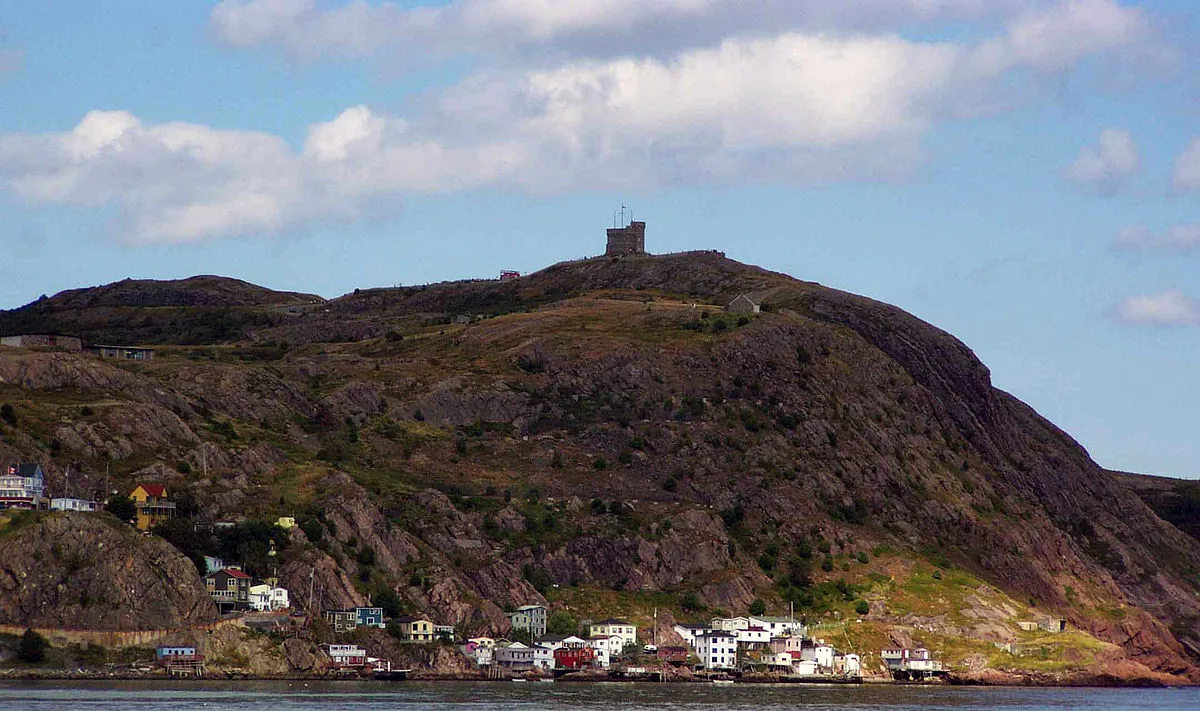
Fortifications have crowned this height since the late 1700s, serving as the primary defense for the strategic port of St. John's. The Battle of Signal Hill in September 1762 saw Colonel William Amherst lead a surprise British assault that finally ousted the French from North America's shores. Cabot Tower was later commissioned in 1897 to commemorate the 400th anniversary of John Cabot's landfall and Queen Victoria's Diamond Jubilee. Though it was built for signaling ships, it became immortalized when Guglielmo Marconi used the site for his groundbreaking wireless experiment. During the world wars, the hill returned to its martial roots, housing anti-aircraft batteries and coastal defense searchlights that scanned the dark Atlantic for U-boat periscopes. Today, it is a protected National Historic Site where the ghosts of soldiers and inventors share the same salt-stiffened grass.
What Signal Hill actually is
Wind-scarred granite and the rhythmic boom of the Atlantic define the rugged crown of St. John's. Signal Hill is the easternmost guardian of North America, a place where the air always tastes of salt and the horizon feels impossibly wide. Cabot Tower, a late-Victorian sandstone fortress, perches atop the cliffs like a stubborn sentinel, overlooking the treacherous Narrows that lead into the safety of the harbor. Here, the landscape is stripped down to its essentials: grey stone, deep blue water, and a sky that can change from brilliant azure to a ghostly fog in minutes. It is a theater for the elements, where the transition from a calm morning to a gale-force afternoon is simply part of the daily rhythm.
Wind-scarred granite and the rhythmic boom of the Atlantic define the rugged crown of St.
Seven Years' War, 1762
Military strategists realized the value of this high ground as early as the 17th century, turning the plateau into a fortified lookout that saw the final battle of the Seven Years' War in 1762. British and French forces clashed on these slopes for control of the lucrative Newfoundland fisheries, a struggle etched into the very foundations of the stone walls. However, the hill's most profound historical tremor occurred on December 12, 1901. Guglielmo Marconi sat in an abandoned fever hospital on the heights, straining to hear through a primitive earphone. Against all scientific skepticism of the era, he successfully received the first transatlantic wireless signal, the letter 'S' in Morse code, sent from Poldhu, Cornwall. This moment effectively shrank the planet, turning a lonely cliff on the edge of the New World into the birthplace of modern global communication.
The climb along the North Head Trail provides
The climb along the North Head Trail provides a visceral encounter with the Newfoundland coast. What registers is how the wind tugs at your clothes with a persistent, playful force as you navigate the narrow wooden boardwalks pinned to the rock face. The clatter of the ocean is a constant, low-frequency roar, punctuated by the sharp cries of gulls nesting in the crags below. Light here has a peculiar, translucent quality, especially in the late afternoon when it illuminates the brightly painted houses of the Battery neighborhood huddled at the hill's base. Standing on the ramparts near Cabot Tower, The sheer height of the 500-foot drop to the sea. The deep ruts in the earth where cannons once sat, and occasionally, you might spot the white mist of a whale’s blow in the distance. Most people focus on the tower itself, but the real magic is found in the quiet moments on the ledge, watching a massive container ship squeeze through the Narrows with only meters to spare on either side. The experience peaks when the fog rolls in, swallowing the tower and leaving you in a muffled, white world where the only reality is the smell of wet moss and the distant moan of the harbor's foghorn. Accessing the summit involves a steep, winding drive up Signal Hill Road from the heart of downtown St. John's, a route that offers increasingly dramatic views with every turn. Many locals prefer to walk up through the historic Battery district, a steep climb through narrow lanes where houses are bolted directly into the granite. Taxis and a seasonal hop-on-off bus service cater to those who prefer to save their legs for the cliffside trails. Regardless of how you arrive, the final approach to the tower is always on foot, crossing a windswept plateau that makes the modern world feel a thousand miles away.
The Experience
The soundscape is a relentless duel between the whistling wind in the tower's rigging and the heavy thud of the North Atlantic against the rocks far below. There is a grit of the sandstone under your palms as you lean against the tower walls, realizing the stone was hauled up here by hand and horse. What you catch first is the way the weather doesn't just happen; it arrives like a physical wall, whether it's a sudden rain squall or the thick 'sou'west' fog that turns the world into a grey smudge. Most travelers miss the remains of the old Queen's Battery lower down the slope, where the silence is deeper and the perspective on the harbor entrance is even more intimate. A sense of profound scale as you watch a lone iceberg drift past the headlands in early summer, looking like a discarded piece of white marble in a vast indigo gallery. The moment that lingers is the noon day gun, a sudden, chest-thumping cannon blast that has marked the time for the city's residents for generations.
The soundscape is a relentless duel between the whistling wind in the tower's rigging and the heavy thud of the North Atlantic against the rocks far below.
Why It Matters
Signal Hill matters as the definitive site where the Atlantic was finally conquered by technology rather than just sail and steam. It is a cultural landmark that embodies the resilience of the people of Newfoundland, standing at the literal edge of the continent. Humanly, it represents the transition from the era of wooden ships and iron cannons to the age of invisible data and global connectivity.
Why Visit
Worth your time because this is one of the few places on earth where you can stand on a 500-foot cliff and look out at a horizon that contains nothing but water until the coast of Ireland. You go to see the birthplace of the wireless age, but you stay for the raw, unpolished energy of a landscape that refuses to be tamed by the city at its feet.
✦ Insider Tips
- 1
Hike the North Head Trail starting from the top and going down into the Battery; it’s easier on the knees and the view of the harbor unfolds more beautifully before you.
- 2
Listen for the 'Signal Hill Tattoo' in the summer, where costumed soldiers perform 19th-century drills that echo off the cliff faces.
- 3
Pack a windbreaker even on the warmest days, as the temperature at the summit is often five to ten degrees cooler than in the downtown core.
- 4
Visit the Ladies' Lookout, the highest point on the hill, for a 360-degree view that includes the vast barrens of the interior and the endless sea.
- 5
Stop at the visitor center to see the scale model of Marconi’s kite-antenna setup to truly appreciate the low-tech nature of his high-tech breakthrough.