“Four ancient petroglyphs, hidden for over a millennium, were recently rediscovered not by archaeologists, but by the hooves of a reintroduced bison herd reclaiming their ancestral wallows.”
About Wanuskewin
While the Pyramids of Giza were being raised, nomadic peoples were already gathering in this valley to conduct ceremonies and hunt bison. The site contains nearly twenty archaeological markers, including a medicine wheel that dates back approximately 1,500 years, making it one of the most concentrated heritage sites in North America. Throughout the 1930s and 40s, the land was part of a private farm, which ironically helped protect the delicate tipi rings and bone beds from urban development or looting. In 1992, the Wanuskewin Heritage Park opened as a non-profit center, unique for its governance by a board of Indigenous leaders and university scholars. The 2019 reintroduction of Plains Bison marked a spiritual homecoming, as the animals immediately began 'working' the land, uncovering sacred carvings that had eluded scientific surveys for decades.
What Wanuskewin actually is
Wind ripples through the needlegrass of the Opimihaw Valley with a sound like a collective indrawn breath, smelling of wild sage and sun-baked earth. Wanuskewin sits on the edge of the prairie north of Saskatoon, a place where the undulating land hides a archaeological record deeper than that of the Egyptian pyramids. The landscape is a masterclass in subtlety; what looks like a simple coulee is actually a sacred gathering place used by Northern Plains peoples for over six millennia. Grey-green lichen clings to ancient boulders while the South Saskatchewan River carves a steady path nearby, shimmering like beaten silver under the vast, predatory sky. Walking these trails, you realize that the silence isn't empty. It is a dense, layered quiet that feels heavy with the presence of the ancestors who hunted, lived, and prayed in this precise depression of the earth.
Wind ripples through the needlegrass of the Opimihaw Valley with a sound like a collective indrawn breath, smelling of wild sage and sun-baked earth.
Archaeological discovery here began almost by accident in the early 1980s when local veterinarian Ernie Walker recognized that the stone circles on the surface were not random scattered rocks but intentional formations. These turned out to be tipi rings, medicine wheels, and bison jumps that had remained undisturbed for thousands of years. Excavations eventually revealed that every pre-contact culture on the Great Plains had traveled to this valley, drawn by its shelter and the abundance of bison. In a remarkable turn of historical symmetry, the bison returned to the land in 2019. Their hooves soon uncovered even deeper secrets; as the animals wallowed in the dirt, they unearthed four petroglyphs and the stone tool used to carve them, hidden for a thousand years. This living laboratory proved that the relationship between the land, the animals, and the people was never broken, merely waiting for the right moment to resurface.
The air on the valley floor is notably
The air on the valley floor is notably stiller and warmer than on the exposed plains above, creating a natural amphitheater for the songs of meadowlarks. What hits is the coarse texture of the buffalo jump cliffs, where the drop is sudden and the history of the hunt feels remarkably close. The clatter of the wind through the wolf willow provides a constant, rhythmic backdrop moving between the dig sites. A strange hum of energy at the medicine wheel, a circle of stones aligned with the stars that has sat in this exact spot since before the rise of the Roman Empire. Following the bison paths, The heavy, musky scent of the herd before you actually see them grazing against the horizon. The majority focus on the indoor interpretive center, but the true spirit of Wanuskewin is found in the high grass where the light at sunset turns the prairie into a sea of liquid copper. The standout is the way the light catches the white feathers of a soaring hawk, emphasizing the sheer scale of the sky. The bit that stays with you is standing by the creek at dusk, hearing the water rush over stones that have been stepped on by travelers for two hundred generations. It is a physical sensation of being a very small part of a very long story.
Reaching the park involves a short ten-minute drive
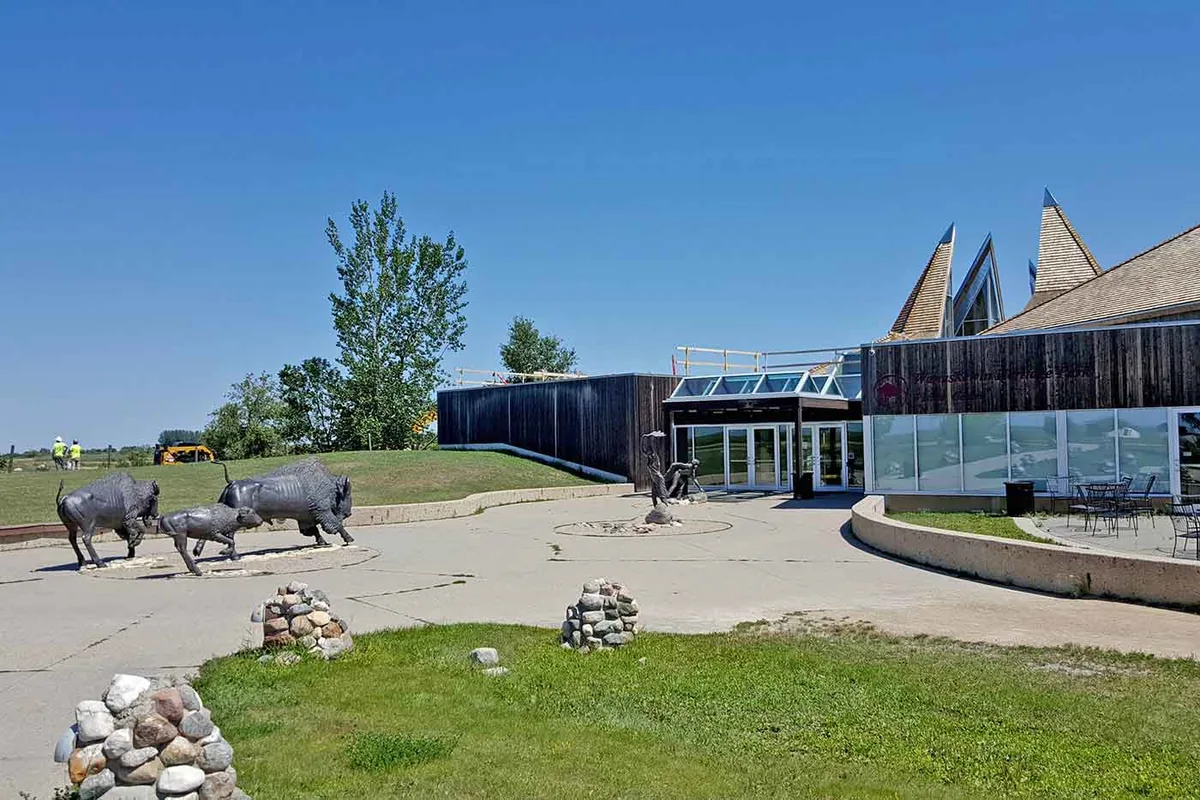
Reaching the park involves a short ten-minute drive north of Saskatoon, moving away from the city's neon and gridlock into a collection of horizontal infinity. The road transitions from pavement to a sense of arrival as the architecture of the visitor center, designed to mimic the soaring lines of a tipi, rises from the prairie. Many visitors arrive via the highway, but the most poetic way to understand the location is to look out across the valley toward the river, imagining the thousands of years of foot traffic that funneled into this hidden sanctuary from all directions.
Reaching the park involves a short ten-minute drive north of Saskatoon, moving away from the city's neon and gridlock into a collection of horizontal infinity.
The Experience
The soundscape is dominated by the dry rustle of prairie grasses and the distant, guttural grunts of the bison herd moving across the ridge. The mass of the sun’s heat radiating off the dark soil, a warmth that carries the pungent, medicinal aroma of wild sage. The first thing you register is the way the light seems to expand here, lacking the vertical interruptions of trees or buildings, making the clouds look like massive, slow-moving sculptures. Most visitors overlook the small depressions in the earth near the creek, which are actually the remains of ancient pithouses. The sharp, obsidian-like eyes of the bison as they watch you with a wary, ancient intelligence from behind the fences. The bit that stays with you is the walk back to the visitor center as the first stars appear, realizing that the medicine wheel beneath your feet is perfectly aligned with the lights beginning to flicker in the sky above.
Why It Matters
Wanuskewin matters because it is a living bridge to the pre-contact history of the Great Plains, offering a narrative that is entirely Indigenous-led. It serves as a sanctuary for the restoration of both a landscape and a culture, proving that the prairie is not a wasteland but a rich, ancestral library. Humanly, it offers a rare opportunity to witness the physical continuity of 6,000 years of human habitation in a single, sacred coulee.
Why Visit
Visit Wanuskewin to experience the silence of a place that has been continuously inhabited longer than almost any other site in Canada. You go to see the bison and the medicine wheel, but you stay because the valley offers a perspective on time that makes the modern world feel like a brief, fleeting whisper against the enduring stone of the prairie.
✦ Insider Tips
- 1
Walk to the bison viewing platform during the hour before sunset when the herd is most active and the light makes their coats appear like velvet.
- 2
Look for the wild sage growing along the Path of the People; if you rub a leaf between your fingers, the scent will stay with you for the rest of the day.
- 3
Visit the medicine wheel in the early morning to see how the stones catch the very first light of the sun, highlighting their ancient alignment.
- 4
Try the local bison sliders or bannock at the restaurant; the ingredients are sourced to reflect the traditional diet of the peoples who gathered here for millennia.