While imperial patrons funded China's great northern grottoes, local monks, merchants, and communities funded the Dazu carvings, and produced something more human: 50,000 figures teaching Buddhist ethics through scenes of hell, farming, and family life.
About Dazu Rock Carvings
Carving began at Dazu in 650 CE and peaked under Song dynasty monk Zhao Zhifeng's program at Baodingshan (late 12th–early 13th century). The carvings integrate Buddhist, Taoist, and Confucian traditions in a didactic visual program aimed at a non-literate audience. UNESCO World Heritage Site since 1999.
What Dazu Rock Carvings actually is
The Dazu Rock Carvings in Chongqing Municipality are a collection of over 50,000 Buddhist, Taoist, and Confucian stone sculptures carved between the ninth and thirteenth centuries CE across 75 protected sites on the hills surrounding Dazu county. Unlike the great northern grotto sites at Yungang and Longmen, which were imperial commissions, the Dazu carvings were largely funded by local communities, merchants, and monks, giving them a different character: more narrative, more intimate, and more directly concerned with everyday human concerns.
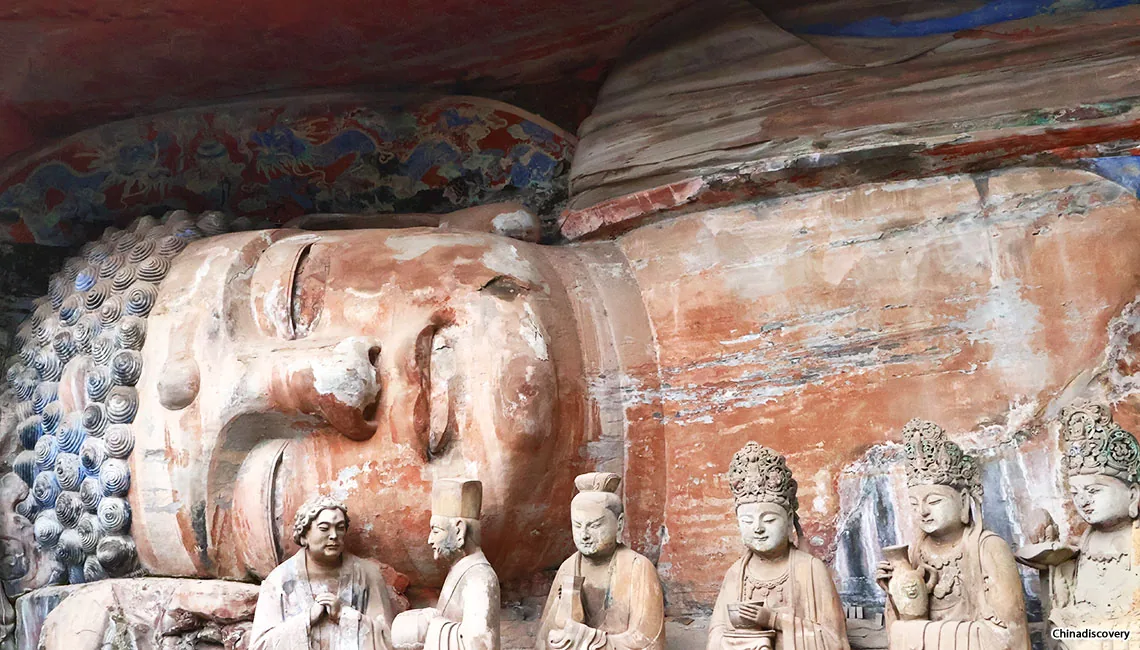
Dazu Rock Carvings, China
at Dazu began, 650
Carving at Dazu began in 650 CE during the Tang dynasty and reached its peak under the Song dynasty (960–1279 CE) when the monk Zhao Zhifeng led a decades-long program at Baodingshan, the most elaborate of the Dazu sites. Zhao's vision was didactic, the carvings were designed to teach Buddhist ethics to a largely illiterate population, using visual narrative sequences that functioned like instructional comics carved into rock. The scenes include depictions of hell punishments calibrated to specific sins (a drunkard boiled in wine, a gossip with tongue pulled out) alongside scenes of parental devotion, agricultural labor, and filial piety that are unlike anything in the northern cave traditions.
The two main sites are Baodingshan , 15 kilometers from Dazu, and Beishan, 2 kilometers from the county town. Baodingshan's curved cliff face, 500 meters long, contains the most complex continuous narrative program, the scenes flow into each other around the U-shaped valley. The Reclining Buddha at Baodingshan, 31 meters long, depicts the Buddha entering parinirvana with mourners carved in detail around the figure. Dazu is 160 kilometers west of Chongqing, accessible by high-speed rail (1 hour from Chongqing North station). From Dazu station, local buses and taxis reach both main sites.
The Experience
Baodingshan's 500-meter curved cliff face with continuous narrative sequences, from hell punishments specific to particular sins to agricultural and family scenes, and a 31-meter Reclining Buddha; Beishan's earlier Tang and Song figure collections.
Why It Matters
The Dazu carvings document both the synthesis of China's three major religious traditions and the use of visual narrative as mass religious instruction, a social function of art that the imperial grotto programs never attempted at this scale.
Why Visit
The scenes at Baodingshan are unlike anything in the northern cave tradition, narrative, specific, and populated with figures engaged in recognizable human activities. The quality of observation in the social scenes is genuinely surprising.
Insider Tips
- 1
Hire a guide at Baodingshan, the iconographic program is dense and a guide decodes the narrative sequences.
- 2
Visit Baodingshan before Beishan; it is the more complex and more rewarding of the two main sites.
- 3
The Reclining Buddha scene at Baodingshan is most effectively seen from the far end of the valley looking back.