“In 210 BCE, China's first emperor was buried with an army of 8,000 individually modeled soldiers. Farmers found the first figure in 1974. The excavation is still ongoing.”
About Terracotta Army
Constructed 246–210 BCE as the funerary guard for Emperor Qin Shi Huang, the terracotta figures were buried in formation around the emperor's main burial mound. Discovered in 1974 when local farmers struck ceramic fragments while digging a well. UNESCO World Heritage Site since 1987.
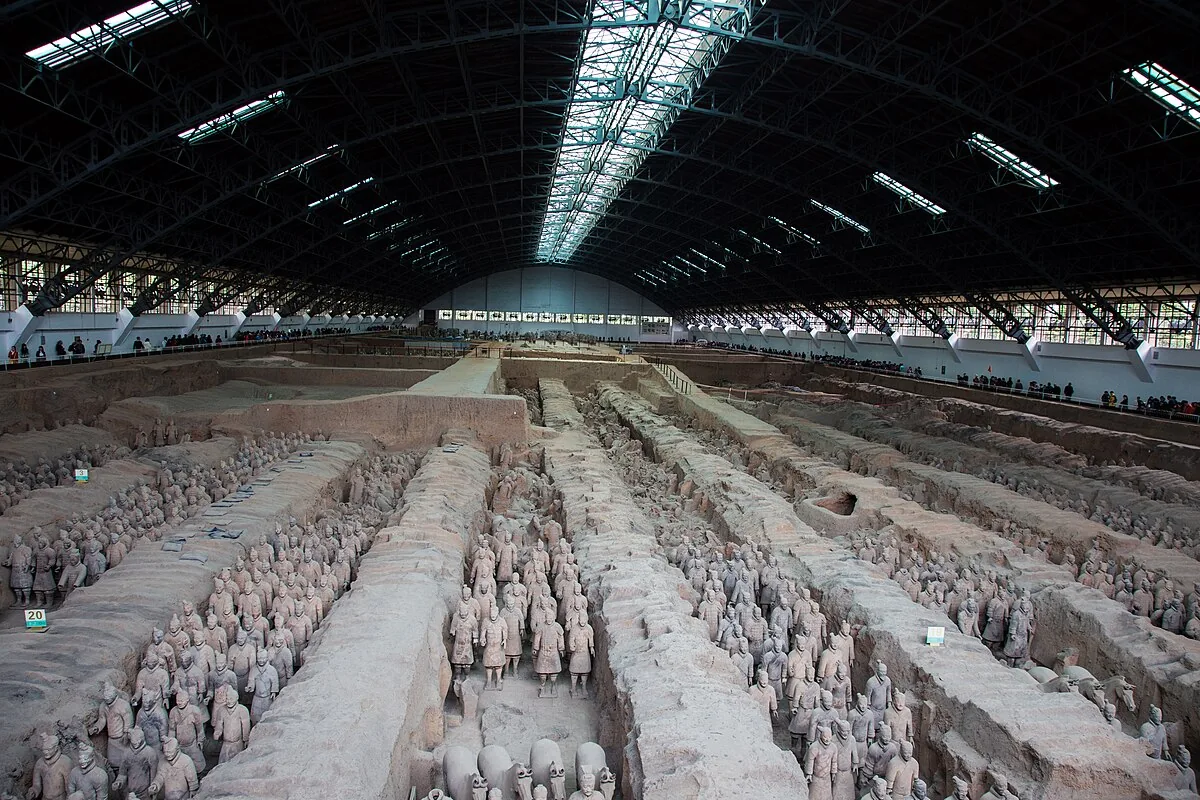
What Terracotta Army actually is
The Terracotta Army, the funerary guard of China's first emperor, Qin Shi Huang, was buried near Xi'an in 210 BCE and discovered by farmers digging a well in 1974. The three excavated pits contain an estimated 8,000 soldiers, 130 chariots, 520 horses, and 150 cavalry horses, each figure individually modeled with distinct facial features. The site is one of the most significant archaeological discoveries of the twentieth century and a UNESCO World Heritage Site since 1987.
The Terracotta Army, the funerary guard of China's first emperor, Qin Shi Huang, was buried near Xi'an in 210 BCE and discovered by farmers digging a well in 1974.
China's warring states, 221
Qin Shi Huang unified China's warring states in 221 BCE and immediately began constructing a tomb complex intended to replicate his empire in death. The terracotta army was the military component of an underground world that also included bronze waterfowl, acrobats, officials, and a main burial mound that has never been excavated, ancient texts describe it containing rivers of mercury and a ceiling studded with pearls to replicate the night sky. Construction required 700,000 conscripted laborers over 36 years. The figures were originally painted in vivid colors that oxidized within minutes of exposure to air after excavation, a loss that archaeologists are still working to prevent for unexcavated sections.
Pit 1 is the largest and most dramatic , a hangar-sized building covering the main infantry formation, where rows of soldiers extend toward the horizon. Pit 2 contains cavalry and archers in a more complex arrangement. Pit 3 is smaller and shows the command structure. The Museum of the Terracotta Warriors adjacent to the pits displays the original paint pigmentation on preserved fragments and shows restored figures in full detail. A kneeling archer and a bronze chariot and horses are among the specific pieces worth seeking out.
The Terracotta Army is 30 kilometers east of Xi'an city center. Tourist buses depart regularly from the Xi'an railway station forecourt; the journey takes approximately one hour. High-speed rail connects Xi'an to Beijing (4.5 hours) and Shanghai (6 hours).
The Terracotta Army is 30 kilometers east of Xi'an city center.
The Experience
Three excavated pits of increasing complexity, from the main infantry formation in Pit 1 to the command structure in Pit 3, plus a museum displaying original painted pigments and restored figures in detail.
Why It Matters
The Terracotta Army is both a supreme artistic achievement (8,000 individually modeled faces) and the key to understanding Qin dynasty funerary practice and the organizational scale of China's first unified state.
Why Visit
The physical experience of standing at the edge of Pit 1 and seeing the formation extending into the distance is one of those genuinely overwhelming encounters with ancient scale that no reproduction prepares you for.
✦ Insider Tips
- 1
Hire a guide at the site, the historical context transforms what would otherwise be an impressive but opaque display.
- 2
Look for the kneeling archer in Pit 2 and the bronze chariot in the museum, both are exceptional pieces.
- 3
Arrive at opening time (8:30am) to have Pit 1 with fewer bodies in the viewing galleries.