“A retired official in 1509 named his garden after a poem about growing vegetables instead of pursuing ambition. Five centuries of owners later, the water-and-pavilion design it evolved into is the definitive example of classical Chinese garden art.”
About Humble Administrator's Garden
Commissioned by retired official Wang Xianchen in 1509, the garden passed through multiple owners who each modified and rebuilt sections. The current layout reflects centuries of overlapping design rather than a single conception. Part of the UNESCO Classical Gardens of Suzhou World Heritage Site since 1997.
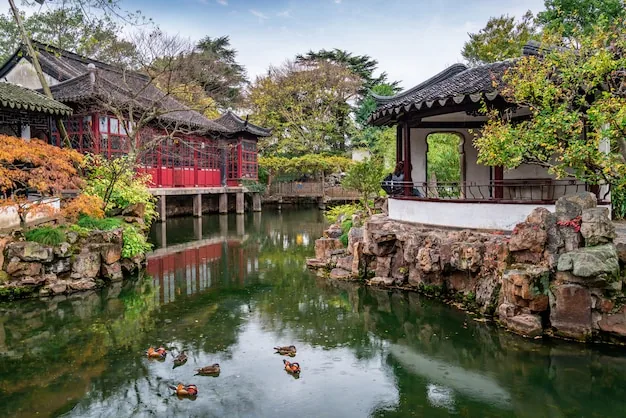
The Humble Administrator's Garden in Suzhou is the largest classical Chinese garden in the city and one of the Four Great Gardens of China. Covering 5.2 hectares, it was designed in the sixteenth century around a series of connected pools, pavilions, and plantings that create an illusion of natural landscape within a walled urban space. UNESCO included it as part of the Classical Gardens of Suzhou World Heritage Site in 1997.
The Humble Administrator's Garden in Suzhou is the largest classical Chinese garden in the city and one of the Four Great Gardens of China.
commissioned the garden, 1509
Wang Xianchen, a government official who retired to Suzhou after a career in Beijing, commissioned the garden in 1509. The name, drawn from a line in a Jin dynasty poem about a humble man who tends his garden instead of pursuing official advancement, was self-deprecating commentary on his retirement from court politics. The garden passed through multiple owners over the following centuries, and each rebuilt or modified sections; the current layout reflects centuries of overlapping design decisions rather than a single vision. Suzhou developed as China's garden city because its flat, water-rich terrain and prosperous merchant class created both the conditions and the clients for garden construction from the Song dynasty onward.
The garden is divided into three sections.
The western section is the most expansive, centered on a large pool with pavilions at water's edge and rock formations framing distant views. The middle section contains the original sixteenth-century core, with the most refined arrangements of water, rock, and planting. The eastern section is more open and includes a bonsai display. The garden is most visited in early morning before tour groups arrive and in the two hours before closing.
The garden is in central Suzhou , accessible from Shanghai by high-speed rail (25–35 minutes). From Suzhou station, the garden is reachable by metro (Line 2, Suzhou Museum station) or taxi.
The garden is in central Suzhou , accessible from Shanghai by high-speed rail (25–35 minutes).
The Experience
Three connected garden sections, centered on pools, pavilions at water's edge, rock formations, and layered plantings, that demonstrate the classical Chinese design principle of creating the illusion of natural landscape within a walled urban enclosure.
Why It Matters
The Humble Administrator's Garden is the canonical example of a form of landscape art that developed in Suzhou over five centuries and influenced garden design across East Asia. It encodes specific philosophical relationships between human space, water, rock, and plant that have no Western equivalent.
Why Visit
The garden's spatial logic, where each turn reveals a framed view, and the sense of the garden's size consistently exceeds its actual 5.2 hectares, is a design achievement that repays slow attention.
✦ Insider Tips
- 1
Arrive at opening time (7:30am) for the earliest sections with significantly fewer visitors.
- 2
Walk slowly and look back frequently, many of the best views are framed by gates and doorways behind you.
- 3
The adjacent Suzhou Museum, designed by I.M. Pei, is worth combining with the garden visit.