A monk had a vision in the desert in 366 CE and began carving. One thousand years later, 492 decorated caves held 45,000 square meters of Buddhist murals. The caves were sealed, forgotten, and rediscovered in 1900 with 50,000 manuscripts inside.
About Mogao Caves
Carved continuously from 366 CE to the 14th century by Buddhist patrons along the Silk Road, the Mogao Caves were sealed around 1000 CE and rediscovered in 1900 when monk Wang Yuanlu found the Library Cave. European collectors removed most of the manuscripts in the early 1900s; the caves were designated a UNESCO World Heritage Site in 1987.
The Mogao Caves outside Dunhuang in Gansu Province contain 492 decorated Buddhist grottoes carved into a desert cliff over a period of one thousand years, from the fourth to the fourteenth century CE. The caves hold the largest and best-preserved collection of Buddhist art in the world, 45,000 square meters of murals and more than 2,000 painted sculptures, accumulated by the merchants, pilgrims, and monks who used the Silk Road oasis at Dunhuang as a waypoint and a place of prayer.
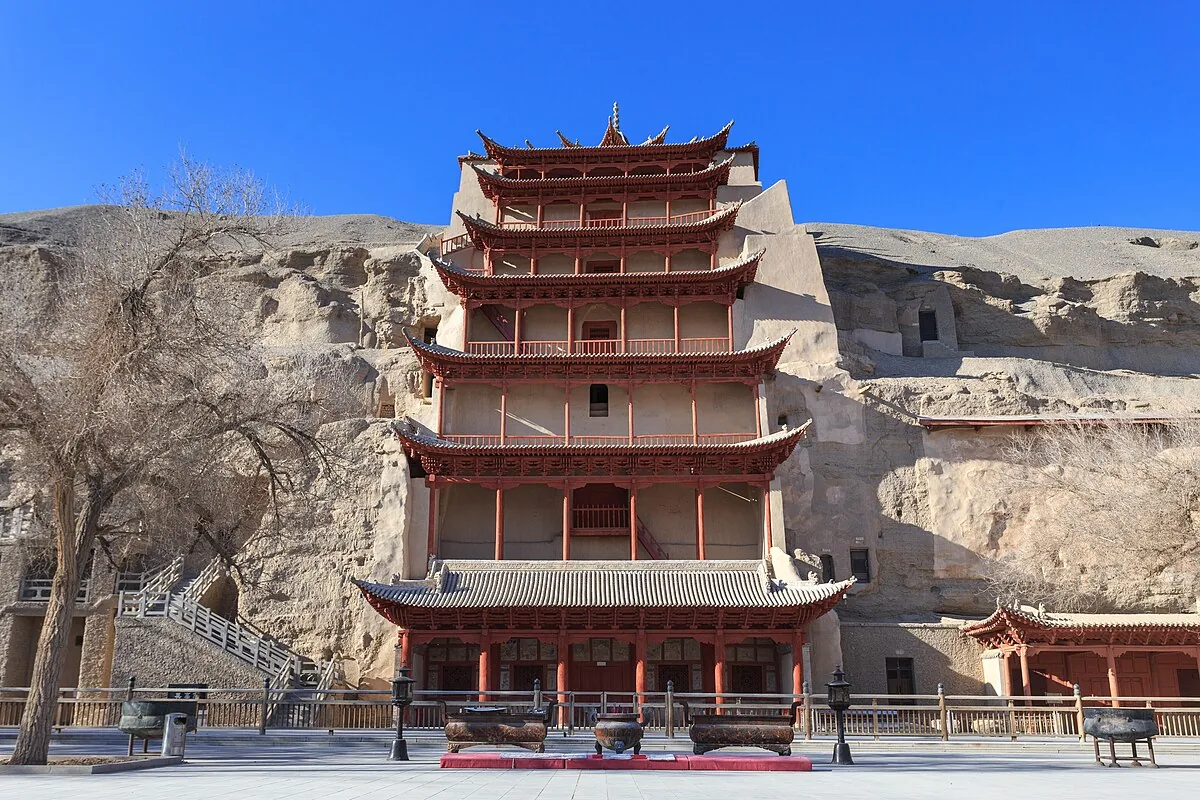
Mogao Caves, China
cave was carved, 366
The first cave was carved in 366 CE by a monk named Lezun who reportedly saw a vision of a thousand Buddhas in the desert light and began digging. Successive patrons, traders seeking safe passage, officials seeking merit, wealthy families seeking intercession, funded cave after cave over the following millennium. The caves were sealed around 1000 CE, probably as a precaution against invasion, and rediscovered in 1900 when a Taoist monk named Wang Yuanlu opened a walled chamber containing 50,000 manuscripts, painted scrolls, and textiles, the Library Cave. European, American, and Japanese scholars removed most of the Library Cave's contents in the early 1900s, much of which now resides in the British Museum and the Bibliothèque nationale de France. The removals remain a source of cultural property debate.
Visits are strictly guided and managed, groups of 20 cycle through approximately 8 open caves on a standard tour, with a digital exhibition center providing context and high-resolution reproductions of restricted caves. The paintings in the accessible caves span Tang dynasty elegance, Northern Wei austerity, and later Yuan dynasty influence. The scale of a cave interior covered floor-to-ceiling with narrative murals is not reproducible digitally.
Dunhuang is accessible by air from Xi'an, Lanzhou, and Urumqi, and by high-speed rail from Lanzhou and Urumqi to Liuyuan station (25 km from Dunhuang). The Mogao Caves are 25 kilometers southeast of Dunhuang town.
“Dunhuang is accessible by air from Xi'an, Lanzhou, and Urumqi, and by high-speed rail from Lanzhou and Urumqi to Liuyuan station (25 km from Dunhuang).”
The Experience
Guided tours of 8 open caves (from 492) with floor-to-ceiling Tang, Northern Wei, and Yuan dynasty murals, supplemented by a digital exhibition center with high-resolution reproductions of restricted grottoes.
Why It Matters
Mogao holds the world's largest and best-preserved Buddhist mural collection, a visual record of Silk Road religious art that spans a millennium and documents the transmission of Buddhism from India through Central Asia to China.
Why Visit
Standing inside a cave whose walls are entirely covered with 1,400-year-old narrative murals is an experience that has no digital equivalent. The Mogao Caves are the finest surviving example of Buddhist art at this scale anywhere on earth.
Insider Tips
- 1
Book tickets online weeks in advance, daily capacity is strictly limited.
- 2
The premium tour adds access to more caves and is worth the additional cost.
- 3
Spend time in the digital exhibition center before or after, it provides context the guided cave tour cannot deliver in the time allowed.