Kashgar is where the Silk Road split around the Taklamakan Desert, a trading city that changed hands between Chinese, Uyghur, Mongol, and Kyrgyz powers while its bazaars and courtyard houses persisted across two millennia.
About Old City of Kashgar
A Silk Road oasis city for over 2,000 years at the junction of routes from China, India, Persia, and the Mediterranean. Under Qing control from the 18th century; the Old City has been subject to significant government renovation since 2009. The Uyghur population has maintained Islamic practice and Central Asian architectural traditions across multiple political transitions.
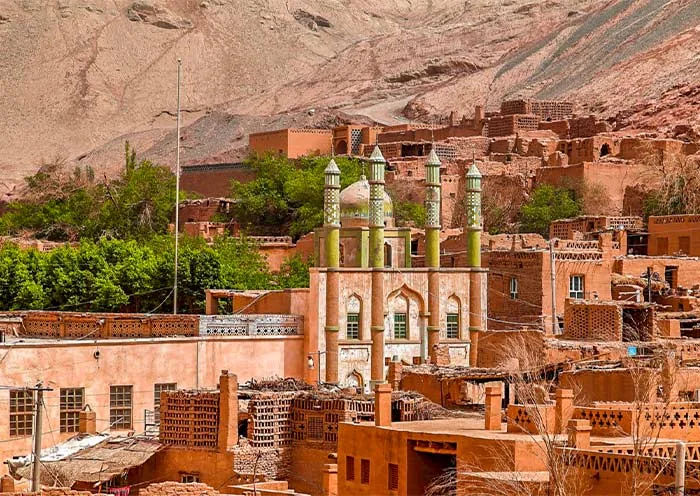
Kashgar in Xinjiang sits at the western edge of China, where the Silk Road split into northern and southern routes around the Taklamakan Desert, making it one of the most significant trading crossroads in Asian history. The Old City, a dense neighborhood of mud-brick courtyard houses, covered bazaars, and the Id Kah Mosque, preserves the physical texture of a Central Asian oasis city in a form that has been substantially altered by government renovation projects since the 2000s but retains enough of the original fabric to convey the character of the place.
Kashgar's position at the convergence of trade routes from China, India, Persia, and the Mediterranean made it wealthy for over two millennia. Silk, jade, spices, and horses moved through its markets; the city changed hands between Chinese, Tibetan, Uyghur, Kyrgyz, and Mongol powers repeatedly before coming under Qing control in the eighteenth century. The Uyghur population maintained their language, Islamic practice, and courtyard architecture through these transitions. The Sunday Market, historically the largest market in Central Asia, drew traders from Afghanistan, Tajikistan, Kyrgyzstan, and beyond. Significant demolition and reconstruction of the Old City began in 2009 under government renovation programs that replaced deteriorating mud-brick structures with new buildings designed to resemble the old ones.
The remaining Old City lanes between the Id
Kah Mosque and the hilltop Abakh Khoja tomb area retain genuine historic character. The covered knife market, the copper and tinsmith workshops, and the bread bakeries visible from lane level give the neighborhood a working texture. The Sunday livestock market on the city's outskirts, where sheep, goats, and cattle are traded, is unchanged and functional. Kashgar is accessible by air from Urumqi (1.5 hours) and Beijing (4.5 hours). High-speed rail from Urumqi reached Kashgar in 2020 (4 hours). Foreign visitors require documentation beyond a Chinese visa; check current requirements before travel.
The Experience
Old City lanes with working craft workshops, covered bazaars, and the Id Kah Mosque, plus the Sunday livestock market on the city outskirts, one of the most functional Central Asian market scenes in China.
Why It Matters
Kashgar is where Chinese civilization met Central Asian, Indian, and Persian trade networks for two millennia. The physical city reflects this convergence in its architecture, cuisine, and living craft traditions in ways that no inland Chinese city replicates.
Why Visit
Kashgar is one of the few places in China where the Silk Road is a physical experience rather than a historical abstraction, the lane textures, the craft markets, and the Sunday livestock trade are continuous with patterns that predate modern history.
✦ Photo Gallery
Best Season
🌤 April–October; the desert climate makes spring and autumn most comfortable.
Quick Facts
Best time to visit
April–October; the desert climate makes spring and autumn most comfortable.
Getting there
In Kashgar, China; reach Kashgar first, then continue to the site.
Location
Kashgar, China
Type
attraction
Insider Tips
- 1
Visit the Sunday market early, it peaks in the morning and becomes significantly more crowded by midday.
- 2
The covered knife and craft markets near Id Kah Mosque are most active on weekday mornings.
- 3
Check current travel documentation requirements carefully, Xinjiang entry has specific procedures for foreign visitors.