“A civilization flourished in Sichuan 3,000 to 5,000 years ago and produced bronze masks, a 2.6-meter standing figure, and sacred trees that bear no relationship to anything else in ancient China. Nobody found any of it until 1929.”
About Sanxingdui Museum
First discovered by farmers in 1929, systematically excavated beginning in 1986 when two sacrificial pits yielded thousands of Bronze Age objects. Six additional pits discovered in 2020–2021 are still being excavated. The Sanxingdui culture represents a Bronze Age civilization parallel to and apparently independent of Yellow River cultures.
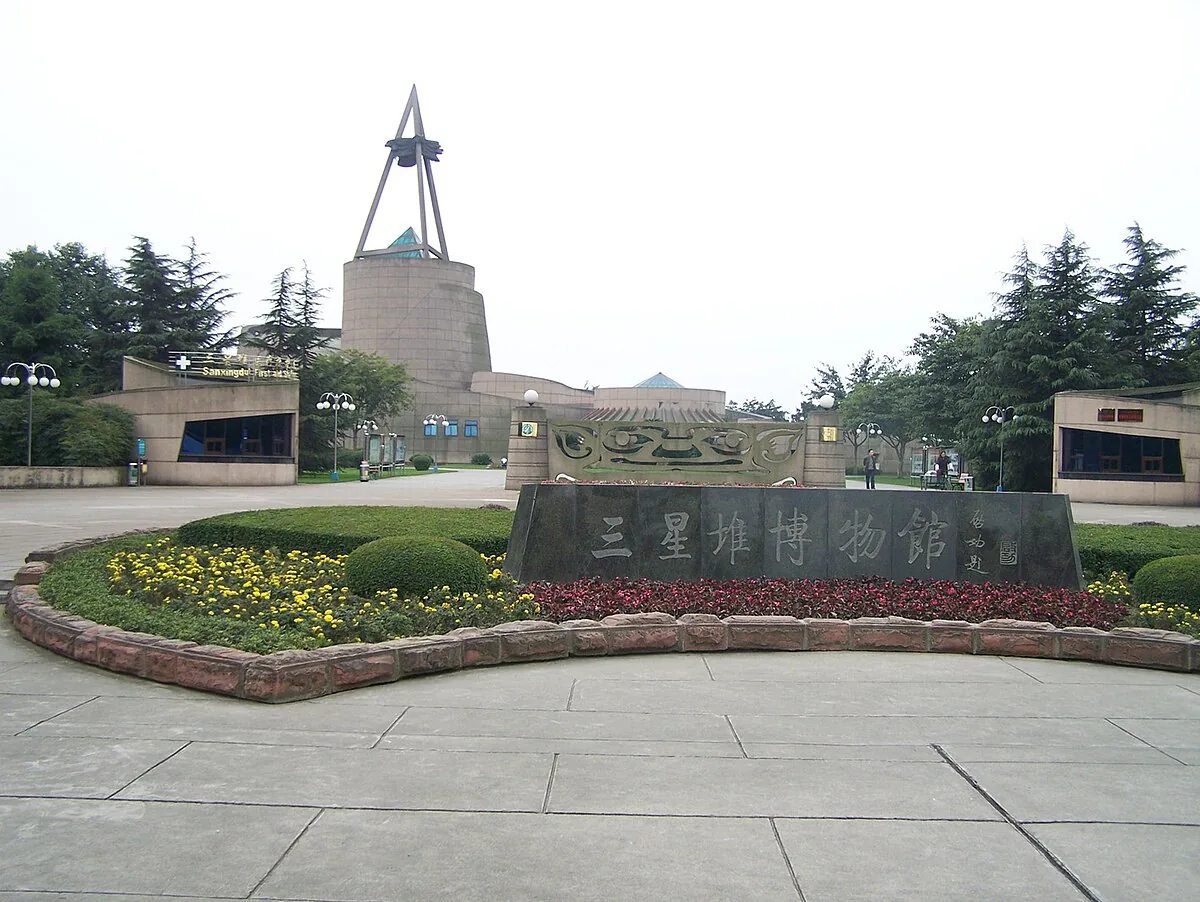
Sanxingdui Museum
The Sanxingdui Museum in Guanghan, Sichuan, houses the artifacts of an ancient civilization that was entirely unknown until farmers discovered bronze and jade objects in 1929, and remained almost entirely mysterious until systematic excavation began in 1986. The objects, bronze masks with protruding eyes, a 2.6-meter bronze standing figure, gold face masks, and sacred trees with birds, belong to a Bronze Age culture that flourished along the Minjiang River 3,000 to 5,000 years ago and has no clear relationship to the Yellow River civilizations that form the conventional narrative of early Chinese history.
The 1986 discovery of two sacrificial pits at Sanxingdui overturned the assumption that Bronze Age China developed from a single Yellow River culture. The Shu civilization, the probable name for the Sanxingdui people, clearly had bronze-working technology of high sophistication and a religious system centered on forms that appear in no other ancient Chinese tradition. The goggle-eyed bronze masks, in particular, have no known parallels in contemporaneous Chinese culture, and their function and meaning remain genuinely disputed. In 2020–2021, six additional sacrificial pits were discovered; the ongoing excavation is still producing major finds and has received international media attention.
The museum's new building (opened 2023) houses the recent pit discoveries alongside the 1986 material, with state-of-the-art preservation and display cases allowing close observation of objects in extraordinary condition. The standing bronze figure, nearly 2.6 meters tall, hands extended in an unknown ritual gesture, anchors the collection. The gold mask and the sacred tree reconstructions are among the most visually arresting objects in any Chinese museum. Guanghan is 40 kilometers north of Chengdu. High-speed rail from Chengdu takes 20 minutes; local buses and taxis reach the museum from Guanghan station.
The Experience
A new museum (2023) housing both the 1986 discoveries and the ongoing 2020–2021 pit finds, the standing bronze figure, goggle-eyed masks, gold face coverings, and sacred tree reconstructions constitute one of the most disorienting ancient collections in the world.
Why It Matters
Sanxingdui required a fundamental revision of early Chinese history by demonstrating that Bronze Age civilization developed independently in multiple regions simultaneously. The objects remain partially unexplained, their iconography has no equivalent elsewhere in the ancient world.
Why Visit
The Sanxingdui objects are among the strangest things produced by any ancient civilization, the goggle-eyed masks and the standing figure are unsettling in a way that most ancient art is not. The ongoing excavation means the collection is actively growing.
✦ Insider Tips
- 1
Allow three to four hours, the new museum is large and the material rewards careful attention.
- 2
The 2020–2021 pit finds are in the newer building section; don't skip them for the earlier 1986 material.
- 3
Combine with a Chengdu visit, Guanghan is close enough for a half-day trip from the city.