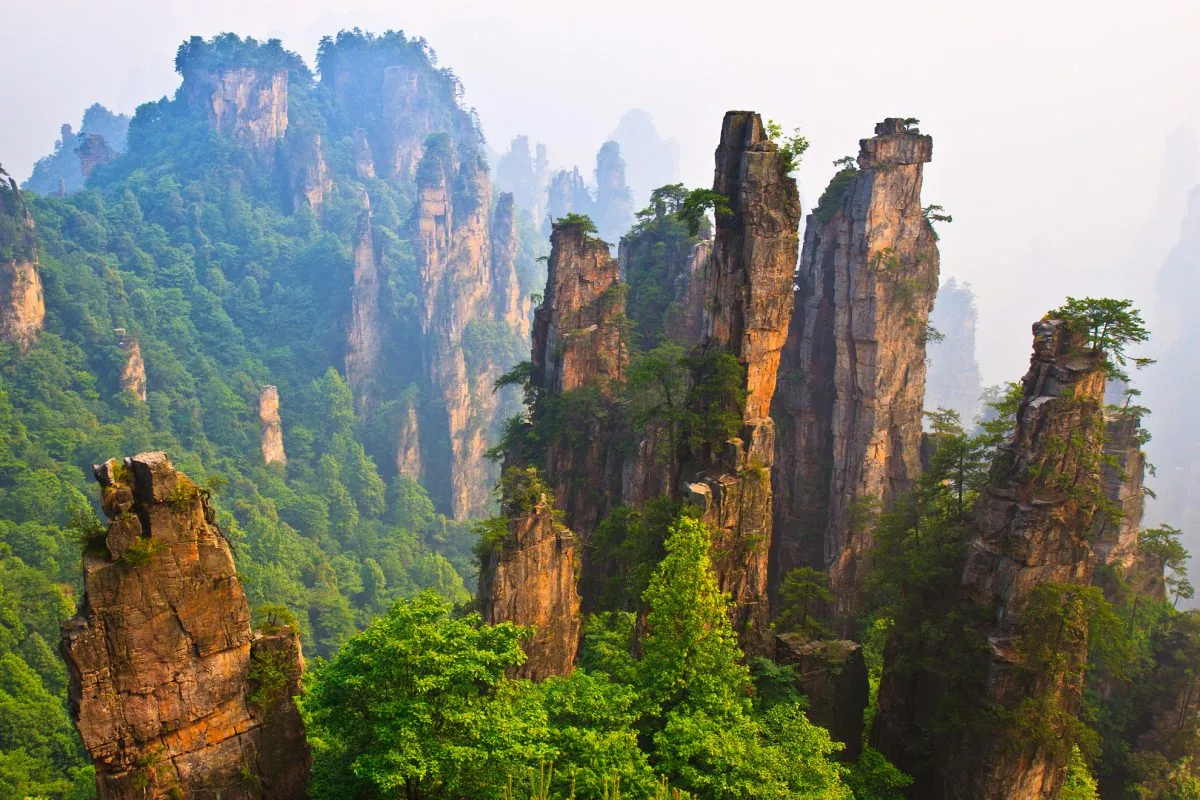
Over 3,000 sandstone pillars rise from a forested valley in Hunan, the landscape that provided the visual reference for Avatar's floating mountains. The reality is stranger than the film.
About Wulingyuan Scenic Area
The pillar formations developed over 380 million years through differential erosion. The area was opened to tourism in the 1980s following road construction. UNESCO World Heritage designation in 1992; the Avatar connection brought international attention after 2009.
What Wulingyuan Scenic Area
Wulingyuan in Hunan Province contains over 3,000 sandstone and quartzite pillar formations rising from a forested valley floor, some exceeding 200 meters in height. The landscape was the primary visual reference for the floating mountains in the film Avatar, a fact that has driven significant tourism but also accurately describes the surreal quality of the terrain. The UNESCO listing came it a World Heritage Site in 1992.
The pillars formed over 380 million years as harder quartzite and sandstone layers resisted erosion while surrounding softer rock dissolved. The area remained largely inaccessible until a road and infrastructure project in the 1980s opened it to visitors. Local Tujia and Miao indigenous communities had named the formations individually for centuries, local mythology populated the pillars with spirits and stories that guided early visitors before official signage existed. The Avatar connection has been both a blessing and a complication: one pillar was renamed the Avatar Hallelujah Mountain in 2010 following the film's release, generating controversy among those who felt the commercial association diminished the site.
Wulingyuan is too large for a single day , the full scenic area covers 264 square kilometers. The Zhangjiajie National Forest Park section is the most visited and contains the most dramatic formations. Cable cars, glass-bottomed bridges, and an elevator (the Bailong Elevator, 326 meters) provide access to upper viewing platforms; walking trails connect the main viewpoints for those preferring to climb. Cloud inversions in autumn and winter, when mist fills the valley between the pillars, produce the landscape's most dramatic version.
Zhangjiajie city is the gateway, flights connect from Beijing, Shanghai, Guangzhou, and Chengdu. The scenic area is 30 kilometers from the city; shuttle buses run regularly. Allow at least two full days.
The Experience
Cable cars, glass bridges, and the 326-meter Bailong Elevator provide access to upper platforms above the pillars; walking trails connect viewpoints at a slower pace. Cloud inversions in autumn and winter fill the valleys between formations with mist.
Why It Matters
Wulingyuan contains the world's largest concentration of sandstone pillar formations and represents a landscape type with no close equivalent at this scale anywhere on earth.
Why Visit
The pillar landscape is genuinely alien, walking among formations that rise 200 meters in every direction produces a spatial disorientation that no mountain or canyon quite replicates.
✦ Photo Gallery
Best Season
🌤 October–November for autumn color and cloud inversions; April–May for green foliage. Summer is hot, humid, and extremely crowded.
Quick Facts
Best time to visit
October–November for autumn color and cloud inversions; April–May for green foliage. Summer is hot, humid, and extremely crowded.
Getting there
In Zhangjiajie, China; reach Zhangjiajie first, then continue to the site.
Location
Zhangjiajie, China
Type
attraction
Insider Tips
- 1
Allow two full days minimum, the scenic area is too large for a single visit.
- 2
Take the Bailong Elevator up and walk down one of the valley trails for the best combination of views.
- 3
The glass-bottomed Zhangjiajie Grand Canyon Bridge is a separate attraction requiring a separate ticket.